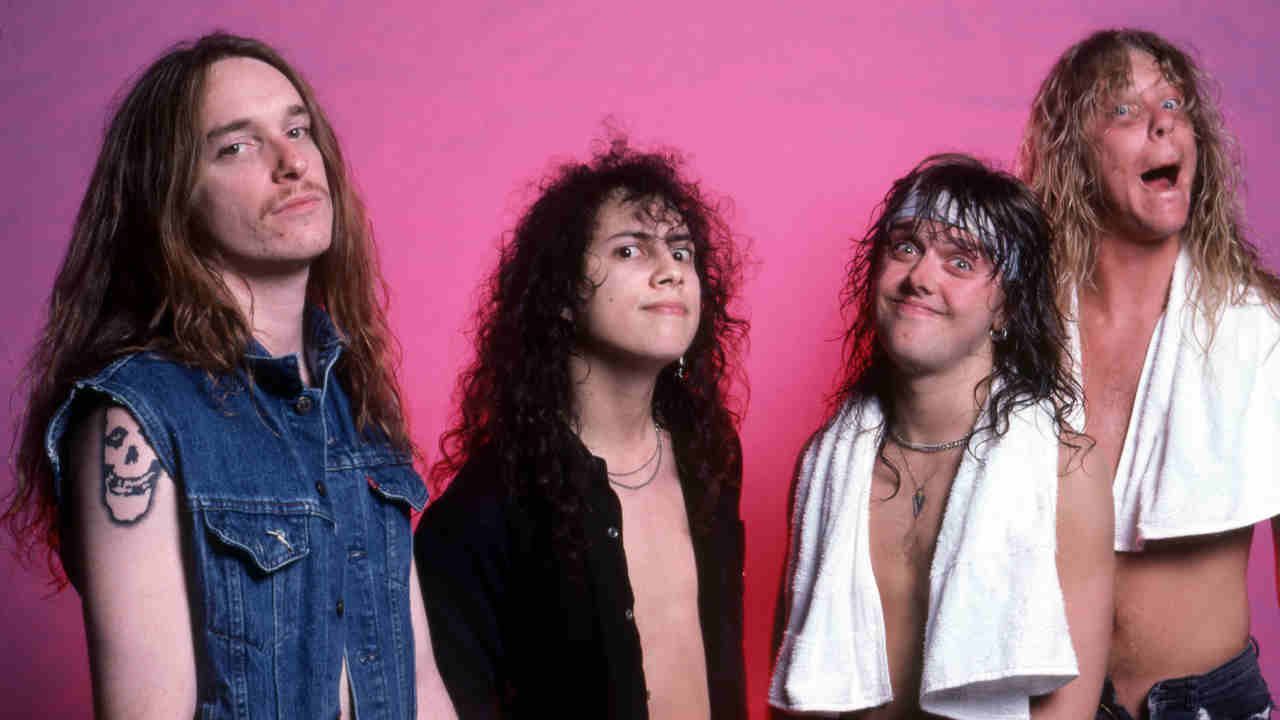
Cliff Burton was Metallica’s guiding star, musically, and his influence still runs deep through the metal world today.
“I’d be very surprised to come across a metal bass player who doesn’t list Cliff Burton as one of their influences,” says Becky Baldwin, who plays bass with King Diamond and appears on Tony Iommi’s new solo album.
It’s a measure of how valuable Cliff was as a musician that James Hetfield and Lars Ulrich upped sticks and moved to San Francisco in order to get him to join the band. He may have been a relative latecomer, replacing original four-stringer Ron McGovney in 1982, but he had a heavy hand in shaping the band’s music and, ultimately, their success. It’s something that Flemming Rasmussen, the Danish producer who worked on Ride The Lightning and Master Of Puppets, witnessed first-hand.
“He was the only schooled musician [in the band],” says Flemming. “He’d had musical training, so he’d steer them in the right direction. He also had all these really crazy ideas that we kind of just went with, because we knew that even his craziest ideas might turn into something really great.”
Metallica’s Cliff Burton and James Hetfield in 1985 (Image credit: Pete Cronin/Redferns)
Cliff’s influence on Metallica was evident from the start. The earliest signifier of his greatness is (Anesthesia) Pulling Teeth, effectively a bass solo dropped into the middle of Metallica’s 1983 debut album Kill ’Em All. It was a bold move at a time when almost nobody was putting such a thing on a metal record, let alone one as shocking and extreme as this.
“There was rhythm bass and there was lead bass,” says David Ellefson, “and Cliff made it acceptable to do both inside of one band.”
That ‘lead bass’ occurs most famously on the distortion-and-wah-wah-soaked intro for Ride The Lightning classic For Whom The Bell Tolls, a part many people mistakenly assume is a guitar. Ditto the opening of Damage, Inc. from Master Of Puppets.
“People think it’s keyboards and guitars, but it’s all bass,” says Flemming Rasmussen.
But Cliff’s crowning glory is Orion, the Master Of Puppets instrumental that stacked everything he could do at that point into eight-and-a-half minutes. David Ellefson calls it Cliff’s “huge opus”, while Becky Baldwin – who had to learn it when she played with tribute band Metallica Reloaded – is still floored by it.
“To have a bass solo, and then to say, ‘No, we’re going to harmonise this as well’, he’s thinking not as a normal bass player would,” she says.
For all his musical brilliance, the man himself was a low-key presence. But his quiet demeanour still commanded respect. When he spoke, people listened – not least his Metallica bandmates.
“No decisions were made without Cliff nodding,” says Flemming. “You always knew if he didn’t like what we were doing. We’d often change things to make Cliff happy.”
I’d be surprised to come across a metal bass player who doesn’t list him as one of their influences
Becky Baldwin
It often seemed like he existed in his own world, especially onstage. David recalls the way he would headbang slightly out of time to the music that was screaming past him.
“His body language told us where his tempo was,” he says. “As everything around him was blazing at super-high velocity and ferocious tempo, he was the guy who anchored everything.”
Coming at it from a later generation, Becky Baldwin is struck by the way the band pushed him forward, giving him a platform for his inimitable talents: “It was unique how the band was, like, ‘Our brother Cliff here is great; please show off for a bit.’ And he did it without it going to his head.”
Cliff’s sudden and tragic death on the morning of September 27, 1986 was a massive shock, especially to those who knew him. David Ellefson recalls Megadeth frontman Dave Mustaine, who played with the bassist in an early incarnation of Metallica, receiving a phone call telling him that his friend was gone.
“Dave picked up his guitar and began writing [Megadeth classic] In My Darkest Hour,” says David. “Lyrically, it’s not really about that moment, but the mood of it, especially musically, came from that phone call.”
Metallica paid their own tribute to their fallen bandmate with To Live Is To Die on 1988’s …And Justice For All album. A long and (mostly) instrumental track pieced together from riffs and ideas the bassist had recorded during the Master Of Puppets sessions, it completed the holy triptych of Cliff Burton songs that also included (Anesthesia) Pulling Teeth and Orion.
You always knew if he didn’t like what we were doing. We’d often change things to make Cliff happy
Flemming Rasmussen
What Cliff would have done had he lived is hypothetical. But as an innovator in terms of playing and writing, it’s not beyond the realm of possibility that he may have moved away from metal and explored other areas.
“He was always seeking,” says David Ellefson. “He was looking for more than just how to play another heavy metal song.”
At 40 years’ distance, it sometimes feels like he’s never really left. Becky Baldwin still hears him in Metallica’s music today.
“I hear remnants, or little ghosts, of Cliff’s playing,” she says. “Maybe because he made the blueprint early on that Metallica still stick to.”
David Ellefson goes further: “Here we are, still talking about him as if he was still here,” he says. “Because he is. His music and his heart and his spirit are still here with us.”
(LouderSound)
Leave a Reply