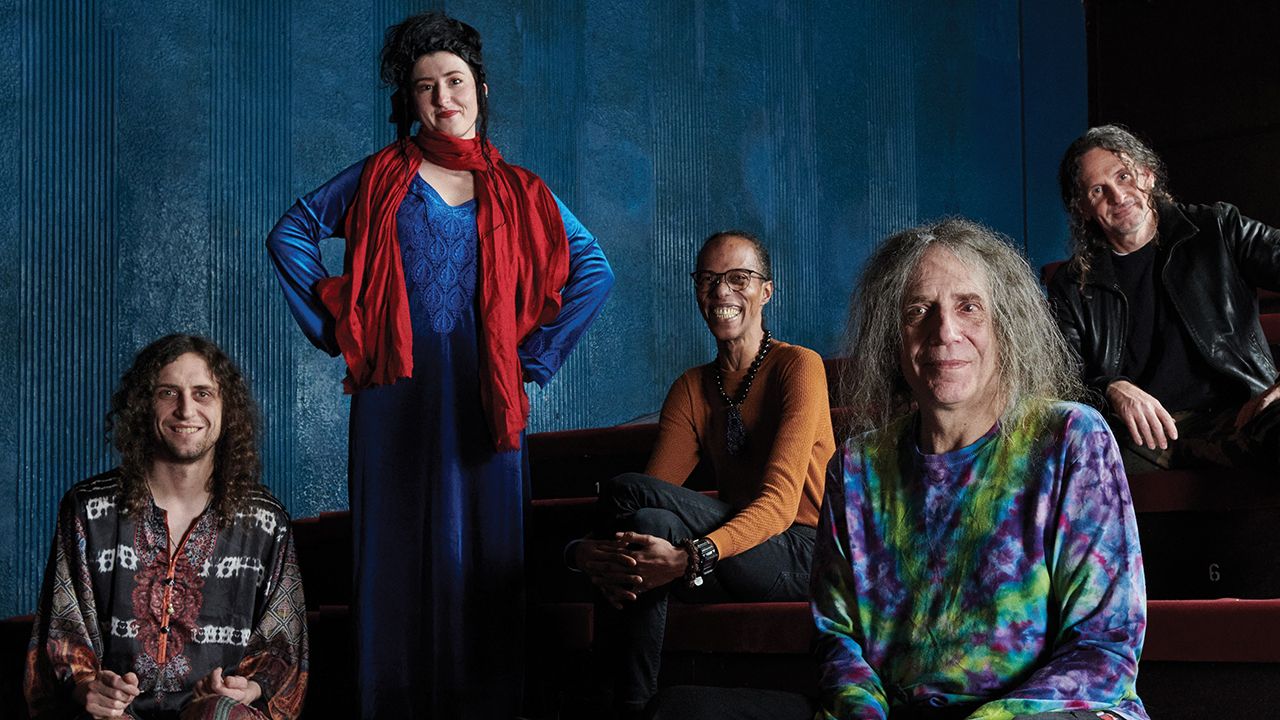
The prolific Ozric Tentacles continue to carve out their own sonic universe on 17th studio album Harmonic Mind, which evokes their free-spirited origins and takes in trippy 90s rave culture. Prog catches up with bandleader Ed Wynne to discuss hanging out in Donovan’s flat, the ever-changing collective and his plans to avoid the AI trap.
For progressive music fans of a certain vintage, Ozric Tentacles always seemed like the new kids on the block, bucking the trend in the late 80s by purveying instrumental, intricate, driving, guitar-based fare. So it’s rather surprising to realise it’s 40 years since they permeated our consciousness – firstly as hidden champions of the free-festival movement, subverting record company norms by self-releasing a succession of brightly coloured cassettes; then unlikely pioneers of neo-psychedelia’s resurrection, capturing a crossover audience with their ravey vibe.
We’re now almost 17 studio albums in, give or take the vast number of off-the-record releases, authorised or otherwise, in the Ozrics’ “floativerse.” The current line-up’s youthful energy captures something of band’s critical and commercial peak circa the early-90s Erpland era. Guitarist and band leader Ed Wynne acknowledges that the prevailing vibe extends to latest release Harmonic Mind.
“Each album does sort of tread on the shoulders of the one before,” he says as he gears up for an autumn tour with The Orb, “but there’s a hark back to some of the earlier stuff, more of a band feel – there are camaraderies between bandmembers enjoying the progression and development of the tracks.”
Harmonic Mind is, perhaps, a gentler vibe than other recent releases. “I don’t know what that comes from. Maybe because I am!” he says. “I do have it in mind to make an outrageously heavy tune very soon!”
All members of the current live line-up contributed to the studio work, most notably Wynne’s son and right-hand man Silas Neptune, whose implacable countenance behind a bank of keyboards and dials belies a dexterity that’s only occasionally unleashed. In Wynne’s words, “He takes care of a lot of the synthesisers, and making sure everybody can hear each other.” Neptune’s musical partner, Saskia Maxwell, contributes fulsome flute; Wynne contrasts her with former Ozrics flautist ‘Jumping’ John Egan.
“She’s more accurate than John! It was fun with John, but I recorded everything he played because it was never going to repeat. With Saskia I give her a scale and she’ll go away for a day and practise; there’s more control.” Maxwell also lends a mysterious dancing presence onstage: “She brings a female element, which hasn’t always been the case with this band.”
The line-up is completed by drummer Pat Garvey and bassist Corey Wallace – “a real joy onstage; he’s got this feeling about him.” Wynne himself works through his usual melange of guitar styles: funky rhythmic licks, bell-like harmonics, and full-blown eyeballs-out soloing, as well as acknowledging “an acoustic resurgence,” with the title track incorporating “more than one guitar superimposed over another, sculpting, erasing and editing.”
For a family as musical as the Wynnes, there was little formal training as Ed grew up; instead, innate talent prevailed. “My mum got me trying to have piano lessons, but the guy took her aside and said, ‘I’m very sorry but this is the only totally unmusical person I ever tried to teach. It’s not going to work!’ I started off just playing piano and then my brother had a guitar and I thought, ‘I must have a go on that.’ I thought that little grid on the chord-book must mean the frets and fingers. I worked a few chords out and started really enjoying it.”
He can’t recall his transition to playing solos, but that blistering work remains his calling card. He lists Hendrix, Zappa, Hillage, Santana and Holdsworth as key influences. Just as important growing up, though, was the innate atmosphere around him. “My father was a sculptor – an artist – and there was an aura about the house we grew up in,” he explains. David Wynne’s most recognisable works included Girl With A Dolphin (1973), a statue that stands near London’s Tower Bridge; and an interlocking hands design for the 50p that marked the United Kingdom joining what was then the EEC that same year.
Wynne recalls: “A few famous musical people used to hang around the place, which was very inspiring and made me think, ‘This is a good way to be.’ I was given the freedom to not get some boring job. I was very blessed.” Home was an apartment in Wimbledon, London, in the same block as psychedelic singer-songwriter Donovan. “I’d get back from school and think, ‘Which door should I go in? I’ll go in Don’s door today!’ There they all were with their instruments, smoking dope, with weird lights, telling their jokes and odd people doing strange things. It was absolutely fascinating!”
Woking in his attic, Wynne became a prolific composer and performer from the early 1980s onwards. “I had my four-track recorder where I spent all day, every day, just recording stuff. It was brilliant. I couldn’t stop. I thought, ‘Well, why stop? What if I can’t stop?’ I just got into recording as a permanent way of life, really.”
There’s a load of bootlegs out there which I’m not that proud of, but it’s fun for people to see where it comes from
Wynne became equally adept at guitar, bass, various keyboards and production techniques, but also took on board a rolling collective of people, some of whom, like brother Roly, ended up in the Ozrics and its precursor, Bolshem People. “The house was between the local pub and the railway station. People used to pop in on the way back from the pub – which was either good or bad! We used to set up and just crank it out. My dad would stomp on the door and say, ‘It’s too loud. I’m trying to work here!’ He was fairly nearby in the house trying to make his sculptures.”
Tapes were altruistically sent out to anyone interested in them, starting a dispersed archive of unofficial material, which has continued to this day. “It was experimental stuff,” says Wynne. “There’s a load of bootlegs out there which I’m not that proud of, but it’s fun for people to see where it comes from.”
That was also the starting point for the band’s six coveted brightly coloured cassettes, including the wonderfully-titled Tantric Obstacles, which were sold at gigs and via mail order for the few in the know. “Roughly once a year we were like, ‘Oh, look, we’ve got enough for another tape!’ As those evolved, it became more like doing an album.”
(Image credit: Press)
The culmination was 1988’s masterful, ethnically diverse Sliding Gliding Worlds, which was subject to additional influences “Prior to that I went for a three-month jaunt to Thailand – I just got fed up with the whole Western thing and said, ‘Sorry, guys. I’m getting a ticket. See you in a few months!’ I had an acoustic guitar and got to the point where I felt very, very content. I came home and literally camped out in the studio. Nobody saw me for about a month, and I had Sliding Gliding Worlds at the end of that.”
Prog wonders if self-releasing the cassettes was an anti-system statement in itself? “It was more about the fact that it was too strange for most labels!” he replies. “And it was really fun. We used to literally spend all week copying tapes and getting photocopies, cutting out covers, folding and putting them in there and having a box of them at the gigs, selling them for £2.50.”
I didn’t have to explain the frame or the mode or the scale or the style – Roly would just grab the bass and play the perfect line
By that time he’d developed an affinity with the free festival movement. “I left school and ended up going to Stonehenge Free Festival and playing at campfires – all kinds of random fun free stuff.” The band were a main attraction at the famously anarchic Treworgey Tree Fayre in Cornwall in 1989, not long after they’d released their first official album, the pristine Pungent Effulgent. Their ramshackle, jammed performance on Wango Riley’s Stage (an open-sided lorry) very much represented a messy alter ego.
“It was hard for people to get paid at that festival,” he recalls. “There was a farmhouse on the edge of the site and we managed to get past the gatekeeper. Suddenly we were in this normal house, full of hippies. We made a cup of tea and one of our lot went upstairs to get the dosh for the gig. He found this room where the floor was completely covered in pound coins, with this guy desperately trying to pull it all together!”
The classic line-up featured Wynne’s sadly missed brother Roly. “He was a pure bass player,” he remembers. “I didn’t have to explain the frame or the mode or the scale or the style – he’d just grab the bass and play the perfect line.”
Alongside the brothers in the late 80s were Egan, the flautist and visual centrepiece; plus Joie Hinton and Merv Pepler, soon to succumb to their ravey sides with Eat Static. High points were Jurassic Shift, which reached No.11 in the UK charts in 1993, and high billing at Reading and Glastonbury Festivals the same year.
Both the Ozrics and The Orb found themselves in the vanguard of a new movement in that era, 80s, which bridged genres and generations: The Orb via samples of Steve Hillage’s Rainbow Dome Musick and Pink Floyd; the Ozrics with ravey wig-out tracks such as The Throbbe, Sploosh! and Pyramidion – which still feature in today’s live sets. Their audiences cross-pollinated at the time, but as they prepare to tour together, is that still the case? Wynne thinks so.
I admire the fact that The Orb aren’t too serious. I find it crazy when people do take themselves too seriously
“The bands are very, very different to listen to. But there’s a match with the feeling that comes across: the almost goofy, funny kind of spacey thing that people enjoy. I admire the fact that The Orb aren’t too serious about things. I find it a bit crazy when people do take themselves too seriously.
“It’s something to do with – sorry to say this – prog people. When someone says ‘prog’ to me, it makes me think of complicated music and people with furrowed brows trying to play it as well as they can. It’s probably my biased opinion, but to me ‘prog’ means ‘progressive,’ which means moving forward. In one way we’re progressive because we’re trying to push out the edges of what’s been done before.
“At the moment I’m basically trying to second-guess AI. I don’t want AI to be able to copy what I do. I’ll have to make it a bit stranger, perhaps!”
Harmonic Mind is on sale now.
(LouderSound)
Leave a Reply