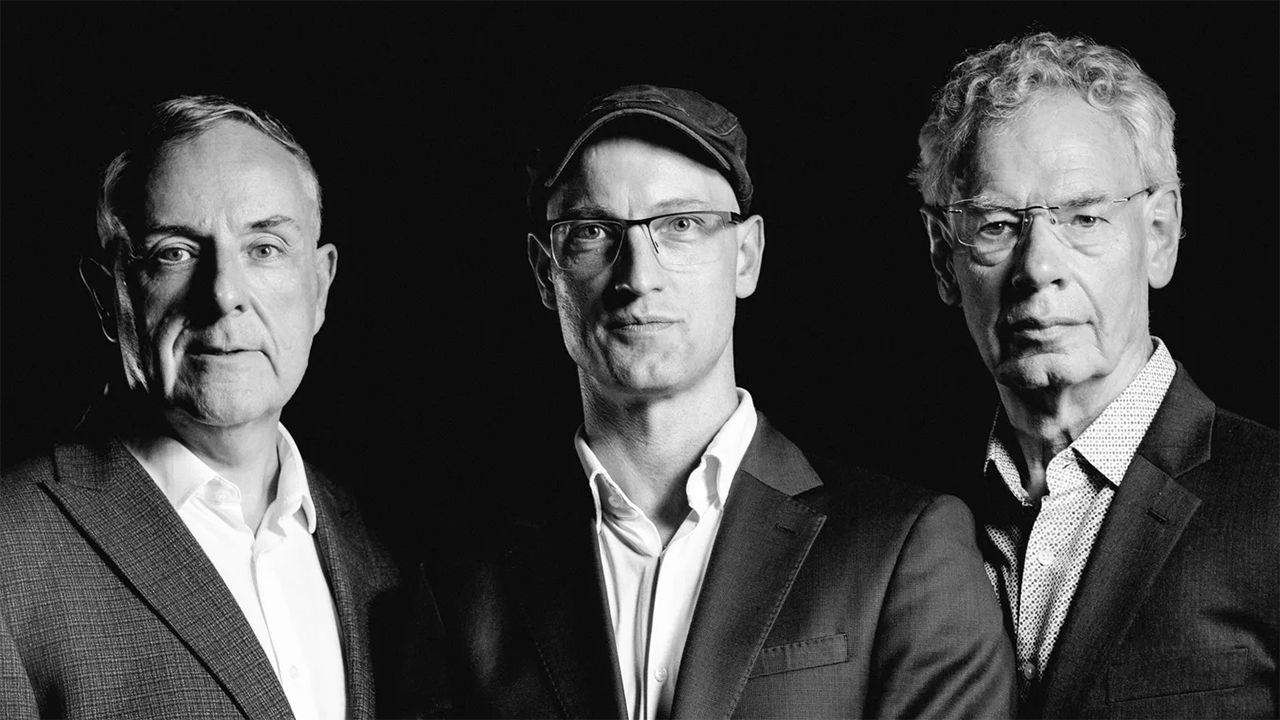
When Bill Bruford’s former tech Pete Roth asked the prog veteran to play jazz for fun, no one realised it would bring the veteran prog drummer out of retirement. In 2024 the Pete Roth Trio started taking themselves seriously – but as the band leader tells Prog, they’re still aiming to have fun above anything else.
Growing up in a small town near Baden-Baden in Germany, with his grandparents playing as enthusiastic amateurs and his father having enjoyed a semi-professional career as a younger man, Pete Roth was constantly surrounded by harmony. Having dallied with piano, sax, accordion and other instruments, he decided to learn guitar.
He worked after-school jobs and bought his first guitar as an 11-year-old in December 1991. His teacher introduced him to the music of Joe Satriani and Steve Vai, and soon his horizons widened further into jazz, where players including Pat Martino, George Benson and Joe Pass exerted their influence.
In 2011 Roth released his first album, Meridian, followed by Circus In The Sky three years later. However, it’s fair to say that, lauded as a young talent in the jazz world, most Prog readers didn’t know of his work until he joined forces with Bill Bruford.
Marking the influential drummer’s return to headline performance after a 13-year hiatus, as well as his first appearance on an album new material in 19 years, Group Chat by The Pete Roth Trio showcases Bruford, Roth and bassist Mike Pratt’s ability to walk the tightrope between composition and improvisation. “The secret,” Roth says, “is that we’re a band of equals and we have each others’ backs.”
How did you meet up with Bill Bruford?
I’d moved over to the UK and was studying at Guildford, where Bill was teaching. Before that I’d been his drum tech for a number of years, so we already had a nice friendship. In 2022 we began playing together, just for the love of the music, jamming along to our favourite jazz standards and coming up with material just for playing and rehearsing.
There was really no band at this point, and no idea we’d play publicly. That didn’t happen until 2024 when we started doing a few small gigs that were local to us – again, just for fun.
What made the trio more of a going concern?
By 2025 we were doing more and more gigs, so we had to make a decision: either we needed to step out of the situation entirely and return to not necessarily facing the public, or take the trio seriously and make the necessary commitment.
(Image credit: Rob Blackham)
That commitment included playing at 2026’s Cruise To The Edge, where you were on the bill that included Marillion, Big Big Train and other prog luminaries. What was that experience like?
I have to make a confession: I’ve not really grown up with prog, nor do I know much about it – so Bill was filling me in about who was who. I’m a huge fan of Adrian Belew, who I knew from his work with Zappa; and of course I was aware of his King Crimson history. Adrian’s band was spectacular. I loved it. Although I don’t know too much about prog, I love good music.
How did you guys go down with such hardcore prog fans?
We weren’t going to record a studio album. Live is what we do. Our band is built on trust, spontaneity, interaction and improvisation
I think we were the outliers, doing something entirely different to anybody else on the ship, so there was a danger of people feeling a bit short-changed. But actually we had the exact opposite experience. – when we played, people took to it so easily. We were really happy. We did two shows; I think the audience wasn’t quite sure what to make of the first. But then they all came for the second, and it was just a party. It was amazing.
Is being labelled a jazz act a help or a hindrance?
I think calling us a jazz trio is a poor description. We all come from different influences. Bill has a rock background, but he also has a love of be-bop. Mike falls into the funkier side of things, and there are all kinds of things in my playing.
Group Chat, sourced from live performances, was a while in the making. Why was it important for it to be a live album?
We were adamant that we weren’t going to record a studio album. Live is what we do. Our band is built on individual trust, spontaneity, interaction, and total improvisation in some places. We’re talking about building things from absolutely nothing onstage, in many cases every night in a slightly different fashion. Obviously we have certain frameworks; I think improvisation also needs corners and boundaries.
Does it bother you that a large part of the audience is in the room for Bill?
A lot of people say, “We came for Bill, but we stayed for the trio,” and that’s very encouraging to hear. There’s no point in denying that Bill is a giant in our world. But the thing is,he never says anything like, “I’m 77, I’ve made 91 records, I’m in the Rock & Roll Hall of Fame.”
When we’re in the room together, it’s as three equals. He could very much put his foot down and tell us all what we should be doing because it’s his name that’s selling the tickets – but he doesn’t do that at all.
The reason it’s called the Pete Roth Trio is simply that when we started, Bill didn’t want to be all the way to the front, doing all the admin and all the boring stuff that you have to deal with again. He wanted to be that kid who just loves playing the drum kit, and that really works for all of us.
Group Chat is on sale now.
(LouderSound)
Leave a Reply