Drawing from internet culture, memes, travel and everyday observations, the illustrator and graphic designer makes colourful collages that bring humour and absurdity to everything from horses to politics.
“It’s funny how an ordinary photo can become something completely different with a caption or a change of context,” says Rui Pu, an illustrator and graphic designer based in China. And we can absolutely see why. Across Rui’s portfolio, you’ll spot energetic colour palettes, fuzzy and warm gradients, a plethora of texture and familiar motifs turned into something strange and wacky. A horse-human, for example, with two heads – or a man bursting out of a Taco Bell with greasy snacks flying everywhere.
After studying digital media – “but wasn’t very interested in the course” – Rui graduated and worked as a designer at ByteDance, which is where his illustration projects really kicked off and became something to explore further. He moved to London to study for an MA in Illustration at Camberwell College of Arts, followed by a blossoming practice that involves working with publications and brands such as Apple, Spotify, Nike, and Columbia University. The New York Times and Bloomberg Businessweek. All of which are in Rui’s unmatchable, wacky aesthetic.
Taking inspiration from internet culture and memes, Rui has built a habit of saving strange images and videos, which will then go on to inspire his creations. He also loves travelling, spending time in unfamiliar places “without planning too much sightseeing” and wandering around, “looking at odd signs, flyers and graffiti and noticing people’s everyday lives – those little details often give me inspiration”.
When the creative sparks hit, there are two methods which tend to follow depending on the type of project. If it’s a commission for one of his clients, he will dive into the brief and – once he’s got a grip of it – he will think about how he can make the idea “clear” and, of course, “the artwork fun”. He adds, “Political and economic topics can take quite a while just to get my head around.” A few different directions will be proposed, and one will be picked with the art director, which will then be developed in Procreate and Photoshop, “replacing parts of the drawing with photographic collage.” It’s like a mishmash of ideas coming together, scrambling the original into something almost unrecognisable. “Finding the right photos takes ages! I often try lots of similar photos before choosing just one. A small change in an expression or gesture can make the whole image feel like a different vibe.”
As for his personal projects, which are a big part of how he’s developed his distinctive style, the process is similar but a lot “looser”, he says. “Sometimes I just put a few photos I’ve saved or taken together and see what happens. I enjoy not knowing exactly how it will turn out.”
100 Horses is a great example of this process. A personal book made this year in celebration of the Year of the Horse, Rui collected 100 “weird” horse images from the internet and everyday life, then put his signature spin on things. On the cover there’s a horse mid-leap, a necklace of geometric spheres adorning its neck, plus a mix of typographic styles peppered around the border with a mishmash of images. Inside there are more horses, but not as we know them. They’re stretched, elongated, warped into dinosaurs, strawberries and placed into odd scenarios. “I let go of my usual concerns about grids, typography and colour, and just had fun. The finished book was very different from my first idea, but I loved the surprise and how relaxed it felt making it. I hope these weird horses bring a little energy and make my friends smile over the new year!”
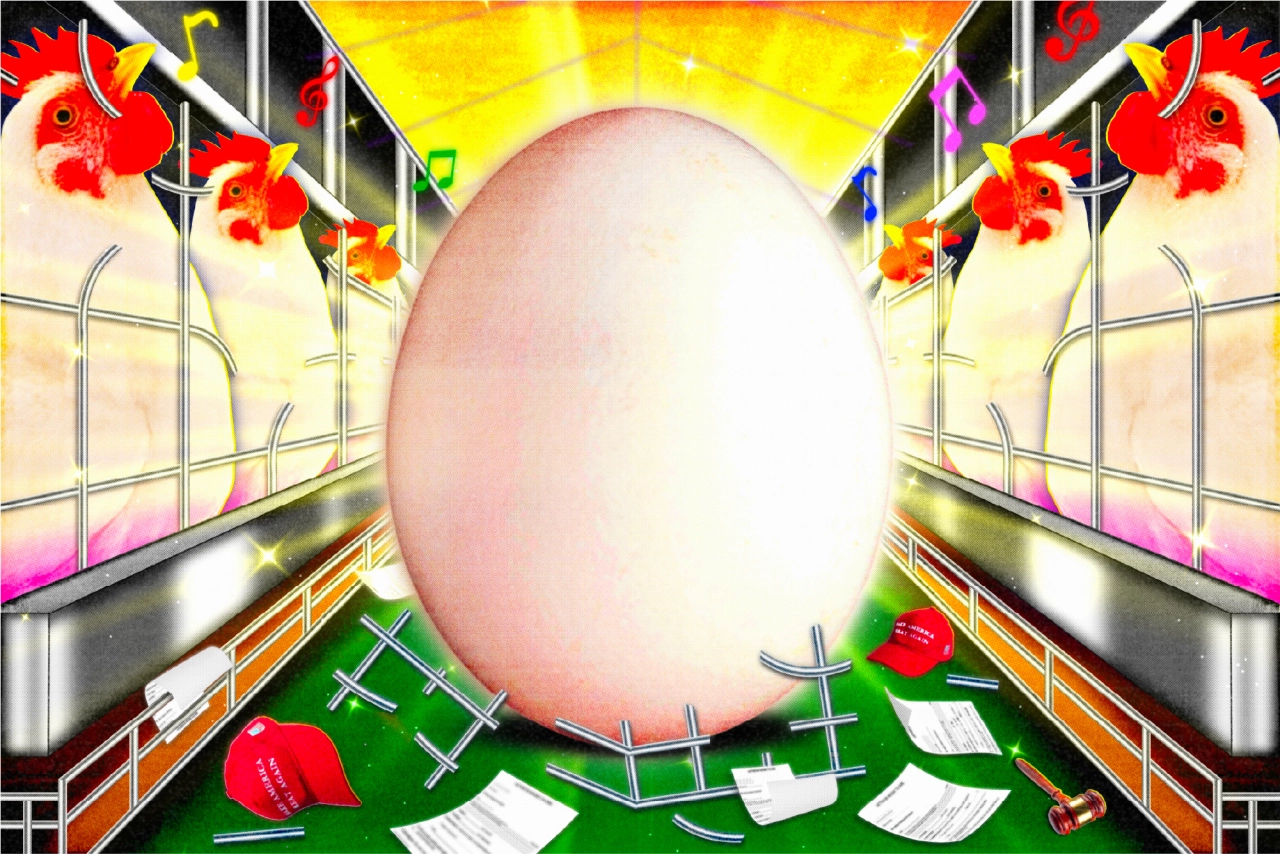
In a series for Bloomberg Businessweek’s Extra Salt column, Madeline Montoya, then-art director, invited Rui to illustrate the column, which uses food as a means of exploring politics, business, consumer trends, culture and identity. “I wanted to make some of these heavier topics more fun, so I made quite a few silly images: boxers fighting with hamburgers for gloves to show competition between American burger brands, a US map made of sauce bottles, or a huge egg filling the frame,” he says. “I enjoy turning an article’s ideas into something direct and a bit absurd, something that makes people smile while getting the point across.”
And that’s the crux of it, really – Rui’s work is there to make people grin, and turn familiar or heavier topics on their side. “I hope people feel the humour, absurdity or a little sarcasm, straight away. If someone recognises a collage image or a meme and thinks, ‘Oh, you know this too!’ That makes me happy.”
Leave a Reply