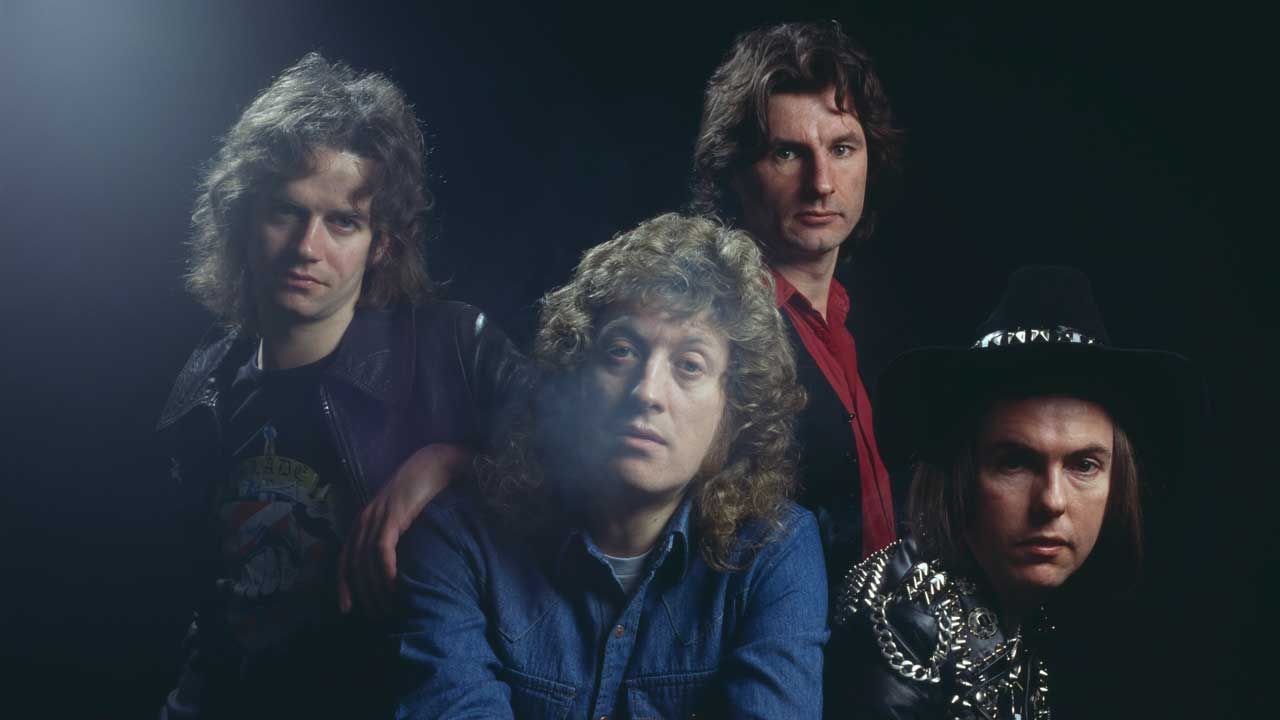
Famously described as “The Citizen Kane of British pop movies” by BBC film critic Mark Kermode, 1975’s Slade In Flame movie was expected to be another rung on the ladder to international stardom for Slade, but it didn’t quite work out like that. In 2003, Classic Rock spoke with frontman Noddy Holder about one of the greatest, most enduring dramatic rock films of all time.
It’s all too easy to forget just how enormous Slade actually were. Perhaps it’s because it would be inconceivable today for four homely rapscallions from Wolverhampton to gain even the most tentative foothold in a contemporary pop scene almost entirely based on airbrushed skin and washboard six-packs. But in the spring of 1974 Slade – undeniably the least glamorous glam band of them all – appeared utterly invincible.
This feature originally appeared in Classic Rock 53, published in May 2003.
Despite being fronted by a mutton-chop-whiskered, tartan-suited foghorn in a mirrored top hat who had a voice so caustic it could very probably peel paint, Slade were relaxing in the afterglow of Merry Christmas Everybody, their sixth number one hit single to date, which had sold half a million copies on its first day of release, debuted at the top spot and set up camp there for five weeks. Their third consecutive chart-topping album Old, New, Borrowed And Blue had just hit the racks, and Slade were, officially, the biggest band to hit the UK since The Beatles.
Consequently, band manager Chas Chandler (ex-Animals bass player and formerly manager and producer to Jimi Hendrix) was looking to consolidate Slade’s position with an entirely new challenge and, following Brian Epstein’s exemplary Beatles template, decided that the time was right for Slade to make a film.
“We just saw it as the next step in our career,” remembers Noddy Holder, Slade’s effusive former vocalist today, “We always took our career in stages: when we had our first hit we wanted a Number One; then we wanted another; then we wanted to go in at Number One on the day of release. We always had a goal to aim for, but had never really considered making a film. Chas Chandler saw it as the next inevitable step on our career path. I don’t think he looked on it to widen our market; he just thought it was another step up the career ladder and something we should try.”
Noddy’s protestations notwithstanding, Slade were intent on broadening their market as they set to work on what would become Slade In Flame. Ubiquitous at home and all points east Slade might well have been, yet in spite of dogged touring, the all-important, enormously lucrative American market remained relatively oblivious to the band’s parochial charms. Slade’s all-stomping, boots-and-braces lads’ rock may have entirely entranced Britain’s teens, but the peculiar, quintessentially English spectacle of the band’s perpetually prancing guitarist Dave ‘Superyob’ Hill simply didn’t translate into significant sales across the Atlantic.
The natural progression and maturation of Holder and bassist Jim Lea’s songwriting prowess also saw Slade courting a more adult market at home; the deliberately misspelt rowdiness of Mama Weer All Crazee Now and Skweeze Me Pleeze Me had given way to the reflective balladry of My Friend Stan and Everyday, a pair of singles that, significantly, failed to reach the Number One spot.
“We knew that we couldn’t carry on churning out things like Cum On Feel The Noize over and over again,” Noddy remembers, “We didn’t want to be stuck in a rut doing one type of thing. We knew we were a far broader band musically than that.”
It was at this pivotal juncture that Slade decided to launch themselves onto the big screen. At a time when it was crucial not to further alienate their wavering core audience (already dumbfounded by Everyday for its reinvention of Noddy as a love-sick crooner, and also slightly resentful of the amount of attention that the band were paying to America), the hitherto happy-go-lucky Slade spent an entire year working on an uncharacteristically dark film that absolutely nobody expected.
Most ironically of all, the very qualities that so completely perplexed mid-70s youth on Slade In Flame‘s initial theatrical release ultimately assured the film’s enduring longevity.
“The reason that Flame has stood the test of time so well,” Noddy reckons, “is because it wasn’t what people expected. They expected a slapstick, speeded-up comedy with car chases and not much plot, but we went totally the other way. We made a film that would show the other side of the rock business, not the side that the public generally see, and I think the public, certainly in ’75, were very shocked by it. It wasn’t what they expected from Slade at all, but I think it’s helped it stand the test of time as a good rock film.”
Directed by Richard Loncraine (who later worked with Sting on Brimstone And Treacle), Slade In Flame follows the swift rise and spectacular fall of Flame, a late-60s rock band who sound uncannily like Slade. Stoker (Noddy Holder) fronts a tragic theatrical horror rock band, based loosely on Screamin’ Lord Sutch And The Savages.
He then teams up with Barry (Dave Hill), Paul (Jim Lea) and Charlie (played with brave aplomb by Slade drummer Don Powell, still suffering the short-term memory loss symptomatic of the head injuries he’d received in a July ’73 car crash), who have been enjoying the collective ignominy of backing PJ Proby-style club crooner Jack Daniels (a magnificently convincing performance from Alan Lake).
The four-piece become Flame, and are quickly discovered by high-class wheeler-dealer Robert Seymour (Tom Conti, in his first film role), who casually grooms them for stardom. All is going swimmingly until the band’s former agent, violent underworld shark Ron Harding (menacingly realised by bespectacled Johnny Shannon), turns up with a long-forgotten, watertight contract and comprehensively pisses on the party.
Slade and cast members during the film of Slade In Flame (Image credit: Evening Standard/Hulton Archive/Getty Images))
Rather than simply offering a tarted-up time capsule of the brickies-in-blouses glam rock epoch, the gritty, unflinching realism of Slade In Flame harked back to the kitchen-sink dramas of the early 60s, and as a consequence joins A Hard Day’s Night and The Girl Can’t Help It as one of the greatest, most enduring dramatic rock films of all time.
Although it’s a cautionary tale of credibility-stretching exploitation that’s laced with moments of eye-watering violence and highly improbable road-life preposterousness, apparently it’s all based on cold, hard fact, as Noddy recalls: “While working on the soundtrack we went out to America to do some dates, and took the writer (Andrew Birkin, brother of ‘Je T’aime‘ Jane) and director out to America with us to tell them stories of what life was like in a rock’n’roll band-not only from our point of view, but from other bands that we knew. They then came back and finished off the storyline and script while we finished the tour.
“So every scene in the film is actually true, even though some of them do seem far-fetched. Even the story of the gunfire on the pirate radio station [Flame have shots fired at them as they endeavour to conduct an interview with a staggeringly youthful Tommy Vance on an offshore pirate station], that’s a true story that happened at Radio London in the Thames Estuary back in the 60s. And yes, Screamin’ Lord Sutch did get trapped in his stage-prop coffin when someone leaned the lid against a wall – he was rather accident-prone.”
If it was the anecdotal script that provided the realism, it was the supporting cast that provided the grit. Johnny Shannon, fresh from intimidating Mick Jagger in Nicholas Roeg’s Performance, was a genuinely scary individual, a textbook East End wide-boy pitched somewhere between Mike Reid and Ronnie Kray. “When he pulled your hair,” Noddy confides with a wince, “he really pulled your hair”.
Alan Lake had just come out of prison. While enjoying a few libations in a nightclub, renowned hell-raiser Lake had assaulted a fellow boozer who’d had the effrontery to insult his wife, Diana Dors, and was subsequently detained at Her Majesty’s pleasure. Slade In Flame marked Lake’s return to the screen, and he was expected to be on his best behaviour.
However, on the very first day of filming, he headed for the nearest available hostelry, enjoyed a hearty liquid lunch, returned to the location and took a full-blooded swing at the manager of the club in which they were filming. Lake was clearly a loose cannon, and simply had to go.
Despite Slade’s forthright assertions that Alan Lake was Jack Daniels, the producers gave him his marching orders. The following day, Diana Dors – in all her pneumatic glory – arrived on the set and literally begged for Lake to be reinstated. She gave her personal assurance that he would stay off the sauce and from that day forth be as good as gold. He was given one more chance.
And true to Diana’s word, his subsequent behaviour was exemplary. In the thumb-twiddling downtime between takes, Lake, a seasoned raconteur, would unravel colourful, hair-curling tales of inebriation, fisticuffs and porridge that most certainly kept the band entertained, but by electing to use unpredictable wild cards of Lake and Shannon’s calibre, Slade were hardly making life easy for themselves.
“That’s why we chose them,” Noddy says. “They were menacing characters in their own right, and that’s why we picked them to be in the movie. We wanted to give the movie a menacing look and to have the realism that those old black-and-white movies from the 60s used to have, the gangster-type movies that used to be around. We wanted to give Flame that sort of atmosphere.
“But, on the other hand, we got in Tom Conti, who was a real bona fide trained actor. So Flame had a bit of everything; it had a bit of the dark side of the rock business, it had a bit of comedy in it had all different sorts of acting abilities in there, but it all seemed to mesh together and click.”
Far Far Away, the first single to emerge from the Slade In Flame soundtrack – released an almost unprecedented five months after its predecessor, there, Bangin’ Man (at their most prolific, the gap between Slade’s singles was a truly head-spinning nine weeks) – stalled at No.2. The next one, How Does It Feel? never rose higher than No.15, bringing to an end Slade’s impressive run of 12 straight top five singles.
Still one of Noddy’s favourites, How Does It Feel? certainly wasn’t lacking in quality. And while its relative commercial failure was partially symptomatic of the listening public’s growing disillusionment with the glam rock scene as a whole, it was proof positive that by taking a year out to make a movie, and concentrating all their remaining efforts on breaking America, Slade had ultimately bitten off more than they could chew.
“I’m sure that it did cause us to lose momentum,” Noddy concurs. “I mean, when you’re as hot as we were at the time, you have to be there all the time, plugging away on Top Of The Pops every week. That was the only way of promotion in those days. There wasn’t no MTV or videos to promote you; you had to go out and actually do the legwork and go all around the world promoting yourselves, doing TV, radio and live gigs all the time. You couldn’t just send the video out to the territory and expect it to give you a hit record. That wasn’t the way it worked in those days.
“But I think with the type of movie that Slade In Flame was and by going to America we did lose impetus. We’d been to America in short bursts before, but then we decided to make a concerted effort, and of course when you do that your other territories suffer.”
Of course, since disbanding Slade, Noddy has cultivated quite a reputation as a singularly naturalistic thespian, so how goes his post-Grimleys acting career?
“I don’t really want to go down the path of playing ageing rockers that top themselves,” he says. “But I do get sent quite a few of them.”
This feature originally appeared in Classic Rock 53, published in May 2003. Slade In Flame can be streamed via the BFI Player or Amazon. A remastered 50th Anniversary Blu-ray/DVD was released in 2025.
(LouderSound)
Leave a Reply