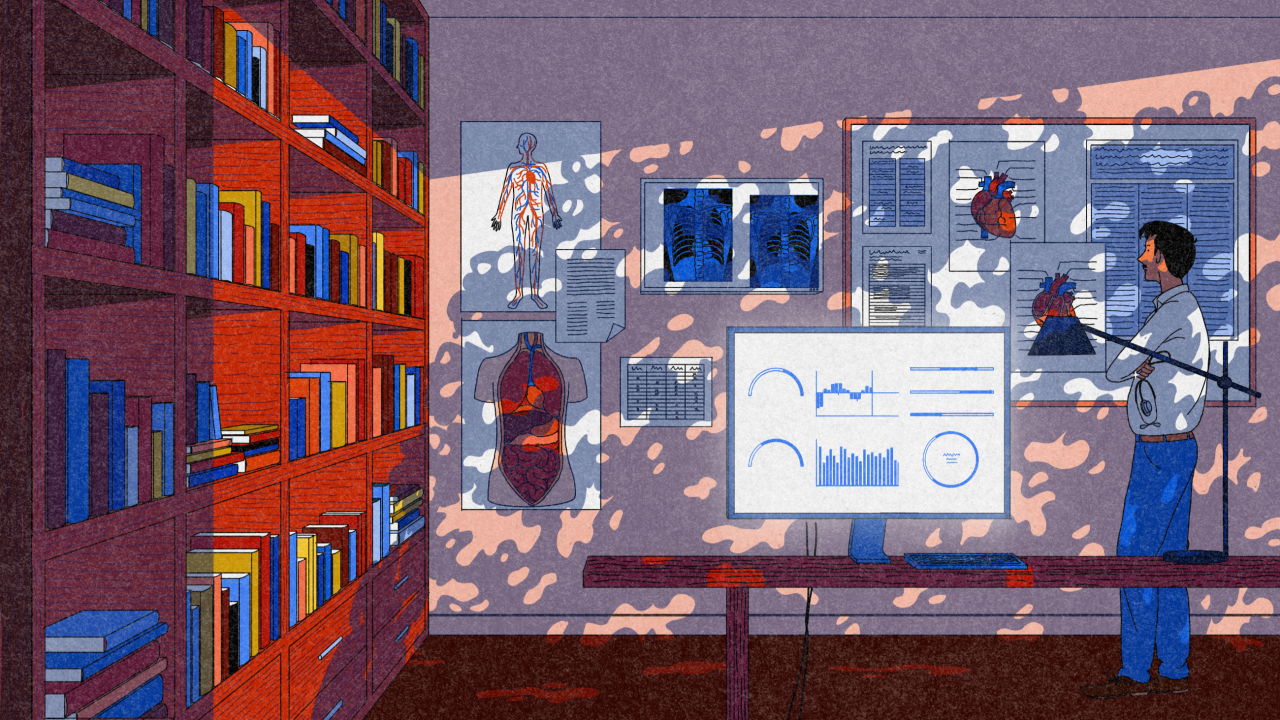
The Antwerp-based illustrator on finding a style of your own, why the first idea is usually the best, and why you must never settle for less than your work is worth.
There’s a reason why videos about funny accidents are so popular on YouTube. We obviously don’t enjoy seeing people fall over and hurt themselves, but there’s something about the imperfection of humanity that grounds us. That no matter how many mistakes we make, we’re not alone.
I’m always bumbling into rooms and making awkward small talk. I’m sure I’m not that bad, but the famous Instagram account, Very British Problems, exists for a reason. We’re a funny bunch, us Brits. Just last week I went to the back of a queue and said to the person there, “Is this the back of the queue?” We might cringe at our own behaviour, but it’s all rather charming, and…well, human.
We’re hankering after a lot more imperfection these days. It’s a theme that keeps popping up as it makes a good antidote to all the AI-generated nonsense. And it’s the whole point of Jenna Arts‘s work, too.
“It’s what makes us human,” says the Antwerp-based illustrator. “Not the perfection, but the imperfections, the silliness, the quirkiness, the unnoticed beauty, even the beauty in the ugliness, the unexpected, the fun when everything goes wrong. It’s about laughing at ourselves. We’re silly human beings. That’s what puts a smile on our faces, and not perfection.”
Boy, could we do with that reminder. Jenna’s website describes the person she draws as “the one who stumbles, marvels, acts a little strange and is at the same time completely ordinary”. Which, let’s be honest, is all of us. But you’ll find that normal person in much of her work. From the pages of NRC, De Volkskrant and De Correspondent to campaigns for Eurostar and Frontaal Brewery. “I hope that my characters aren’t perfect,” she says. “I would take that as a compliment.”
Many of us have that inspirational moment when lightning strikes and we realise what we want to do. For Jenna, it was when she was 15 or 16 that she read a magazine article about an illustrator living in Paris and realised, for the first time, that drawing could be a profession.
After graduating from AKV St. Joost, she got an internship at the Dutch newspaper NRC. “Illustrating live in a newsroom with very little time meant that I was forced to just draw something,” she says. “That led to a lot of surprises in the work. It was pure, honest drawing. It was drawing over thinking, over any style. And eventually, it led to a style. But I don’t think there’s an end to developing a style.” Indeed, it’s an ongoing process.
Her current preoccupation is finding balance between the story she’s trying to tell and the characters. “You don’t want to give the setting the main role, because that weakens the story,” she explains. “I’m also trying to add more depth to my work lately.”
If you’ve been following Jenna’s work for some time, then you’ll know her early characters used to have tiny heads, wavy arms and legs, and everything deliberately “wrong”. She’s since matured her style and opted for a more realistic approach. “I do sometimes miss the rebellion and creative freedom in my work back then,” she says.
Editorial illustrations have to meet deadlines, as any artist knows. Jenna admits she’s not a huge fan of the time pressure. Her one trick, when the clock is ticking, is the same lesson that the newsroom taught her many moons ago: “Don’t think it over, just draw. There’s always a better idea, so you might as well stick with the first.”
Commercial briefs are a different challenge entirely. “I do believe that when a client asks me for a project, they also want the wink and humanity of my work. Most of the time.” Work for Frontaal Brewery gave her a lot of freedom; bigger jobs like Eurostar, made with the agency Further, involve compromise. “That’s just how it works.”
The exception is music, where freedom comes naturally. Her album work for Klangstof and Robin Kester went deliberately off-script. “Music artwork is a chance to experiment, to create more abstract work. I find my ‘standard’ illustration work too literal for it. So I always try something different.”
I asked Jenna about the job or period that nearly broke her. “Honestly, for about two years I was really unwell, I had depression, and I didn’t work at all. I didn’t even draw,” she says. “I don’t want to make this a feel-good story about coming back stronger and lessons learned,” she adds. So we won’t. But what she will say is that some things definitely changed. “I am more aware of what my work is worth, financially and otherwise, and I say no more often.”
Having been through a difficult period myself, I have also learned this lesson of knowing my worth. But it’s more than that. You end up assessing your whole life and making necessary tweaks. Jenna says Belgium is faster-paced than the Netherlands, where she’s originally from. But she handles it by keeping to a proper routine. “I can handle the chaos of a creative job – the deadlines and hours, the flexibility. But over time I did have to learn to set boundaries. It’s just not possible to always be available for work. You have to switch off from time to time, even if you think you can handle it all. It catches up with you eventually. That doesn’t mean I’m not flexible; it means I’m clear about when I am.”
Part of this new mindset is reflected in what she says yes to. After more than a decade in editorial illustration, the thing that frustrates her the most isn’t that budgets haven’t moved; it’s that nobody expects anything different. “I think a lot of editorial clients could afford to raise budgets. It’s a shame, because I really like the work. For me, it’s important to ask myself: is this commission and this budget worth my time? If it’s not, it’s not.”
And so here comes the question about AI. Which conveniently brings us back to the whole theme of Jenna’s work. “I just don’t get why you should prefer a generated illustration over a human-made one,” she says of the new technology. “I mean, where’s the fun in going to a museum to look at generated art? There’s no story, no imperfections, no fun in it.” Imperfection still rules.
Does she have any advice for others in the field? “Being an illustrator and loving to draw isn’t a reason to settle for less. Your work is worth paying for. Even if you are just starting out.”
Leave a Reply