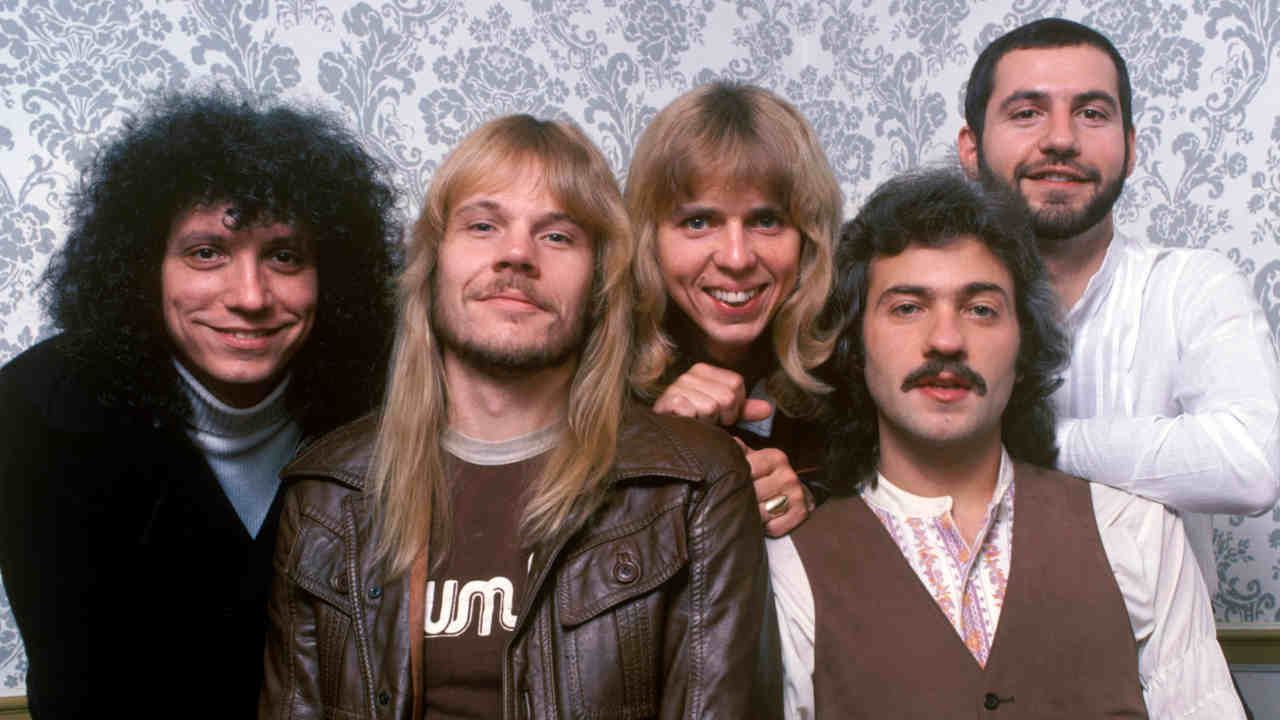
Knocking on the door of success for years, Styx embodied the never-say-die, never-surrender ethos of their blue-collar Midwestern roots. Signed to Wooden Nickel Records, their self-titled debut was released in 1972 to little fanfare. A quick succession of studio albums followed in its wake (Styx II, The Serpent Is Rising, Man Of Miracles, Equinox and Crystal Ball); these prog-pop confections, anchored by muscular musicianship and consummate song craft, failed to make a major dent on the national charts, save for power-ballad Lady, penned by vocalist/keyboard player Dennis DeYoung, which reached No.6 in the US Top 40 in March 1975.
Steadily building their audiences on a grassroots level off an exhaustive touring schedule and explosive, well-oiled live presentation, Styx remained resolute in their quest for superstardom, seemingly undeterred by the obstacles that lay in their path. The Grand Illusion (1977), the band’s seventh album, finally connected with the public on a grand scale, delivering the smash career-changing hit they so desperately needed with Come Sail Away. The group’s gifted trio of songsmiths, DeYoung and guitarists Tommy Shaw and James ‘JY’ Young, supplied the firepower that kept Styx permanently residing in the upper reaches of the album and singles charts.
Following their initial split in the wake of 1983’s divisive Kilroy Was Here, the band regrouped at the end of the decade minus Shaw. Another split in the mid-’90s was followed by yet another reunion, though DeYoung and the band parted company in 1999. The two parties have never reunited, though the singer has continued to fly the flag for the band he formed decades earlier.
In 2014, as he prepared to release a new CD/DVD combo, Dennis DeYoung And The Music Of Styx – Live In Los Angeles. Classic Rock sat down with the charismatic frontman to discuss the stories behind a suite of his old band’s classic songs.
Styx’s Dennis DeYoung in 1978 (Image credit: Gus Stewart/Getty Images)
Lady (1973)
DDY: “Lady was the first song I ever wrote and sang by myself on a record. I was not a songwriter when we started making records in 1972. We started writing a few songs in those early days in 1970-71, but we were really a covers band. We spent most of our time getting hired and playing gigs by covering other people’s music.
“So I was not really a writer, and Lady was my first attempt to write a song from start to finish by myself. It was written for the first album, but the producer kept it off and made us record four other songs that were by outside songwriters – one [After You Leave Me] being George Clinton, believe it or not. Styx and Parliament/Funkadelic, yeah, they go together [laughs].
“Lady is really one of the first songs of its kind, and I can tell you why. When it was released to radio, they wouldn’t play it at first because they said they didn’t know how to categorise it. It started out like a sweet ballad and ended like a big rock song. Now that defines pretty much 50 per cent of all the music that’s written these days. Back then they didn’t really know what to do with it, so there you go. We’d often be compared to bands like Queen, but that was written before I ever heard a Queen record.”
Lorelei (1975)
DDY: “Lorelei was a song that was originally written by James Young and myself. It was the first song we wrote together in 1970 when he joined the band. It was originally called Live Our Lives Together. We wrote it, and then two years later we got a record deal. We’d never completed it, so in 1975 we revisited the structure. I wrote the lyrics, and it was influenced by the Stones’ Let’s Spend The Night Together. They were changing times in the 70s, where for the first time people were moving in and living together – I know it’s hard to imagine today but people gasped over that kind of thing. In fact, James was actually living with his girlfriend, later to become his wife.
“So they lived together, and at the time while it wasn’t unheard of – it was definitely groundbreaking. So I wrote those lyrics for Lorelei based on the idea of people living together and not being married. That’s what was the impetus to the lyric. The original hook was ‘live our lives together’, so I needed a three-syllable name. I started thinking of the letter ‘L’ and I came up with ‘Lorelei’, which is a made-up name. I never knew a Lorelei, and I’ve met many since who have told me their mothers named them that, and of course I apologise to them [laughs].”
Suite Madame Blue (1975)
DDY: “Suite Madame Blue was written in 1975. Everywhere you looked they were advertising the coming Bicentennial celebration in 1976. They were advertising Bicentennial mugs and trinkets, and I think there were Bicentennial panties too [laughs]. This is the first song I ever wrote about America. I got to thinking about how I felt about the state of the country in 1975, and I didn’t feel too good about it, considering we had just come through the end of Vietnam, Watergate and the oil embargo of 1974.
“At the time, we were on the road trying to travel in a van. For the song, I used a metaphor of a once-beautiful lady who had refused to acknowledge that she’d grown old, and that it was time for her to look in the mirror and figure out a new way to make it in the world. I guess because I was afraid of saying it literally, I used some sort of phony baloney metaphor. At the end of the song I do say red, white and blue – so Suite Madame Blue was the metaphor for the United States.”
The Grand Illusion (1977)
DDY: “The Grand Illusion was my way of expressing to the audience that the pressure that is put on them by advertising, media and, yes, rock stars, to believe in an illusion that really does not exist, was not healthy for them.
“I was trying to point out to them simply that they shouldn’t believe the myths that other people create for them; they should understand that it really is in some ways a form of entertainment or simply advertising. That message comes across in the song: ‘Don’t be fooled by the radio, the TV or the magazines/they show you photographs of how your life should be/but they’re just someone else’s fantasies.’
“It’s about trying to fulfil a fantasy and feeling that you come up short if you don’t meet these certain requirements, but that’s a never-ending chase. You can’t ever get the carrot, because there will always be another one placed in front of you. It’s under the guise of me telling the audience clearly in the opening lines of the song: ‘Here we are and don’t we look good up on the stage because we’ve got the great lights and we look larger than life’ – we had this big PA.
The classic Styx line-up: (from left) Tommy Shaw, John Panozzo, James ‘JY’ Young, Dennis DeYoung, Chuck Panozzo (Image credit: Michael Ochs Archives/Getty Images)
“But really, in The Grand Illusion, I was warning them not to buy into what we were presenting to them, the whole idea that [recites lyrics again] ‘deep inside we’re all the same’. This is something I thought about in 1977. The people who write about music are ultimately the people who kind of determine what is cool and what is not cool. I don’t think the band ever really received much credit ever outside of our audience, which was pretty substantial, about what we were trying to say in a lot of our songs.
“We really wrote a lot about what it was like to be an American. I’m proud of those lyrics in The Grand Illusion and the fact that I was clear to the audience. The funny thing is, when you’re dealing with an audience of younger people at the time – let’s figure that they were between 15 and 20 years old – I don’t know that they understood what was being said as much as that it had a good beat, that they like the singer and how tight their pants are [laughs]. But I’m proud of those lyrics, and I can look back and say that wasn’t the stupidest thing I ever said.”
Come Sail Away (1977)
Dennis DeYoung: “This song was written out of frustration from always having been the bridesmaid and never the bride in terms of a touring band.
“Before Come Sail Away we were everyone’s favourite backup band. We backed up groups like Kiss, Aerosmith, ZZ Top and [Bob] Seger – you name them, we played with them. But we never seemed to be able to make that leap to headliner status. So Come Sail Away to me is a reflection on my life to that point. It’s a song about a yearning to sail away to a better place.
“When I was writing the song I was just writing it about little old me, and somehow it became embraced by other people, some I know and a lot whom I don’t know personally.”
Babe (1979)
DDY: Babe was never intended to be a Styx song. It happened by accident. It was 1979, and it was my wife’s birthday. I wanted to write her a song to tell her how much I understood how hard the separation between us was on me as well as on her, because Styx were on the road a lot. So I went into Pumpkin Studios with John [drums] and Chuck Panozzo [bass] and we did a demo. Our guitar players were not around – JY was in California and Tommy was in Michigan. I’d just written the song, and it was supposed to be a demo for my wife only. The grand piano in the studio was out of tune but in the corner was a Fender Rhodes owned by a musician who hadn’t picked it up that day. I’d never played a Fender Rhodes before; I had
a Wurlitzer but I never played a Rhodes. But I said: “Hey, what does it matter?” Babe was just for my wife. So anyhow, they rolled out the Rhodes and we did the song, and I sang all the background harmonies.
“I played it for my wife, and then we played it for family members, because it was her birthday present. People were weeping openly and saying: “That’s a great song.” So then I played it for the band, and played it for the record company, and they loved it. So we went back in to try to re-record it, because it was just a demo and I thought I could sing it better, but we couldn’t recapture what was on there. I sang it better, but there was some frailty in the original demo. So the record you’ve heard on the radio all these years is that demo that I did, with me singing all the background vocals. The only thing we added was Tommy came in and played the guitar solo.”
Borrowed Time (1979)
DDY: Borrowed Time was a real collaboration between Tommy and I. In the last 20 years or so the political divide in this country has become so rampant, particularly with the media, whether it’s on TV or in magazines. But when I look back on that song today, I didn’t feel exactly that way in 1979.
“In Borrowed Time, I was reflecting on what I felt like as a teenager in the early 60s, when I say: ‘I was so cool back in ’65’. People seemed to know what they had to do and what their purpose was in this country at that time. They knew what they had to do to survive, and then suddenly things changed. [Recites lyrics:] ‘I’m so confused by the things I read/I need the truth but the truth is I don’t know who to believe/The left says yes, and the right says no/I’m in-between and the more I learn well/the less that I know.’ And that’s when we sing: ‘Yes! No!’ To me, that was like the left and the right, the conservatives and the liberals, yelling at each other. And I say: “I’m in the middle”, because that’s where I feel that I am in terms of my politics.
“When I look at politics today, even though I tend to be more conservative than liberal on certain things, I am not easily defined. I say right in the song [recites lyrics]: ‘I had my car and I made the scene/didn’t give a damn about no gasoline…’ That was the point. In 1965 gasoline was ridiculously cheap. In that song I’m reflecting on the change that has come and the change that is coming for this country.”
Rockin’ The Paradise (1981)
DDY: “All the lyrics in Rockin’ The Paradise are mine, but the music is an equal collaboration between JY, Tommy and myself. I was walking to an art gallery and saw a serigraph by a Chicago artist called ‘Paradise Theater’. I loved it. It was image showing urban decay of an old movie theatre with the Paradise Theater marquee, and it said ‘temporarily closed’.
“This was in 1980 and it was a very difficult time for America. We had suffered the Iranian hostage crisis all through 1979, and there was the Presidential election between [Jimmy] Carter and [Ronald] Reagan. Those lyrics really sprung from my feelings about the country.
Styx’s Dennis DeYoung and James ‘JY’ Young in 1978 (Image credit: Gus Stewart/Getty Images)
“I used a metaphor of an old broken-down movie palace in an inner city, a once proud example of paradise as it’s often referred to as America. It’s the land of plenty and milk and honey, and the streets paved with gold. In 1980, to me things seemed even more dire. Carter was doing those fireside chats without the fire. He was wearing a sweater, and talking about turning your thermostat down, and the end of oil as we know it.
“There was this feeling that we had definitely lost our way, and our place in the world. The lyrics in Rockin’ The Paradise deal directly with my feelings. Lots of people tell me the intro riff sounds like The Who. My apologies to Pete Townshend, but I have subconsciously and consciously been ripping him off as long as I can remember [laughs]. My first attempt was a song on Styx II called Earl Of Roseland; that was my first attempt to be in The Who, but they never called me.”
The Best Of Times (1981)
DDY: “I can honestly say in all seriousness that I have pretended with great aplomb to know exactly what I’m doing when actually all I’m doing is making things up as I go along.
“Performers are 50 per cent pure unabashed ego and 50 per cent complete insecurity, and those two things are always clashing. But I’ve always known when I’ve written something special. It’s a good quality to have as a creative person. You have to be able to be honest with yourself and know when you’re writing mediocre crap. You don’t want to assign As to C-minus work. So with The Best Of Times I felt, “Hey, this is a good song but where it goes from there will be dependent on the music business and less upon what I do. But I can only cover what I do.” So when I wrote The Best Of Times I thought, you know, Dickens had a good idea when he wrote the beginning to A Tale Of Two Cities, why shouldn’t I have this idea again?”
Mr Roboto (1983)
DDY: “Here’s how the song was written. At the time I had
a little keyboard set up in my loft that was in the front of my house – it had 16-foot ceilings and was a cool little space. I bought this brand new Roland synthesiser, and it was the first synthesiser with an arpeggiator on it: you can hold one key and it plays a rhythmic pattern. It’ll do anything you want to programme. I put this programme up and I held this note down and it was going [imitates sound] ‘ding, ding, ding, ding…’ I had this other keyboard and I went [imitates percussive single note] ‘bomp, bomp’ – and that’s where the music came from. It really sprang from my purchase of a brand new synthesiser. And why it was written? It was a song that was supposed to take the narrative of the film that would precede our concert and connect it to the very first song on stage. It was a transitional piece of music to connect a film with a concert.
(Image credit: Paul Natkin/Getty Images)
“That’s all I ever thought of it as, and Mr Roboto was the only song that I’ve ever written that was a million-seller and became a hit that I didn’t ever think would ever be a single. Never. It was never written as a single. When we were doing it, and we did it collectively, nobody in the band would have ever imagined it as a single when we were recording it. It was my wife who said to me: “That is a hit record, Dennis.” I said: “You’re nuts! What are the fans gonna think this record is about? At the end I’m yelling, ‘I’m Kilroy!’ Where the hell does that come from? How can anybody make any sense of that?” And she said: “That’s a hit record.” And it was and I was fooled. All it was, was a transitional piece going from point A to point B on the Kilroy Was Here album.
“The fact that it became a hit record surprised the hell out of me. And contrary to popular belief, the band wasn’t leery of Mr Roboto. To dispel all craziness and rewriting of history, everyone dug that song when we were doing it. Now, was there some scepticism or was there some doubt as to whether or not we could pull off a concept like Kilroy on stage, by having the band members to act in character? Yes.
“There was trepidation and there was fear; there was all that stuff. So none of us ever considered the fact that it was going to have any effect on our audience, however, we didn’t initially see it as the first single. Imagine the first song you heard off Kilroy on the radio was Don’t Let It End. Imagine that. People would have been totally comfortable and understood who that was. Right? That was no shock to the system. But we all agreed collectively to put out Mr Roboto first. The consequences were both positive and negative. But it was a hit. With the fear of sounding like a pompous ass, Mr Roboto has somehow manoeuvered its way into popular culture. And I’m expecting
a cheque any day now from the Japanese people for making Americans aware of how to say ‘thank you’ in Japanese.”
Originally published in Classic Rock Presents AOR issue December 13
(LouderSound)
Leave a Reply