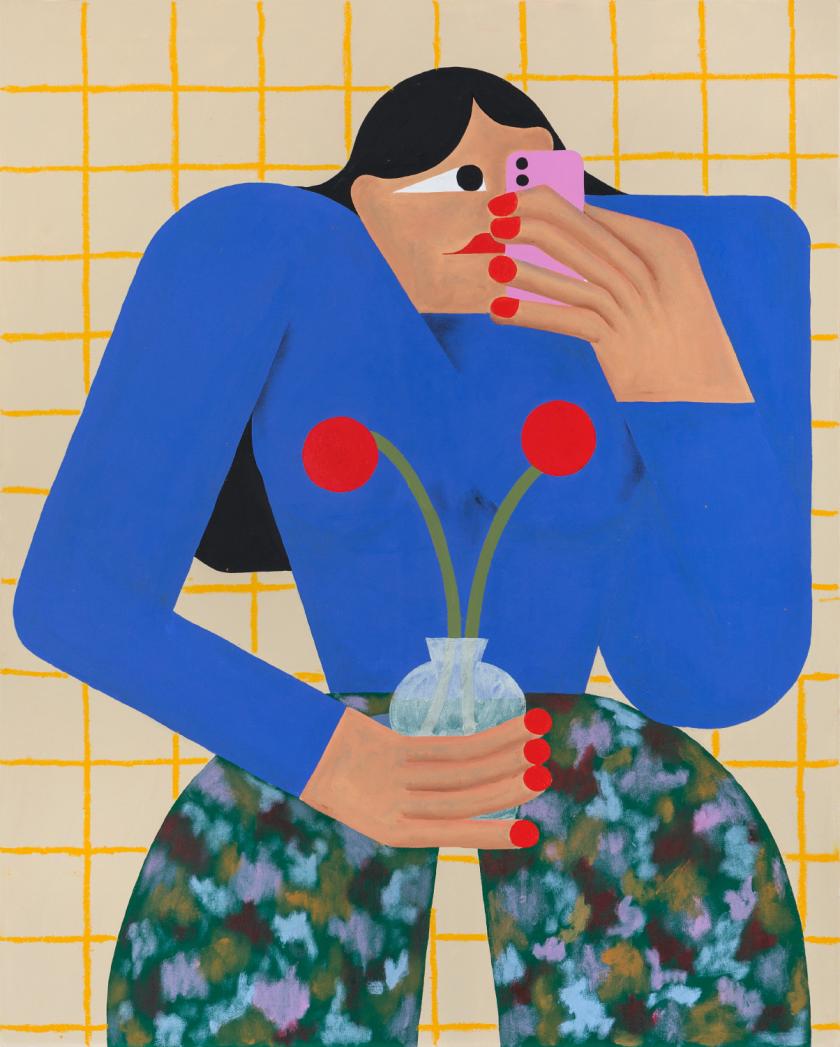
With gestures and postures doing the heavy lifting, the artist tells us why hands have become a recurring motif in her work.
“I always wanted to be an artist,” says Stefhany Lozano, and looking at her childhood, it’s hard to imagine how she could have ended up doing anything else. Born in Bogotá, Colombia, 40 years ago, she grew up in a house where art books filled the shelves, where her aunt painted, where her grandmother loved to talk about art over dinner, and where Sunday mornings meant museum visits with her grandfather.
Even so, her path wasn’t a straight line. She completed a BA in Product Design but “never did anything with it”, moved to Germany in 2010 on a scholarship, thinking she was only going to stay a short while, and ended up staying, eventually pursuing an MA in arts and illustration at Burg Giebichenstein in Halle, under Georg Barber (ATAK), who pushed her towards painting. “I consider that my path as an artist has been very unusual, very different to what I had imagined,” she says. “I was afraid to be an artist because I was not sure I had the talent and could make a living out of it, but things have always worked for me in the untraditional way. I have been able to make a living from my work, and I’m learning to go with the flow and be happy with it.”
Stefhany now works as a freelance illustrator for magazines, newspapers, festivals, museums and apps. She’s also illustrated five books, several landing on Stiftung Buch Kunst’s best-book-design lists – which eventually pushed her towards larger formats. Her paintings have since travelled to the Saatchi Gallery in London and galleries across Australia, Colombia, Spain, Germany and Mexico.
Look at her portfolio, and you’ll notice a recurring motif appearing throughout: hands. In one painting, a woman in a blue sweater cradles a bunch of flowers while lifting a phone to snap a photo of herself, her fingers doing double duty as gesture and subject. In another, from her Coqueta series, which explores the figure of the “coquette” – the definition of which is a soft, hyper-feminine aesthetic laced in bows and pink – a woman leans towards a tear-shaped mirror, made-up and half-hidden by her own hair, cosmetics scattered across the desk in front of her.
Elsewhere, in a series titled Intimidad Pública, a reclining figure holds a phone above her face on a checked blanket, while a second work in the same series shows someone crouched on tiled ground in a pink swimsuit, sunglasses lifted just enough to peer over them. “[The series] comes from my own experiences of seeing, sharing and living moments of extreme intimacy in a public space like the lake, and how that makes me feel uncomfortable. I started wondering about the intimate and the exposed, and how intimacy changes when there is an observer.”
A separate set of studies zooms right into the hand itself, the palm and fingers filling the entire canvas, nails painted a flat, graphic red. The works are part of a larger project called Rock, Paper, Scissors, comprising 26 paintings of hands, sold one a day over Christmas. “A project where I dedicate my time to hands was a dream come true,” she says. “Hands, in particular, have become one of my favourite expressive elements. A slight movement, the tension of a finger, or the position of a hand can completely transform the emotional reading of an image.”
That interest is part of a wider fascination with body language – with gestures and postures standing in for facial expressions, and silent communication doing the emotional heavy lifting. “Most of the time hands are the protagonist; I use hands as a communication tool in my paintings.”
Starting with lists rather than sketches, her process begins with a topic, a set of “scenes” she wants to portray, rough drawings on scrap paper that happens to be in the studio – she’s never owned a proper sketchbook. A fixed colour palette and a handful of canvas sizes narrow the decisions down before the work starts, composed on the wall using rulers and templates she’s built herself. “This is one of the most fun parts,” she says, “having these rulers and templates somehow gives me freedom within my own creative process.”
Her newer series introduces oil paint for the first time, which she uses to render skin with more texture, and she’s recently been extending the work into fabric – soft sculptures of hands, built from collaged elements pulled straight out of her paintings, including Chain of Unity, a 350cm fabric piece made for the Floating Curtains festival in Hamburg and Innsbruck.
In her personal work, she tries to keep the audience out of the process entirely. “I try to stay as free as I can in my creative process,” she says. “I know somewhere there will be people who resonate with my work, and that’s one of the most rewarding things you can experience.” This year is about building her series even further – “a lot of ideas I want to work on,” she says, “and that is very exciting.”
Leave a Reply