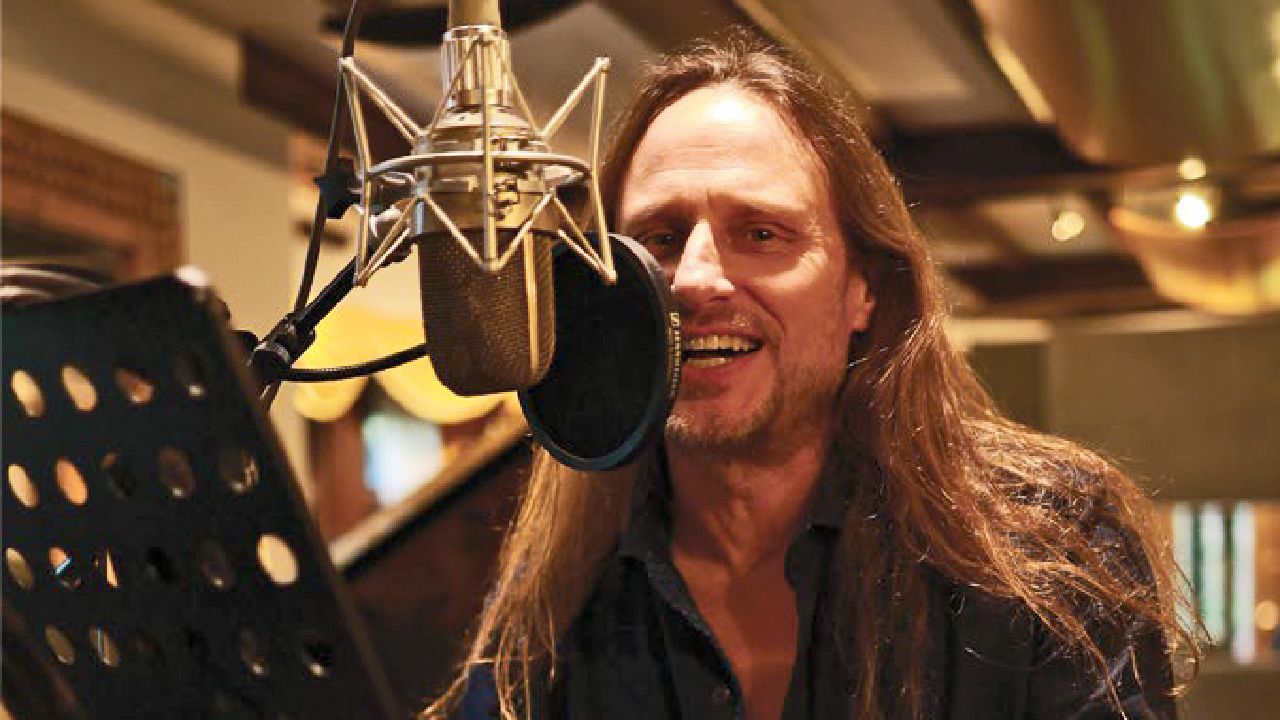
Aurora is the third Yes studio album to be released in five years, an astonishing work rate for a veteran band who seem to be riding a genuine wave of creativity. Prog spoke to Steve Howe and vocalist Jon Davison about this burst of activity and how, even after nearly 60 years, the band are still honing their craft.
To release three albums in the space of five years would be a fine effort for any contemporary band. For a supposed ‘heritage act’ with a history spanning more than 55 years, it’s a herculean feat – although Yes’ current rate of work isn’t quite on a par with their run of early-1970s classics.
They recently unveiled Aurora, the third work in a trilogy that began with The Quest in 2021 and continued with Mirror To The Sky in 2023. “I really like some of the songs on The Quest,” says guitarist Steve Howe. “But we were finding our feet. Then on Mirror To The Sky, we were much more assertive with the rock elements. When the opportunity came up for another record, we all felt we should try to do even better; we wanted to develop more polish and detail, leading to a greater continuity in the music. I think it’s quite a successful project in that regard.”
A feature of Aurora is the varied combinations of writing credits, with even Jay Schellen – playing drums on a Yes album for the second time following Alan White’s passing in 2022 – contributing to the 13-minute album centrepiece, Countermovement. “Each song takes a great deal of crafting, and every member of the band contributes,” explains Howe, “especially in developing the arrangements. That’s always been the key to Yes music. We still want to attempt to inspire, and to get across that Yes are a band of very high standards, which we still hope to achieve.”
A further aspect of the record is the enhanced contributions of keyboardist Geoff Downes, following a somewhat muted role on Mirror To The Sky. Vocalist Jon Davison confirms it was a deliberate move. “We wanted to bring him more tightly into the fold, so we expressed our love and appreciation for him and how important it was that he be given a position where he could place his unique stamp on the album.”
Downes was chiefly responsible for the Anytime Soon section of Countermovement, sung by Howe, and much of the music of the grandiose Ariadne. The latter is one of only two orchestral arrangements from Paul K Joyce, whose fine work graces all three recent albums; his other contribution being on the title song. “The treatment’s quite different this time because although we only use the orchestra twice, they’re on big tracks,” says Howe. “I didn’t want them to keep interfering with the band too much, so when they had their moments, I wanted to make them really huge.”
Davison is also full of praise for Joyce: “He’s our sixth bandmate, if you will, because his classical touches are simply beautiful, and really give a broader sense and legitimacy to our music. I love working with him. His two arrangements are very different. He composed the piano on the beginning of the title track and then arranged that surge into its great, powerful intro, taking various vocal themes from the song and intertwining them. It’s just brilliant.”
Even though Downes is much more prominent on Aurora it doesn’t mean there’s any less of Howe. As always, he provides a wealth of textures, from the layering on the two short pieces that bookend Countermovement to the acoustic and classical textures of Turnaround Situation and Love Lies Dreaming, then the almost aggressive distortion of All Hands On Deck. His beloved Gibson ES-175 was a key instrument.
“It was really enjoyable having the opportunity to use the 175 so much on this album,” he says. “But I still like to develop my steel guitar work, especially because it lets me combine unusual textures. You get that very stern and emotional steel in Freedom’s Edge [the final part of Countermovement]. But in Taro [the first part], it’s more of a playful interplay between the electric and the steel, and I don’t know whether anybody’s ever done that. So I still try to cross bridges I haven’t attempted myself yet.”
Davison’s approach to vocal melodies is intriguing. He’s often working with music that’s already composed and arranged and so his melodies sometimes explore directions the listener may not expect, or indeed appreciate on first listen. “I sometimes approach the vocal melodies instrumentally,” he says, “so I’ll write them with a keyboard, which brings out more complexity than if I were just singing off the top of my head.”
In other areas Aurora is downright catchy; listeners may find that the chorus of Turnaround Situation, for instance, becomes an earworm. Davison laughs as he remembers how he came up with the melody: “I have this habit of repeating something my wife has said – I’ll sing it back to her. It’s quite annoying, actually. One evening, we got lost leaving engineer Curtis Schwartz’s studio. It was late at night in the dark English countryside, and we kept missing our turn. Emily started saying, ‘You know, this is a turnaround situation.’ So rather than me helping her through our navigational predicament, I start singing, ‘Turnaround situation lately,’ and there it was!”
One aspect of the album that might intrigue listeners and even split the crowd somewhat is its structure. It’s front-loaded with pieces that will sound relatively familiar in style; but it finishes with three shorter tracks that display some wild stylistic twists – Howe’s surprising All Hands On Deck, the wordless Outside The Box and the sensitive Davison ballad Emotional Intelligence. How were the sequencing decisions made? “That’s down to the brilliance of Thomas Waber of InsideOut,” says Davison. “He formulates the song order and how it should flow, and then suggests it to the band. It’s worked out that way each time over the last three albums that we finish on a quieter song. Perhaps I have some quality in my songwriting that appeals to him as a nice closure.”
The universe decided that I needed to accept this call of duty from Chris Squire, Alan White and Steve Howe. I’ve done my best to honour Jon Anderson
Jon Davison
When the title track was released ahead of the full album, fans reported mixed reactions. “I don’t really read any comments,” Davison says, “but when the video came out on YouTube and I saw there were so many likes and views, I read some of the feedback. The first one caught my eye – it was really insightful, which led me to the next one. I thought, ‘Don’t read the comments; you know better.’ I kept going, and in the main they were really positive. But I’m not part of Facebook, so I’m not privy to the battle zone, if you will.”
One song that might well prod the hornet’s nest is Howe’s deceptively simple All Hands On Deck. “Fundamentally, Yes is a rock band,” he says, “and if we weren’t, we wouldn’t be Yes – we’d be a lot more middle of the road. So yeah, All Hands On Deck does shout in your face a bit, but I think it’s refreshing to have a track like that.”
(Image credit: Curtis Schwartz)
While some of Davison’s lyrics, such as on Ariadne, have their roots in mythology, others hint a little at former vocalist Jon Anderson’s more oblique phrasing. Does Davison feel any pressure of legacy? “I’ve learned to see it not as pressure, because that would be limiting. I see it as inspiration. I just respect the man so much. He’s a sheer genius; he’s a hero of mine, and for whatever reason, the universe decided that I needed to step up and accept this call of duty from Chris Squire, Alan White and Steve Howe.
“And I’ve done my best to honour Jon. So it’s not like I want to go one way and this voice in my head is telling me to go another. I just do my best to celebrate the Yes music – music I love.”
We need to keep moving forward. It’s no good to keep looking back and saying, ‘Let’s do this song – it’s a bit like Yours Is No Disgrace’”
Steve Howe
With Howe awaiting an essential medical procedure, the band’s upcoming live shows have been pushed back to the spring of 2027. The plan had been to perform the same set they’d been playing during the US tour in 2025, based around the Fragile album, and it seems that will remain the case. They also included Circles Of Time from Mirror To The Sky, which raises the question of whether a song or two from Aurora might appear.
“It’s really challenging to take on the new songs, which is why it’s impossible to say for certain,” Davison says. “When we first toured after Mirror To The Sky came out, we played Cut From The Stars, which wasn’t easy; and we attempted All Connected, which went really well for a while,but the set got too long and that was the one that had to get cut.”
Although the band see their three recent albums as a trilogy, it seems that this definition is a loose one – it isn’t the end of a Yes journey, but more a convenient way to frame the last five years. There’s a clear feeling that there’s more to follow. “We’re really in a good stride now,” says Davison. “There’s a sense of momentum. The muse and its music are sort of taking over the artist, if you will. So, I certainly think there is more music to come.”
Howe feels the same: “These three albums bookend a story about the band. So where we go next has to be more revolutionary or stylistically somewhat different. I think that’s what Yes are about: we don’t have to confine ourselves to being a certain kind of band. We’re free to be whatever we can be. We need to keep moving forward. It’s no good to keep looking back and saying, ‘Lset’s do this song – it’s a bit like Yours Is No Disgrace.’”
So, regardless of how Yes fans react to Aurora, it seems this is a band with plenty more to offer, and with so many of their contemporaries now retired or, at best, sporadically active, that’s quite remarkable.
Aurora is on sale now.
(LouderSound)
Leave a Reply