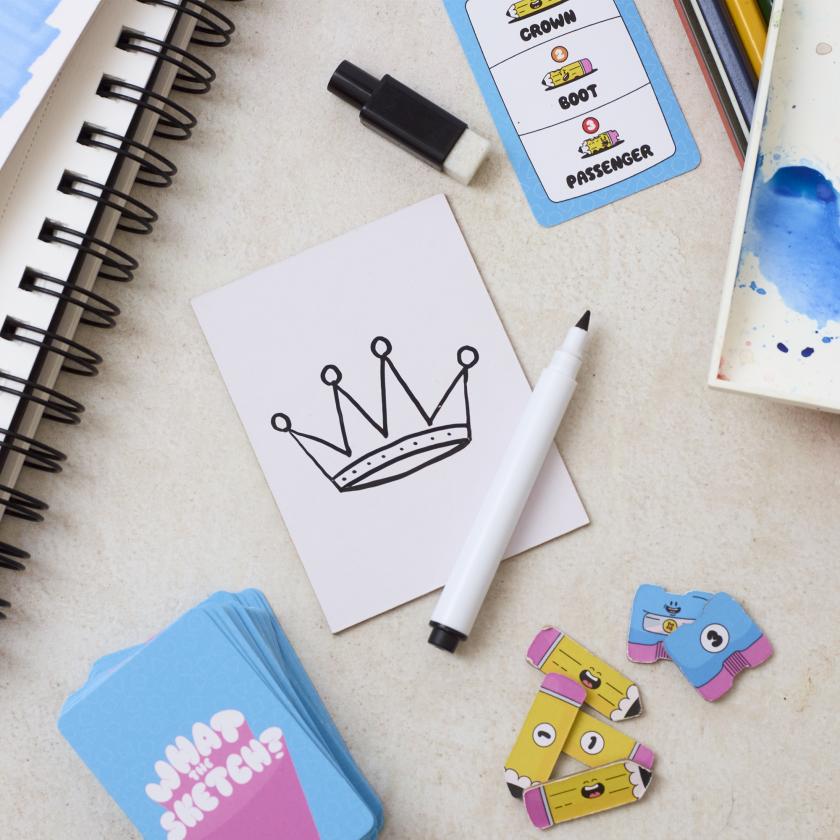
The illustrator talks pencils, party fun, and pitching the perfect box art for Alley Cat Games’ What The Sketch?
Party games live or die on their box art. Before anyone reads a rule or shuffles a card, they’ve already decided, in about two seconds, whether the thing on the shelf looks fun. That’s a lot of pressure to put on a few illustrated characters and a logo. And it’s exactly the brief illustrator Luke McConkey took on for Alley Cat Games’ drawing and guessing game, What The Sketch?
The game itself is simple: one player becomes the art teacher, describing an object using only basic shapes, while everyone else races to draw and guess what it is. Luke’s job was to give it a look that could grab people in a genre already packed with strong competition.
The project started, as these things often do, with a friendly email. “Caezar, who runs Alley Cat Games, reached out and said they had a project they thought I’d be a great fit for, and we just started from there,” Luke recalls. He’s fond of that early stage of a job, before the deadlines and revisions kick in. “It’s always lovely those first few interactions,” he enthuses. “You get the little excitement of a new enquiry, meeting new people, learning about awesome new projects.”
Creative process
Ask Luke how he actually builds a character, and the answer is less methodical than you might expect. Rather than starting with a tight plan, he lets the pencil move first and waits to see what happens. “A lot of it comes from not thinking too much about each individual. I’ll let the pencil start moving and when a bit of shape starts to form, get into the detail,” he explains.
Personality comes later, once a rough shape has emerged from the page. “Once I start seeing a character coming out of the blobs, I start adding personality in my head, giving them a name, what they’re like, what stuff they’re into.” Each pass builds on the last, with characters taking shape gradually rather than arriving fully formed. He seems genuinely amused by the process: “Kinda cool seeing what my funky brain has bubbling away underneath!”
That doesn’t mean, though, that this wasn’t a big challenge. Party games are a brutal market to design for. Walk into any games shop, and the shelves are stacked with bright, competing box art, all fighting for the same three seconds of attention.
Luke did his homework before starting, visiting both big and small games shops to see what he was up against. “Geez, it’s tough out there!” he says. “It really is a tough brief when you’ve got so much awesome stuff from amazing artists and game publishers trying to grab people’s attention at the same time.”
His solution wasn’t to chase trends or second-guess what was already on the shelf. “It’s about staying true to what you and the client want to do rather than playing shadow games to manoeuvre around competition and what’s come before,” he believes. “Just putting love into something goes a long way, I think. People can sense when you’ve done something from the heart, versus strategically trying to second-guess stuff.”
Matching the mechanics
Some briefs feel like a natural fit, and this was one of them. What The Sketch? has players drawing quick shapes and shouting out guesses the moment something clicks, which, as it turns out, isn’t far off Luke’s own working method. “The mechanics of the game resonated with how I work,” she says. “You draw a bunch of shapes quickly and then jump and shout when it looks like a thing. That’s pretty much my nine-to-five!”
In fact, the hardest part of the job wasn’t the drawing itself; it was understanding who the drawing needed to appeal to. What The Sketch? has to land with adults and younger kids at the same time, without tipping too far in either direction. “You don’t want adults thinking it looks too childish and vice versa,” Luke says.
In this light, getting the three main characters right mattered even more than usual, because characters shape who a game feels like it’s for. “It’s also tricky because with party games, people very much judge them by their cover,” says Luke. “When bringing characters into the fold, they massively influence the demographic, and also representation plays into it. I think we struck a sweet chord of harmony with our three characters and their personalities.”
What’s next?
Luke isn’t done with board games yet, not by a long way. He’s a fan of the genre outside of work too, and there’s more in the pipeline with Alley Cat Games already, though he’s keeping the details under wraps for now. Beyond that, he’s got his eye on a different kind of project.
“I’d love to work on something in the fantasy/sci-fi space,” he says. “I think I have myself in the bouncy, gooey, energy box, and I’d love to show how I can apply my style to some wicked monsters, wizards, landscapes. An RPG with some wizards and orcs would be incredible.” Given how quickly he found his footing with a game about shapes and shouting, it’d be hard to bet against him.
Leave a Reply