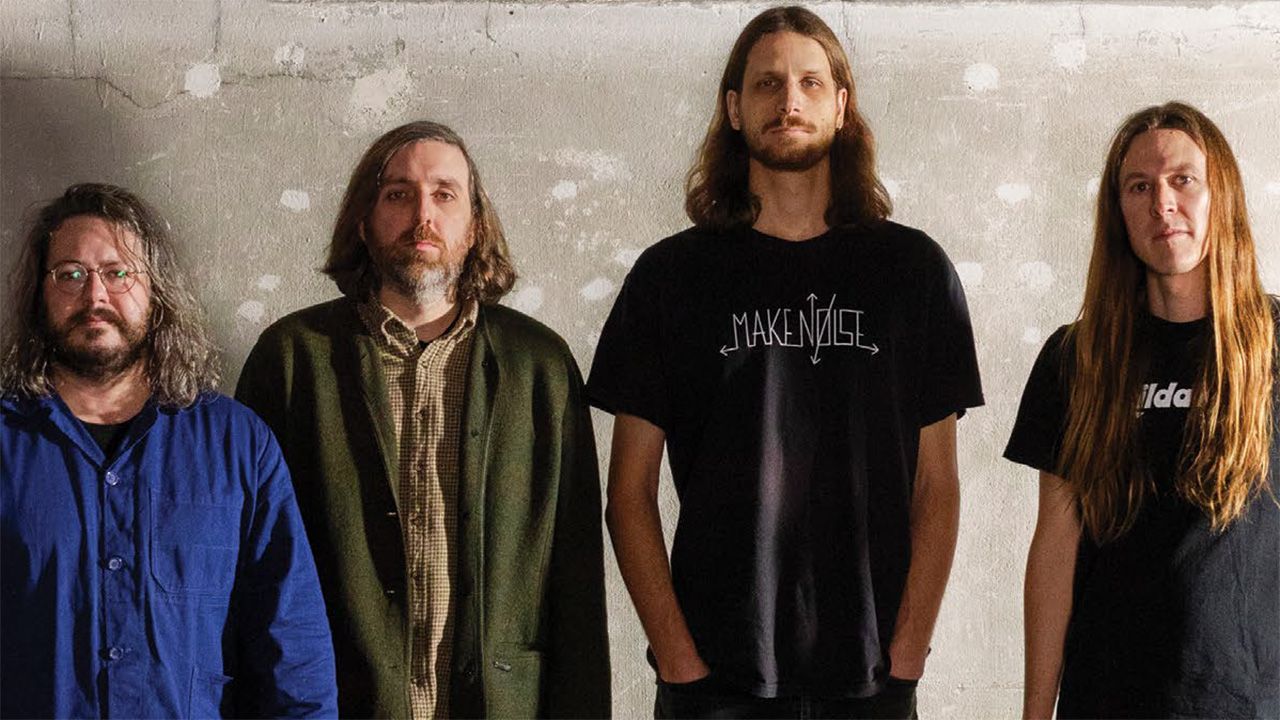
After 2022’s head-turning Innate Passage, Nick DiSalvo was burnt out; he needed to fly from Elder’s nest to explore new worlds. Now, back in the driving seat of the psych rock heavyweights once more, he’s putting himself – and his place in the world – under the magnifying glass with stunning new album Through Zero.
When Elder’s chief songwriter Nick DiSalvo turned his life upside down by swapping Boston for Berlin, the band also went through monumental change. They’ve always immersed themselves in longform songs, where ideas develop at their own pace. But from 2015’s Lore onwards – the first record penned since DiSalvo’s move – they were reborn as 21st-century prog rock pioneers, flying the flag for 70s prog while also giving it a stoner rock spin.
Elder’s seventh album, Through Zero, is a vibrant continuation of that change. It’s their first record in four years, which, for the tirelessly working DiSalvo, represents an extended leave of absence from the studio with the band he formed 20 years ago. He needed a break.
“After the pandemic faded, we started touring again, and we hit it really hard,” he explains. “We were playing 100 shows a year for a couple years. But we’re not 20 any more and my physical and mental health was suffering.”
Through Zero digs deep into DiSalvo’s evocative union of Pink Floyd and Yes with Sleep and Electric Wizard. Yet it somehow feels far more colourful, far more at ease when it comes to striking its stylistic balance. For a while, though, he didn’t have it in him. His solo project Delving was the antidote – he homed in on his love of psych rock, Krautrock and early electronic music.
The first album, Hirschbrunnen (‘deer fountain’ in German), arrived in 2021. After the Innate Passage tour, the project became his obsession; and a follow-up, All Paths Diverge, came in 2024. “I needed some time to explore other musical avenues before my brain was ready to come back and work on another heavier rock record,” he explains.
“We always try to reset and refocus between records so that we’re doing something that feels fresh to us. Taking a break from heavy music made it feel – first and foremost – fun again to stand in front of an amp stack and wail.”
He bemoaned feeling that the world of riff-rock was stagnating – holding onto a belief that history’s greatest guitar riffs had already been written. If he was to return to that world, he had to feel like there was a purpose for another Elder album to exist. So he made the band a vehicle to channel his grievances and musings on a world that felt increasingly alienating.
“My lyrics examine philosophical and metaphysical topics from my own perspective,” he says. “There’s a lot of frustration with the state of the world, and frustration with my place within the creative ecosystem. It’s becoming harder to see why I’m doing this again. Is it because I still have the same spark of joy when I was a 16 playing in my room, or is it because I’m a working musician?
“Being in a band for 20 years comes with a lot of bullshit, and it adds up – I spend more time fucking writing emails than I do playing guitar these days, and that really bums me out.
“[Second track] Capture/Release is about my own struggles with feeling the pressure of the creative economy that we find ourselves in and the devaluation of everything that we do, because of the constant pressure to do things. It’s a psychological re-evaluation; it’s me trying to bring back the joy into creation.”
Most songs are iced with jubilant crescendos, awash with swaths of keyboards, and the sense that light is cutting through the storm clouds overhead. “I think there’s a push-and-pull between my frustrations, and what you’re seeing as joyous music,” DiSalvo says. “Every Elder song goes through several mood shifts; I don’t want our music to be one-dimensionally gloomy. There’s always an arc in the songs that follows the hero’s journey, where you have conflict and resolution.”
The States was a wildly unaffordable place. I couldn’t have continued being a working musician
DiSalvo relocated to a new continent for many reasons – although the holy trinity of love, work and a desire to start a new life chapter were most prominent. He knew the band would feel the effects of the change.
“Before Lore we made our records as a three-piece, jamming and drinking beers. But I needed to experience something else. It fundamentally changed the way we were writing music. If we wanted to be creative, we had to do it on our own.”
He began writing by recording, falling in love with the way he could chop and change things at will. It opened new creative doors for Elder; as did his new life in Berlin.
(Image credit: Getty Images)
“Sitting at the crossroads of Europe, so many bands come through here,” he says. “I see around three shows per week, and it’s been like that the entire time I’ve lived here. It’s an affordable city with a vibrant arts and culture scene. You can see, do and experience a lot – more than I could when I was washing dishes in Boston. When you’re feeding your brain with all sorts of stuff, it’s going to come out somewhere.”
The rest of the band have since followed him to Germany. But what if they’d never moved? “The States was a wildly unaffordable place; I couldn’t sustain myself,” DiSalvo says. “I couldn’t get a break because most of my income was spent on rent. I probably couldn’t have continued being a working musician. Creatively, you just never know; but life is about taking chances and exploring.”
I only really listen to the 70s bands. I find early Yes records shockingly creative
Elder’s music is also about exploring, and Through Zero’s songs unravel in slow motion. “They get out of hand sometimes,” he says. “I feel like I’m just getting going when a song is three or four minutes. Some ideas are too precious to throw into a three-minute song and move on.
“When it comes to prog, I only really listen to the 70s bands. With long songs, you can take a kernel of an idea, let it really bloom and go places that you wouldn’t imagine. I find those early Yes records, in particular, to be shockingly creative.”
That’s not to say piecing together epic sonic journeys is easy. “The revision process is always the most time-consuming aspect. There are probably 10 to 15 versions before a song is finally finished and everything feels purposeful, rather than superfluous. I know they require a couple of listens, but I think it’s important that it’s not just pastiche.”
On Through Zero, the only doubt interwoven into its six tracks is there for narrative purposes. “I feel reaffirmed; making this record was a real joy,” DeSalvo says. “This was the first Elder record where we didn’t hold back. We’re getting more adventurous and I feel we’re at our most playful yet, having fun experimenting with sounds and textures.
“We explored everything we wanted, and it turned out exactly the way we wanted it to. So I’m left with a feeling of relief, but also satisfaction. That makes me excited to continue capitalising on that energy.”
Through Zero is on sale now.
(LouderSound)
Leave a Reply