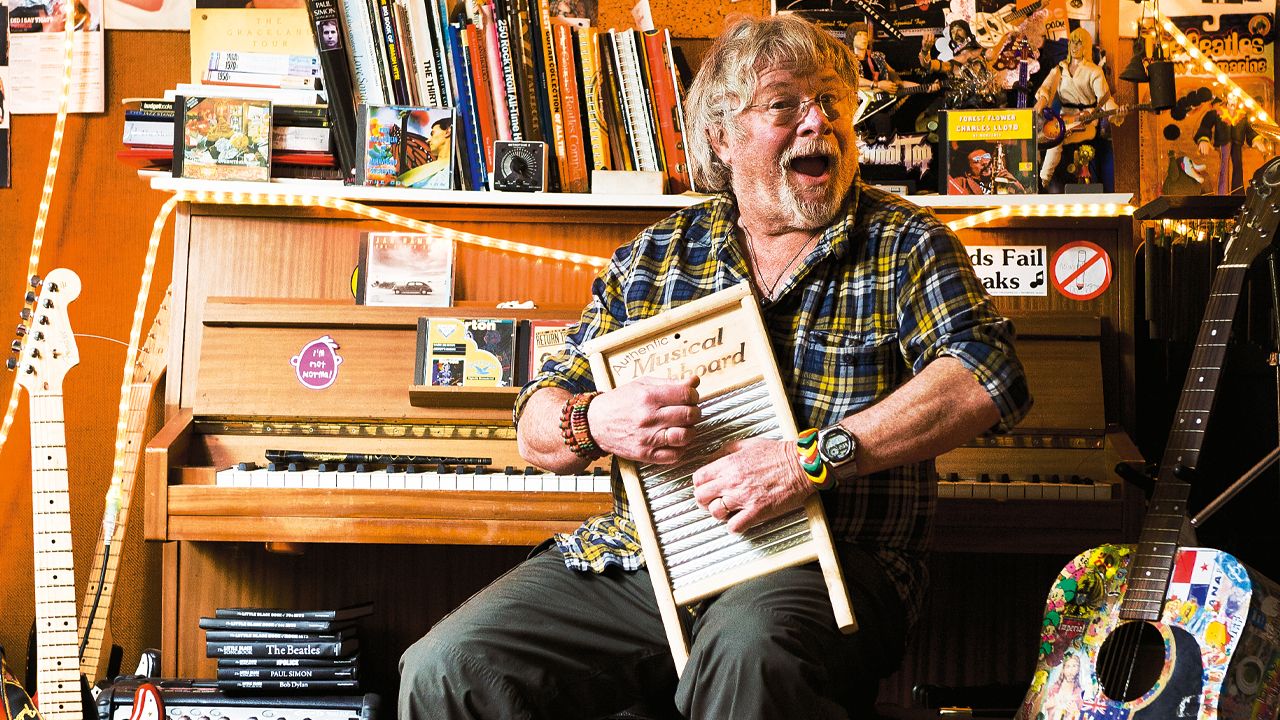
Bill Oddie, one-third of the UK comedy troupe The Goodies, sadly passed away on July 25, 2026. As much a music fan as he was an avid bird watcher, Bill presented Steve Hillage with the prestigious Visionary Award at the Progressive Music Awards at Kew Gardens in 2013. And he allowed Prog to pop round his house and have a rummage through his record collection the same year…
“In my life I’ve had chunks where I’ve been into one type of music predominantly, and then it’s changed and I don’t listen to that any more. That’s happened three or four times. It seems very fickle, but it was a journey. And along the way I always listened to whatever pop songs were knocking about just for curiosity, which when I was a kid were comedy and novelty songs. They were silly but they showed me how to write songs, which I went on to do quite a lot.
But my first more serious listening made me a jazz fan. This was the era of the trad revival in Britain; all these Dixieland line-ups – a trumpet player, trombone and very often a washboard and a banjo. That format was unchanged until Humphrey Lyttleton brought a saxophone player in, and it was like Bob Dylan’s Judas moment. The problem with trad was it didn’t matter how young the band were, they all looked like they were 60, so when I heard skiffle – particularly Lonnie Donegan – there was a more personal, youthful element, and it felt more like a group than a ‘band’.
But the next change that happened was compounded by the jazz society at my school in Birmingham. Up to when I went to university, I only really bought jazz records. I saw Duke Ellington and Count Basie at the Hippodrome, and Chris Barber was bringing over interesting people like Sister Rosetta Tharpe or Salli Terri.
Chris and Humph had an ear for these things, saying, “Look, the music is still changing”. So I shifted over with them. I can visualise my room at college because it looks very similar to every room I’ve ever had – there’s at least one wall covered in album sleeves. At that time it would have been Miles Davis, Roland Kirk and Charles Mingus. Cambridge ’63 was a lively place. And when I went to gigs I took my friends with me – John Cleese, Tim Brooke-Taylor, Graham Chapman, the whole bunch.
By 1964 we were all living in New York. We started off with our Cambridge Footlights Revue [Cambridge Circus] on Broadway and then ended up in a club in Greenwich Village. We got to see many legends of jazz at the time – Mingus and Coltrane, Bill Evans. I made a great friend, a singer called Sheila Jordan, who is absolutely superb. She’s the singer’s singer and yet she sounds more modern than anybody at the same age of 84, 85. She was connected to musicians in our house band. A couple of the piano players we had, who the all-white union had provided, really weren’t cutting it very well. We had a word with the club owner. [Impression] “I can get you a better player than that.” I’d go in there that night – the band had changed colour, and improved. “Is that Ray Bryant?” “Yeah, that’s right.” I’d bought this man’s albums. But he also used to do a bit of jamming and sing new songs after the show.
(Image credit: Will ireland)
Up ’til the mid-60s, 99 per cent of what I’d bought would be jazz records. But I was getting sick to death of the basic jazz 4/4 feel. I hankered for a rock feel, and obviously some younger musicians felt that way themselves, notably Gary Burton. Gary was a whizzkid vibes player since about 18, 19 – and he’d been playing with Stan Getz and big names like that. He formed a quartet that featured electric guitar where he was using distortion, not just blues-playing. Larry Coryell and Pat Metheny played with him for a long time and also Jerry Hahn, who was one of my favourites. Gary looked the part because he used to wear those cowboy jackets with fringes all over the place – you would have thought that would get caught up in your xylophone really, wouldn’t you? Part of the skill was keeping the fringes out of it. This new sound covered most of the records
I bought during the 70s; we called it jazz rock.
The band that knocked me over, almost literally, was the Mahavishnu Orchestra. I remember seeing them at the Rainbow Theatre. I couldn’t sing you the note, I couldn’t tell you the chord but the guys all came onstage, stood there for a moment, and they went into this thing, it wasn’t just volume, it felt like the whole audience had been thrown backwards. Phenomenal musicians, and exactly what I wanted – jazz virtuosity with a real visceral, rock feel. Another act that had this was Chick Corea’s Return To Forever, who started off rather gentle and then got less so. They had a touch of prog about them with titles like Romantic Warrior. They were pretty amazing and I saw them a lot. At this time I also discovered Charles Lloyd. He certainly had a connection to flower power with albums like Love-In, and he played Monterey and wore beads and stuff like that. He was moving into a rock sensibility, especially through his keyboard player Keith Jarrett.
So I didn’t listen to homegrown stuff as I worshipped the Americans. I mingled with some musos, but we weren’t talking Yes, we were talking Weather Report and Zappa. And then Graeme Garden and Tim and I started The Goodies.
We knew we wanted the show to be individual; we knew we wanted music but I resigned myself to the idea that it would all get drowned out by sound effects. We were told we could afford to have a real band, so I decided on doing a track a week in the style of bands I liked. I needed an arranger so I got Mike Gibbs, a very respected man and most British jazz musicians had been in his band at some point, such as Jack Bruce or Dave MacCrae from Matching Mole and Nucleus. I’ll name-drop now; I met Mike at a party at John Dankworth and Cleo Laine’s in 1969.
He was a very mild-mannered man. I said, I really love your compositions, don’t suppose you’d fancy doing music for a comedy series on the BBC? And he said, I’d love to!
The first job was modelled on Crosby, Stills & Nash, and it was abundantly clear were weren’t going to get those harmonies from Tim and Graeme! Mike was a great arranger, and when he stepped down Dave MacCrae took over for the next 10 years. The band line-up would include a host of people from the jazz rock world like John Marshall from Soft Machine, BJ Cole, Chris Spedding… there are hours of unedited tapes out there somewhere.
Musos and comedy fit together perfectly. It was so strange to find myself on a Soft Machine album. On Six, there’s a track called Stanley Stamp’s Gibbon Album. It was taken from a line in the radio panel show I’m Sorry I’ll Read That Again. When I saw it said ‘For BO’ I said, ‘Is this a joke?’. They said, no, it’s for you. Mike Ratledge was a big I’m Sorry… fan. Things like that don’t happen every day, it’s a rather nice memento of the time.”
(LouderSound)
Leave a Reply