She studied fashion, designed accessories for a living, and enjoyed being an artist in whatever time was left over. When the drawing started making her happier than the job, she quit to embrace it full-time.
Yurie Takahashi did everything you’re meant to do. She went to fashion school, graduated with flying colours, and landed a job designing apparel accessories, all while drawing in her evenings and days off for no reason other than that she loved it. You can probably guess how this ends… The drawing won.
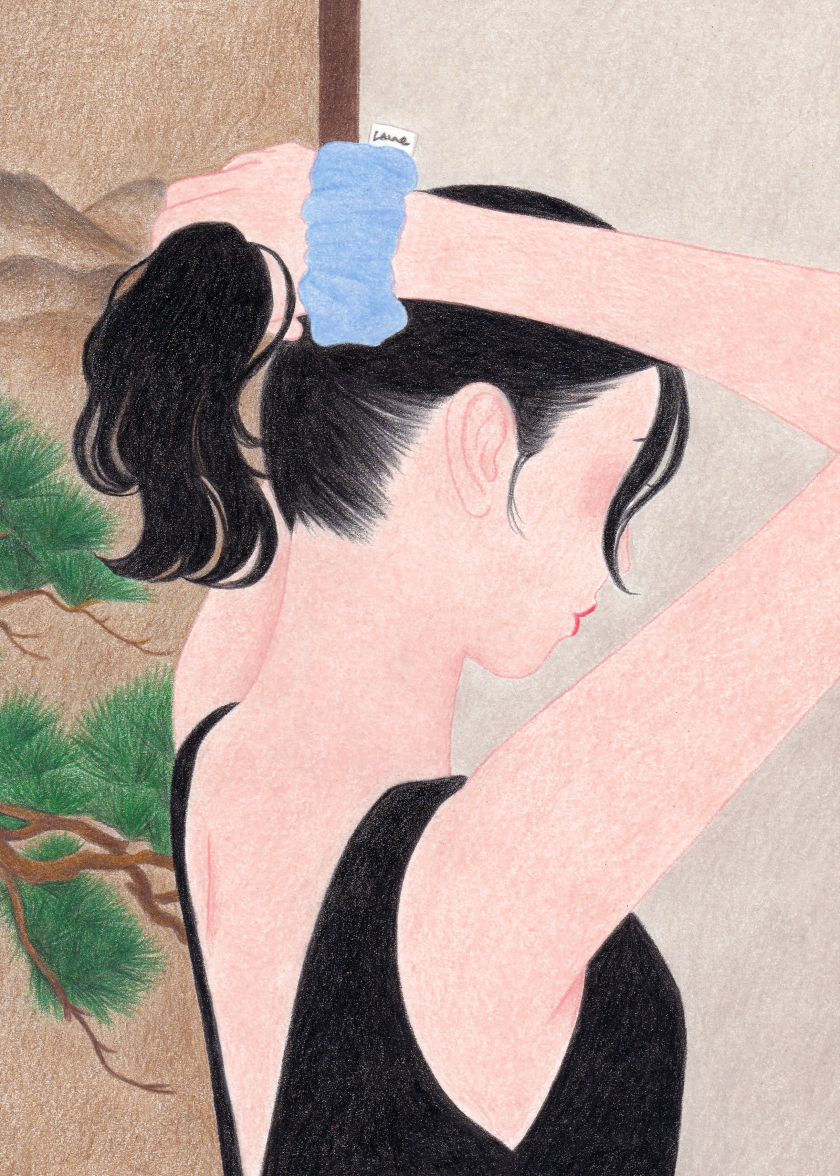
These days she draws “fashion-loving women”, and she illustrates them like someone who has actually made clothes for a living. Her subjects are usually caught mid-something ordinary, tying their hair up with a scrunchie or resting beside a cooling cup of green tea, and she renders it all in coloured pencil against a traditional Japanese backdrop. Nothing dramatic is happening, and everything is composed in beautifully soft hues, using lots of coloured pencils.
None of this was the plan, of course. Yurie studied fashion design at Bunka Gakuen fully intending to make clothes for a living, and for a long time drawing was just a side thing.
“Since I had always loved drawing, I started creating art as a hobby in my free time,” she explains. “As I continued, I realised I found far more joy and fulfilment in combining my love for fashion with illustration than in my design job. That was the moment I decided to leave my career and pursue illustration full-time.”
The fashion training never left her. Ask her why her compositions so often crop in on a sleeve, a piece of jewellery or an accessory rather than a face, and the answer is muscle memory. “Because of my experience as an apparel accessories designer, my compositions often highlight what the person is wearing, or focus entirely on the accessories themselves, rather than focusing solely on the person.”
The women she draws aren’t necessarily ones she spots when out and about, either. Or on any fashion models. The inspiration is closer to home than that. “I keep drawing them simply because I am one myself,” she says. “I’ve loved fashion since I was young, and it always gave me courage and confidence. I draw women expressing their own unique style in the hope that it might resonate with someone out there and bring a little joy or inspiration to their day.”
It’s those unwatched, undramatic scenes that Yurie is drawn to again and again. You just have to slow down enough to notice them. “I feel that everyday life and private spaces are actually overflowing with quiet beauty,” she explains. “By bringing subtle objects like antiques, jewellery, lipstick or a scrunchie into these ordinary moments, that inherent beauty stands out even more.
“Those quiet times when nobody is watching feel like a true luxury to me,” she adds, “so drawing them reflects my personal desire to cherish those private moments.”
Look closely, and there’s almost always a tension running through each artwork: a black slip dress in front of a centuries-old painted screen, or a bamboo steamer lifted with a modern manicure. That collision of traditional Japan and contemporary fashion is entirely deliberate.
“I intentionally blend traditional Japanese motifs with modern fashion,” she says. “Combining contrasting elements makes each subject look much more striking and attractive. My goal is to create a sense of harmony while maintaining a delightfully unexpected contrast.”
What’s surprising is that the gorgeous coloured pencil work is a recent thing. Yurie only started taking it seriously a little while ago, and she has no strict rules about when to reach for pencils and when to pick up the iPad, though the digital tools tend to win for the fiddliest, most detailed pieces.
What the pencils give is something the iPad can’t fake. “People who see my coloured pencil work often comment on how delicate it feels,” she says. “Coloured pencils allow me to vary line weight very naturally, and by layering colours I can create a sense of depth and warmth that is distinct from digital art.”
That instinct for mood and styling has found a home in commercial work, too. For ACCErium at Isetan Shinjuku, Yurie illustrated personal colour types: the analysis that works out which palette best flatters someone’s natural skin tone, hair and eyes. Personal colour diagnosis was having a real moment in Japan at the time, so the brief felt like second nature.
“I focused on drawing women who naturally embodied the mood and aesthetic of each colour group,” she says. A clear set of client guidelines, she adds, made it “a smooth and enjoyable process”.
Exhibitions ask something different of her. For group shows she keeps the theme in mind and aims for visual harmony with the other artists; for solo shows she curates the whole thing to her own vision. Either way, there’s one question she can’t switch off.
“In both cases, I constantly ask myself, ‘Would I want to hang this illustration on my wall at home?’” she says. Commissioned work is about fulfilling the client’s request, she points out, while exhibition pieces exist to excite the people who come to see them, which is why she lets them run bright and colourful.
Looking back, Yurie doesn’t have any regrets about leaving the fashion industry. “The actual workload was extremely demanding,” she recalls. “It took a heavy toll on my physical and mental health, and I realised it wasn’t the right path for me. Coming across illustration allowed me to shift toward a lifestyle that prioritises my well-being while making art.”
Despite being much happier, Yurie works at a restaurant alongside her illustration career, and she admits to the occasional pang when she measures herself against friends further along more conventional paths. She just tries to stay positive. “I try not to be overly pessimistic and focus on enjoying my life journey,” she says.
Given how much of her charm lives in the grain of the paper, you might think Yurie would bristle at AI. She doesn’t. In fact, she thinks it makes work like hers matter even more.
“I believe AI actually elevates the value of handmade art,” she says. “Especially with coloured pencil work on paper, happy accidents happen that can never be replicated in the same way twice. That ‘one-of-a-kind’ quality is something AI will only make more precious.”
And if AI ever did replace her? “It would simply mean my art lacks enough distinct personal charm, so it serves as a reminder to keep refining my skills. In that sense, AI is an important presence.”
But she doesn’t stop at illustration. Over on her second account, @yuriepapierfleur, Yurie makes flowers out of paper stock, a project that began with a paper bouquet for a friend and grew from there.
“Since then, I’ve expanded into creating various plants, including bonsai and orchids,” she says. Next, she’d love to arrange them in vintage pots to make something new again.
For all the exhibitions and commissions, Yurie is quick to say she’s still near the beginning of her own story. Which makes her advice to anyone starting with a similar style feel also like a note to herself: “I strongly believe that art created from pursuing your own personal ‘likes’ possesses a unique charm that no one else can replicate. So cherish your own individuality and keep drawing what feels true to you.”
Looking at her work, you know she means it. And that she’s still following her own advice – one quiet, unwatched moment at a time.
Leave a Reply