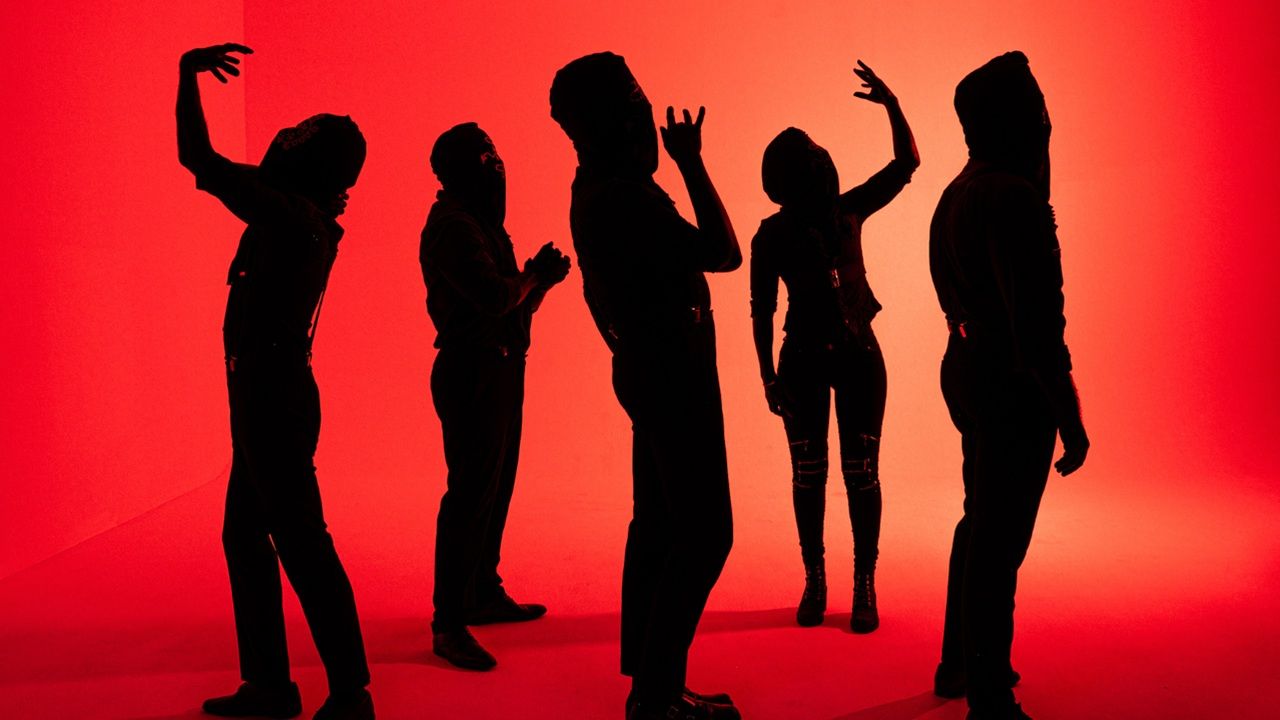
Gaerea’s singer was 16 years old when his best friend was killed. He’s carried the loss ever since. Telling the story is a little complicated because the Portuguese musician doesn’t want his own identity revealed, nor does he want the name of his friend made public. We’ll get into the whys of it shortly, but for now we’ll call the singer by his stage name, Alpha.
Alpha and his friend knew each other from school. They started their first group together, did their first home recordings together, had their first band photos taken together. All the first steps every would-be musician takes, they took them together. But Alpha’s friend was way more dedicated. By his own admission, Alpha himself was just along for the ride.
“I just wanted to smoke my first cigarettes, go out, shit like that,” says Alpha, speaking from his home near Porto via Zoom, unobscured by the striking, sigil-emblazoned mask-cum-headcovering he wears onstage and in photos. With his tied-back long hair, glasses and earnest demeanour, he looks less like a man who has made one of the most emotionally charged metal albums of the year and more like a barista in a moderately trendy coffee shop.
“My friend was actually the one that wanted to become a musician,” he continues. “He had plans for all of that. He had his whole life sorted. But that didn’t happen.”
According to Alpha, his friend had bipolar disorder and was severely depressed. “Also, he was mixing a lot of drugs and alcohol,” says Alpha.
Yet the end was still a shock, not least because of the sudden nature of it. Alpha and his friend had met up one evening. The singer bailed early, but his friend decided to carry on. The next morning, Alpha got a call. It was his friend’s brother.
“He told me he’d been run over on the highway by a truck,” says Alpha, solemnly. “He was trying to make it home after a very drunken night. I was 16, he was 17.”
The death of his best friend more than 15 years ago has shaped Gaerea’s new record, Loss. It uses that traumatic incident as a jumping-off point to explore absence, trauma, guilt and the ephemeral nature of life.
“The whole album is based around my friend who passed away,” says Alpha.
Linkin Park are the band of my generation.
Alpha
Yet for all its lyrical heaviness, Loss is an exhilarating listen and a bold step into the future. Where once Gaerea were a black metal band cloaked in dissonance and darkness, their sound has become bold and expansive, drawing on everything from nu metal to hip hop.
The new album may have a black hole at the heart of it, but the band that made it are anything but hollow. Like every budding extreme metal musician worth their weight in sulphur, Alpha was drawn to the dark side as kid by Beelzebub’s unholy emissaries on Earth: Linkin Park.
“They’re the band of my generation,” he says without embarrassment. “They made me want to pick up the guitar. Did I have baggy jeans? A little bit. Spiky hair, for sure.”
It wasn’t just Linkin Park who shaped his early musical tastes. Trivium and Parkway Drive were in the mix too. So were Bring Me The Horizon, though it was Alpha’s friend – the one who died so young – who really loved them.
“He looked exactly like Oli Sykes,” says Alpha. “I really didn’t like their deathcore phase, but he used to tell me, ‘Man, this band are gonna be so huge one day, you see.’ He was right, but he didn’t get to see them.”
Alpha’s entry point to black metal had been Norwegian C-listers Ragnarok – specifically the song Murder from their 2004 album Blackdoor Miracle. He dived deeper into the scene, pulled down by the aggression and transgression.
“You’re 15, you’re rebellious, you want to express yourself and fuck off your parents,” he says. “You start listening to the most aggressive, irreligious thing you can find. You want to be edgy, and that was edgy enough for me to dive into.”
Alpha vaguely remembers the band the two friends formed being called Devotion. “Very, very, very black metal, corpsepaint, everything,” he says. “We never released anything but we had some recordings we did in our rooms.”
Who knows where things might have gone had Alpha’s friend not been hit by a truck on the highway that night. Alpha dealt with the loss by throwing himself into music. He had a good support system around him, but at the same time he began to isolate himself from his other friends without really realising it.
“From that moment on, I just went full-focus on something I didn’t want to do before,” he says. “Before that, I didn’t want to become a musician, I barely played guitar. When this tragic thing happened, I just went full-on. When I started working on this new album, I realised that I lost so many people because of this. People that were important to me.”
(Image credit: Chantik Photography)
He put together a new band. He remembers playing one early gig in a bar in the shopping mall where they rehearsed. He half-recalls a Bible being burnt onstage. It was youthful button-pushing rather than a concerted attempt to bring down Portugal’s Catholic church.
“When you’re young you do silly shit,” he says with a shrug. “You’re trying to be edgy, making a statement against nothing.”
He formed Gaerea a decade ago, largely as a vehicle to explore his feelings of being an outsider.
“I’m not communicative or outgoing or too social,” he says. “I like to stand in a corner and observe. I like to watch people. Rehearsing where we did [in the shopping mall], you would see all kinds of people and all kinds of shit – tourists, addicts, everyone. And it made me think about my place in the world – ‘Who am I? Does it really matter to be here?’”
Gaerea’s early releases were harsh and bleak, but there was an interesting concept swirling beneath the music. 2018’s debut album, Unsettling Whispers, introduced The Vortex Society, an imaginary world populated by a series of characters lost in an unwelcoming urban environment. Even Alpha admits it was a little on the nose: “Was it Porto? Yes, of course.”
The whole album is about my regrets, things I could have done. You realise you’ve sacrificed so much and you’ve thrown so much away.
Alpha
Their third album, 2022’s Mirage, saw them starting to audibly edge beyond the boundaries of black metal into more expansive territories. 2024’s Coma took things further. Though maybe not as far as Alpha would have liked.
“We were very conservative with it,” he says. “We were afraid of too much change. We should have taken things further.”
Loss definitely delivers on that promise. It’s connected to the band Gaerea once were in the same way as the iPhone is connected to a couple of plastic cups connected by a piece of string: they’re broadly the same thing, but only just. Alpha admits that he was “starting to become a bit bored with a lot of things we were doing before”.
The result is an album that shoots high, piling on big melodies, clean vocals and the whisper-to-a-roar dynamics of modern metal. It’s hardly Linkin Park, but it’s definitely the work of someone who grew up listening to them. Yet the most interesting thing about Loss is the emotional charge it carries.
This is the sound of a someone finally confronting a moment that would shape anybody – the death of a best friend at a time when best friends are everything. ‘There’s a gap inside my mind / Where faces fade away,’ roars Alpha on Luminary, the album’s soaring opener.
“It’s a song about missing something, realising there’s something that isn’t there,” he says. “As much as you go through life and achieve things, you feel completely empty. The faces fading away – that’s people you see throughout your life.”
He talks about the imposter syndrome he felt while writing Loss, perhaps the result of a kind of guilt.
“On some parts of the album, I question myself: ‘Did I just steal this from somebody else?’”
I don’t have to show my face for people to relate to the music.
Alpha
It all comes to a head on the eight-minute Stardust, the album’s musical and emotional climax. The song cycles through bleak balladry, roaring anguish, even a whispered quasi-hip hop section, piling on the agony, despair and guilt. ‘Are you still with me when the world goes dark?’ howls Alpha on the track. ‘Are you still with me when I fall apart?’ The subject of the song is obvious.
“I’m basically talking to [my best friend],” says Alpha. “The whole album is about my regrets, things I could have done. You realise you’ve sacrificed so much and you’ve thrown so much away. You think: ‘Why did you sacrifice so much for one thing?’”
So, why did you sacrifice so much for this one thing? He shakes his head sadly. “I really don’t know.”
That desire to push forwards makes Gaerea one of the most fascinating metal bands at work right now. Ironically, the least interesting thing about them is their anonymity.
“When we started, I just didn’t care for people to know me,” he says. “I still don’t. I don’t care how musicians look. I don’t care if my favourite bands have long hair or they have some shit on their face. I don’t even care if a band changes musicians. As long as the music is there and the vision is there.”
The problem is that metal today is saturated with bozos in joke shop masks, hoping a wacky look will distract people from the averageness of their music. Gaerea may have beaten the rush, but they’ve become caught up in a cliché.
“There are some bands I see that I think are bullshit, just hopping on some bandwagon,” says Alpha. “And I know sometimes people say that about us: ‘Oh, just another masked band.’ But I think people have that bullshit sensor in them: ‘Man, there’s no authenticity to this.’”
What’s so important about being anonymous? People can Google who you are.
“There’s no band who is completely anonymous,” he concedes. “Two clicks and you’re there, including us.”
So why bother with the masks?
“Because I don’t see myself as interesting as a person. I see what my ideas can do for people, and that’s important. It’s not about, ‘That guy creates this thing.’ I’ve come to realise that when people don’t have a public figure to relate to, they kind of place themselves in the artist’s face to do that.”
Doesn’t wearing masks suggest a band who don’t have the confidence to let their music stand on its own?
“It’s the opposite,” he counters. “I don’t have to show my face for people to relate to the music. This is all about the music. Otherwise what else do we have? If the music is not good, it’s not going to work out.”
Will you ever take the masks off? “No, never,” he says simply.
Inevitably, Loss has provoked the ire of some extreme metal online gatekeepers, who insist their bands should be stuck in some kind of unholy arrested development. Alpha has seen the comments and remains admirably unconcerned.
“Every band goes through that phase,” he says. “We even got it when we released the first album. My favourite bands, I don’t love everything they do. But if people prefer the old albums, they can listen to them. They’re all out there.”
He holds up BMTH, who he dismissed as a callow teen, as a band showing how metal can change things up and push forwards.
“They can do a really crusty, grungy song, but then they can do one with trap beats or lo-fi remixes which are fucking amazing,” he says.
“That’s what I like about them. I don’t like every song they’ve done, but it’s the freedom. They just don’t fucking care.”
BMTH bring things back around to the inspiration behind Loss. They were the band his best friend said were going to be massive, but never got to see it happen. Alpha says he still thinks about the kids they were every day, and the absence that comes with it.
“I’ll forever miss him,” he says. “I would’ve loved him to be in my band. I used to feel guilty about what happened, things I said, things I could’ve done differently. But I’ve come to peace with it. I don’t feel guilty anymore. Things happen in a certain way, there is nothing anyone can do about it. It’s the only life we have.”
Loss is out now via Century Media. Gaerea play the UK in September.
(LouderSound)
Leave a Reply