This Edinburgh-based interior designer applied for hundreds of jobs after graduating and got nowhere. Eventually, he decided his “too bold” portfolio wasn’t the problem—it was the brief.
Harry Matuszewicz-Milne spent 10 years as a mental health nurse before retraining as an interior designer. He graduated from UWE Bristol in 2024 with a first-class honours degree and then spent the best part of a year applying for design jobs. Close to 550 of them, by his own count, including speculative letters, branded coasters and a hand-typed cover letter on custom stationery. Not one of them led to a job.
It’s a familiar story for a lot of creative graduates, but Harry’s response to it is worth paying attention to. Rather than softening his work to fit what employers seemed to want, he built a studio, Acid House Designs, around the very thing he kept getting told was the problem.
“The recurring feeling was that my work was too bold, too strange or too much,” he recalls. It’s a line that will land uncomfortably for anyone who has sat through a portfolio review and been told to tone it down. For Harry, the rejection became the founding logic of his business rather than a reason to abandon it.
The problem with “too bold”
The disconnect, he says, began in the final year of his degree. “Throughout my studies, we were all encouraged to push the boundaries and experiment, to discover who we were as designers, finding our own design personality, etc.” That encouragement produced exactly the kind of portfolio you’d expect: bold, colourful, uncompromising. What it didn’t produce was a job.
He had three interviews out of hundreds of applications. He made a three-hour drive for a graphic design role where the interviewer asked what experience he had, was pointed to a CV that said “none”, and ended the conversation there. Another was for an assistant interior design position on minimum wage. He pushed for feedback and was eventually told his designs were too bold.
“This was obviously upsetting, but probably more annoying than anything,” he says, and that distinction matters. It’s not despair driving the next part of the story, it’s irritation; the kind that tends to produce decisive action.
He tried rewriting his CV six or seven times, including a deliberately dulled-down version. He made a video CV that took almost a week to produce and never got a reply. He was repeatedly steered towards kitchen and bathroom sales roles as a stepping stone, which he turned down. “The idea was that to get the job I wanted, I’d have to do a job I didn’t want, to be able to do another job I didn’t want, and then, hopefully, get a job I wanted,” as he puts it. “No thanks.”
Finding proof of concept
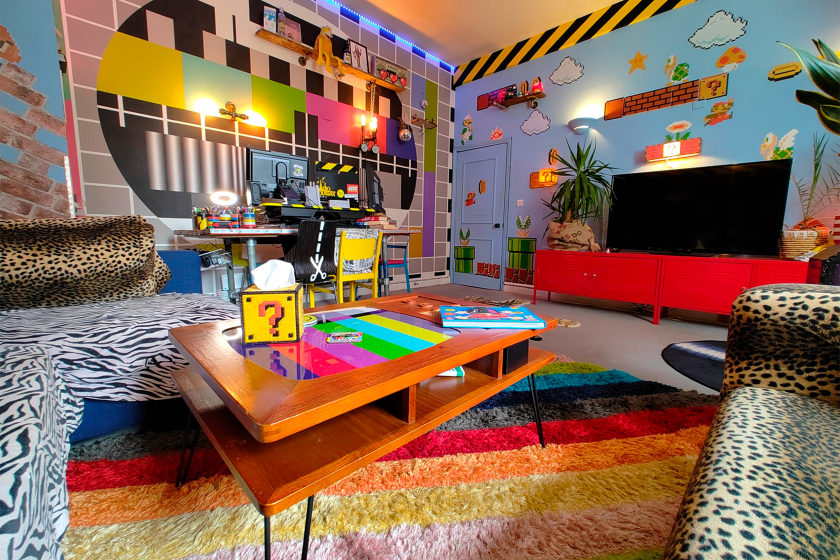
While the rejections piled up, Harry had already been building the portfolio piece that would define his practice: his own Bristol flat. Inspired by Manchester’s Haçienda nightclub, rave culture, and pop art, he painted exposed beams with hazard chevrons, turned a living room wall into a Super Mario level with cheap decals, and built an industrial bathroom from corrugated metal and reclaimed floorboards. None of it, he’s keen to point out, required a serious budget.
“The biggest thing this taught me is that good interiors don’t necessarily come from massive budgets,” he says. “More often they come from experimentation, personality, patience and a willingness to customise things rather than leaving them exactly as they came out the box.”
The flat got picked up by Metro’s property pages and featured on Zoopla’s YouTube channel, where a presenter walked through rooms including a DJ booth, a leopard-print sofa, a fridge disguised as a drinks cabinet and a Mondrian-themed bedroom complete with a ladder running round the walls. It’s the kind of coverage most design graduates would kill for. It changed nothing for his job applications.
That’s the detail that sticks. A flat good enough for national press coverage wasn’t good enough to get him hired. “These features wouldn’t sway any prospective employers,” he says, with the understatement of someone who’s clearly made peace with the absurdity of it.
Turning the rejection into the brief
Acid House Designs now exists because the job market left Harry no other route into the industry he’d retrained for. The studio’s positioning—bold, colour-led, deliberately anti-beige—is basically his old portfolio with a business plan attached. “We’re not interested in looking cool; we’re interested in creating spaces that scream you, your brand, or your business,” reads the pitch. “This studio is for punks, misfits, weirdos and everyone in between.”
There’s a commercial argument underneath the bravado too, and it’s one worth taking seriously if you’re a creative weighing up whether boldness is a liability. Harry points to research suggesting listings with strong design personality can command a price premium of 20 to 60 per cent, and argues that in a market saturated with near-identical Scandi-neutral interiors, distinctiveness has become a competitive advantage.
“If you’re a massive global chain, blending into the background probably doesn’t matter,” he says. “But for independent businesses, boutique hotels, bars, cafés and Airbnbs, being memorable suddenly becomes far more important.”
Key takeaway
What makes this story more than just a nice anecdote is the reframing at its centre of it. Harry doesn’t pretend the rejection didn’t hurt. “It really did give my ego a proper kicking,” he admits. But he also rejected the conclusion that the work itself was wrong. “Maybe my loudness and rule breaking mean there aren’t any design firms where I would fit in,” he reflects. “Maybe that was the problem all along.”
For creatives stuck in a similar bind, that’s a question worth considering yourself. Is the feedback you’re getting about quality, or is it about fit?
Harry’s answer was to stop trying to fit a market that didn’t want what he made, and build a smaller one that does. It’s not a comfortable route, and it’s not available to everyone. But as a case study in what to do when 550 doors close in succession, it’s hard to beat.
Leave a Reply