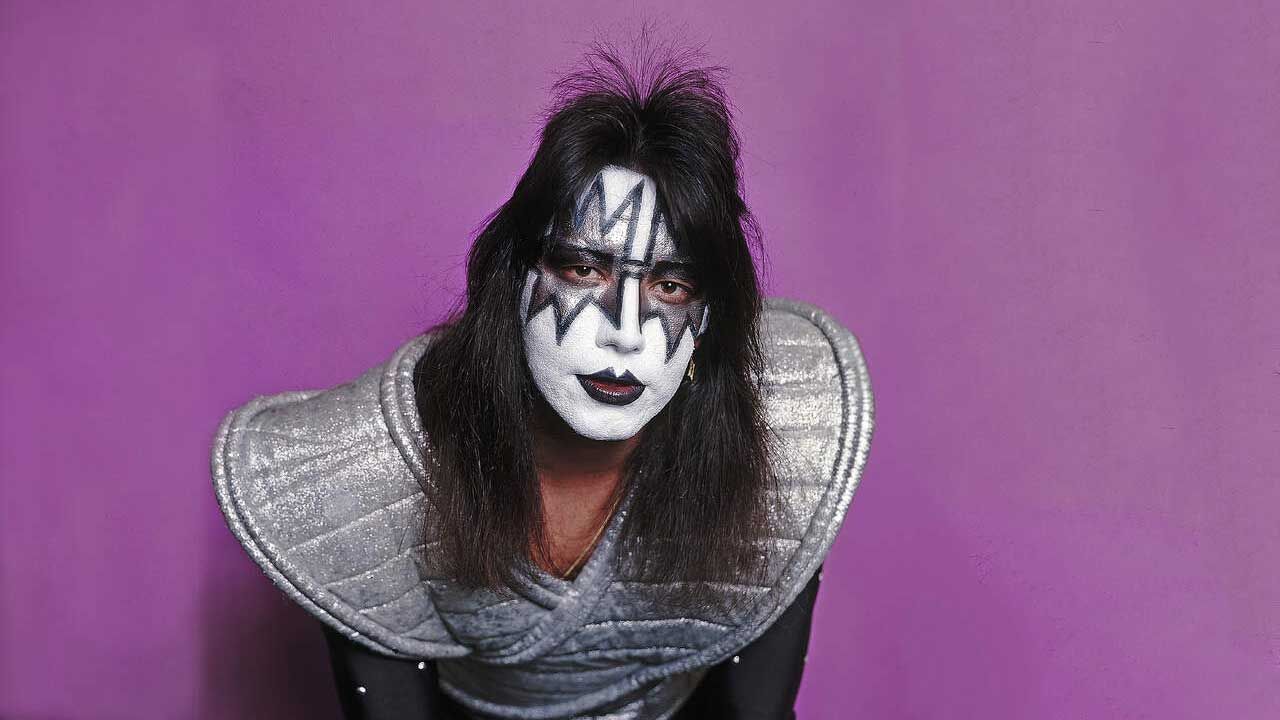
On October 16, 2025, Ace Frehley died after suffering a brain bleed following a fall. It was the second of two tumbles Ace had at his studio as he worked on a new album. He was airlifted to hospital and placed on a ventilator, but passed away several hours later in Morristown, New Jersey. He was 74 years old.
Frehley had two spells with New York-based glam titans Kiss, firstly from their foundation in 1973 until a messy exit circa the Creatures Of The Night album in 1982. He was part of a 1996 reunion of the original line-up, and remained on board for a further six years.
Completely self-taught as a guitarist, Frehley’s style and persona were a massive influence on subsequent generations of rock musicians. On December 7, 2025, when Kiss received Kennedy Center Honors, Frehley was only the third person to receive the honour posthumously.
The guitarist’s relationship with fellow original Kiss members Gene Simmons and Paul Stanley was never an easy one. Frehley liked to have a good time, which often led to butting of heads with teetotal bass player Simmons and rhythm guitarist Stanley, who largely partied in moderation. He was something of a square peg in a round hole, but that’s what made his contribution to Kiss so vital.
All the same, even after Ace belatedly found sobriety in 2006 the pair continued to keep him at arm’s length. And while Simmons insisted that Frehley and co-founding drummer Peter Criss were both invited to attend the band’s final hometown send-off in December 2023, joining them on stage was never going to fly.
Ace prepares to perform at Alex Cooley’s Electric Ballroom on July 18, 1974 in Atlanta, Georgia (Image credit: Tom Hill/WireImage)
Frehley was a hugely talented musician, but he could be his own worst enemy – promoting the solo record that would prove to be his last, 10,000 Volts, he boasted, “My new album is going to make Paul Stanley look like an imbecile”.
From Frehley’s perspective, he had endured a lifetime of humiliation and belittlement from the group’s leaders, and in the autumn of his life he just wouldn’t take it any more.
“In the last few months Paul put me down pretty badly,” Ace told Classic Rock’s Dave Everley. “He even told [shock-jock] Howard Stern that if me and Peter got up on stage with them at Madison Square Garden, you might as well call the band Piss instead of Kiss.”
It was a cheap shot, to be sure, and knowing what Classic Rock does of Stanley, in the cold light of day he probably regretted saying it. But for Frehley this was just another brick in the wall between him and his former partners.
“That [comment] got to me. We ended up having some words,” Ace sighed during the same interview. “But I’m really done with the tit-for-tat.”
In the grand scheme of things, the spat might be dismissed as brotherly rough and tumble, and a full reconnection took place during the final hours of Frehley’s life.
“We are devastated by the passing of Ace Frehley,” said a statement from Simmons and Stanley. “He is and will always be a part of Kiss’s legacy.”
It continued: “In his last moments, we were fortunate enough to have been able to surround him with loving, caring, peaceful words, thoughts, prayers and intentions as he left this earth.
“We cherish all of his finest memories, his laughter, and celebrate his strengths and kindness that he bestowed upon others. The magnitude of his passing is of epic proportions and beyond comprehension. Reflecting on all of his incredible life achievements, Ace’s memory will continue to live on forever!”
Paul Stanley, Peter Criss, Gene Simmons and Ace Frehley pose for the the cover of their self-entitled first album (Image credit: Ginny Winn/Michael Ochs Archives/Getty Images))
The youngest of three children, Paul Daniel Frehley was born in a middle-class area of the Bronx, one of the five boroughs of New York City. The Frehley family lived together in a onebedroom apartment, with Paul and a brother sleeping on a bunk bed in their parents’ bedroom, his sister sleeping on the living-room couch. Money was tight, but there was a lot of love – and music. Everything changed when his dad handed 16-year-old Paul his first instrument.
“It was a cheap, twenty-five-dollar Japanese guitar,” Frehley told to Classic Rock. “Once I hit the E-chord with the volume all the way up on the amp, it was love at first sight; or first hearing or whatever you want to call it.”
While journeying through his earliest bands, Frehley dropped out of high school, and trouble with the NY police was never too far away. “I’d been arrested probably half a dozen times before I was in Kiss,” Ace admitted. “I learned the hard way, but I think it’s helped me in life. You’ve gotta have street smarts to survive.”
It was an advert placed in the Village Voice newspaper that led Frehley to the fledgling Kiss. On January 3, 1973, he famously turned up for his audition wearing mismatched sneakers, but his playing got him the gig.
When the band decided to take on individual stage identities and paint their faces for live shows, Stanley the Starman, Simmons the Demon and Criss the Catman, Frehley’s fascination with science fiction brought him the moniker Space Ace. To make things more fascinating still, Kiss subsequently went to extreme lengths to avoid being photographed without make-up.
Although Kiss’s gonzoid stage show – which involved colourful costumes, and enough pyrotechnics to blow up the Chase Manhattan Bank – brought them cult acclaim, their early records were not successful. A make-or-break last throw of the dice, the double gatefold concert set Alive! not only rescued their career but also began the process of fast-tracking them towards superstardom.
Frehley was loved for his occasional lead vocal tracks like Shock Me, and also for playing a guitar that doubled as a rocket launcher.
At their height of their fame the four band members simultaneously recorded solo albums, all released on September 18, 1978. Debate over their relative merits still rages. But, thanks largely to the cover of the English glitter-rock combo Hello’s hit New York Groove, up against the stylistically diverse releases from Simmons and Criss, Frehley’s Eddie Kramer-produced record sold the best.
“I expected that,” Ace wrote in his 2011 memoir No Regrets. “My goal was to make a really solid, guitar-based album, and I did. Mine outsold the other three albums and produced a top-twenty single.”
Frehley didn’t hold back in criticising Simmons’s album, which included cameos from Donna Summer, Cher and Helen Reddy.
“Helen Reddy? Really Gene? What the fuck?” Ace wrote in his book. “With Gene it was always about making money, advancing and expanding the brand. It was never about art. Never about music.”
(Image credit: Casablanca Records)
Wildly differing responses to the solo records ensured that within Kiss nothing was quite the same again. As the 1980s dawned, drummer Peter Criss was voted out of the line-up, ensuring that Gene and Paul inevitably won any vote over direction. The band cut their hair and changed costumes for the ambitious but dismally received conceptual set Music From ‘The Elder’. An uncomfortable Ace took a back seat, many of his solos rejected.
By the next album, Creatures Of The Night, Kiss were back on track. Their record deal had been re-negotiated, and each member was $20 million richer. Unfortunately, Frehley was ever more self-destructive. “I had lost interest in the band,” he wrote in No Regrets. “My days passed in a blur of drinking and drugging. I knew that if I didn’t leave the group I was going to die.”
Having almost killed himself when he crashed a Porsche, in scenes reminiscent of Smokey And The Bandit, a sky-high Ace was also pursued by cops in his DeLorean for an hour at speeds of up to 90mph, crashing into several other vehicles. The incident inspired a great song called Rock Soldiers for his next project, Frehley’s Comet, but at that point in his life Ace wasn’t in the right shape to be a band leader.
In 1996, with their own career dipping after an era without make-up, even though highly cautious over the probability of the pair’s demons returning, Simmons and Stanley invited Frehley and Criss back on board. Things started encouragingly. The tour was a box-office smash, but Ace and Peter had little to do with a comeback set. This worked in their favour – for the most part Kiss’s Psycho Circus album wasn’t very good.
When flying between cities on tour, Frehley admitted to hollowing out prescribed medication tablets and refilling them with cocaine. Clearly, things couldn’t last. And when Ace arrived with minutes to spare before a gig, tour manager Tommy Thayer was ready in a Spaceman outfit to take the stage in his place. Kiss had a Plan B, in case of disaster.
(Image credit: Jayme Thornton)
Upon completion of their 2001 itinerary, during which Criss had walked away due to ‘contract details’, Kiss installed Thayer as a full-time guitarist, and Frehley was solo again. Perhaps with some justification – previously, during the make-up era, new Kiss band members such as Vinnie Vincent and Eric Carr had been assigned fresh images – it stuck in Ace’s throat that Thayer had a costume the same as his own, and identical make-up.
He found gallows humour in the situation. In a 2008 interview, when a writer pointed out that former Black N’ Blue man Thayer had once played in a Kiss tribute act, Frehley quipped: “He still is”. In another similar conversation, he said: “Paul and Gene have two impostors on stage with them.”
Following several unsuccessful attempts, sobriety changed Frehley’s life completely. “My [AA] sponsor told me: ‘You had to make those mistakes to get to where you are today, and he was right,’” Ace told Classic Rock.
With a clear head and a good woman in his life, Ace entered a fertile era, releasing five albums in a decade.
“I love to write songs, I love to record,” Ace told Classic Rock in 2024. “My fiancée’s got me on a strict diet of organic foods. She’s got me working out, lifting weights and doing push-ups. I’m down to a hundred and seventy-five pounds. I’ve never felt better in my life.”
Certainly, unlike Kiss, at this point retirement was not on his mind.
“I don’t give it any thought,” Frehley insisted. “I will go on till the wheels fall off. Even if I end up in a wheelchair, I can still write songs.”
With typical laser-focused business savvy, Kiss used the second of their farewell New York shows to introduce a new AI-based future for themselves, although Ace saw neither logic nor appeal in turning himself into an avatar.
“That’s not what I’m all about,” he said. “I’m about amps, guitars, singing. As long as I can sing and write and play guitar, the sky’s the limit. I could have two more albums in me. I could have five more. As long as it’s fun, I’ll keep doing it.”
(LouderSound)
Leave a Reply