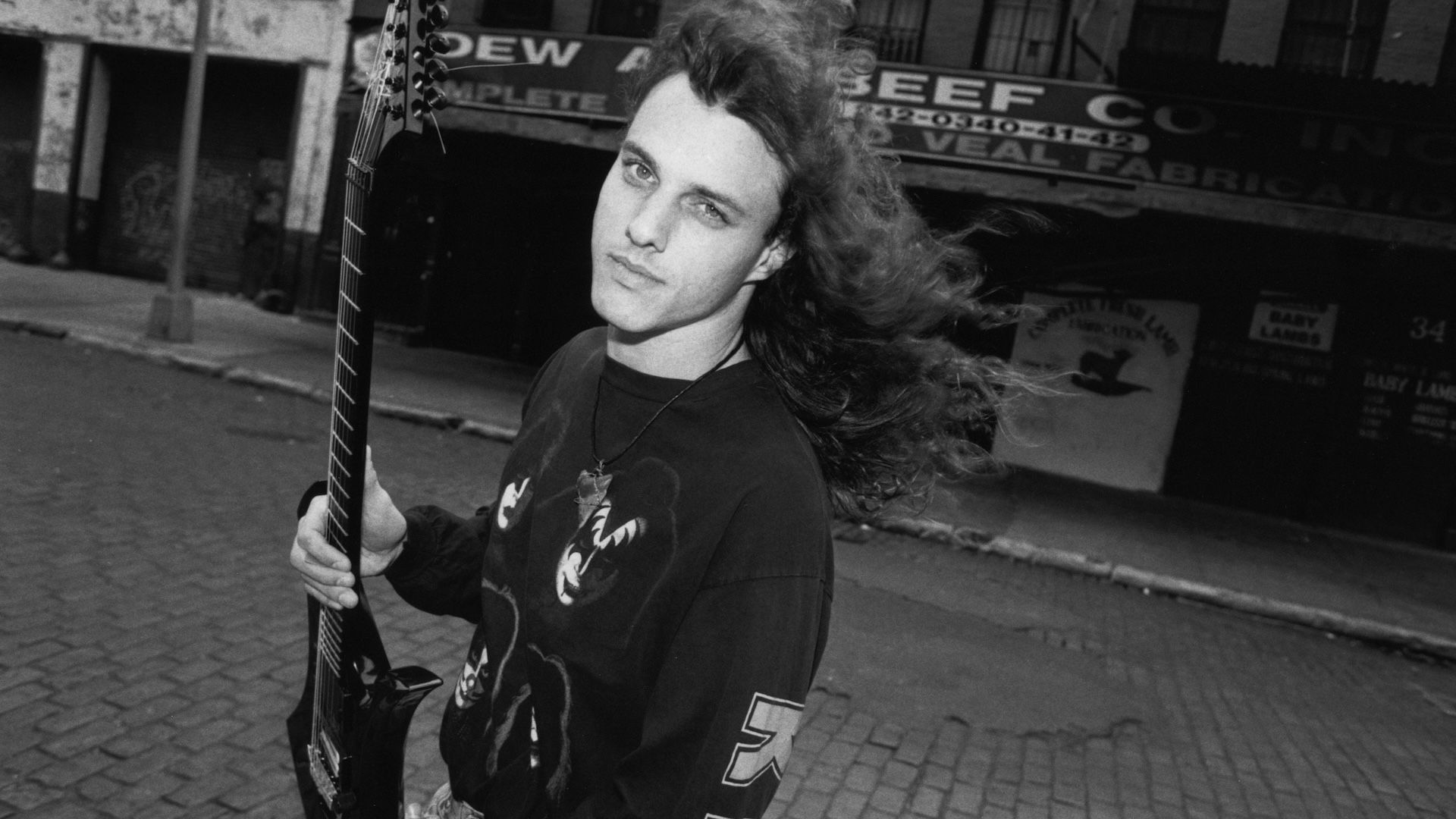
October 1990. On the eve of Kreator‘s two-month-long ‘Torture Over Europe’ tour, Death frontman Chuck Schuldiner pulled out of the shows, citing personal reasons and poor organisation on the promoter’s part.
His bandmates Terry Butler and Bill Andrews, who had been in Death for a few years, intended to honour their contract and recruited Rotting Corpse guitarist Walter Trachsler and Devastation vocalist Louie Carrisalez complete the shows.
The tour kicked off the Espace Culturel Grossemy in Bruay-la-Bussière, France on October 25 and various online comments describe their performances as “ballsy”, “horrible” and “shitty”.
There is no hero’s welcome on their return. After the dates concluded in December, Chuck sacked the pair and took legal action. It probably didn’t help that the temporary touring band were encouraging European crowds to shout “Fuck Chuck!” during their sets.
“A lot went wrong back then,” Chuck told Rock Hard the following year. “It seemed the whole world was turning against me. Still, as the tour was going for three weeks, I tried to come over. However, Bill and Terry weren’t too happy about that. It really hurt me. After all, Death is still my band.
“I really would have loved to come to Europe but at that time I wasn’t able to and those two knew,” he added. “I thought they were my best friends, but I was wrong. At all times, musicians are replaceable, friends are not. I am getting sick and tired of the whole matter. Besides, it bothers me the way people look at musicians. When you’re in a band you are expected not to have any personal problems. You have to be perfect, without mistakes. However, there’s a life outside the band. I’ve been through a lot in the past year and now I hope I’ve learned from it.”
Within six months of Kreator’s dates finishing, Chuck, fuelled by a sense of revenge, hit a prolific streak of songwriting and had already assembled a new band: former Death touring guitarist Paul Masvidal and drummer Sean Reinert, both of Florida prog metallers Cynic, and Sadus bassist Steve DiGiorgio, began rehearsing with a view to recording in Tampa with producer Scott Burns by May.
“I’ve bettered my band and my life in general,” Chuck told Horror Infernal. “I’m working with real people who are very professional, you know what I’m saying? People who don’t put their instruments down for two weeks at a time.”
While rehearsing new material in Miami, the band left their practice space in search of food. In an interview on The Garza Podcast, hosted by Suicide Silence guitarist Chris Garza, Paul says that the four bandmates witnessed the gruesome aftermath of a motorcycle accident.
I’ve bettered my band and my life in general.
Chuck Schuldiner
“We were heading to an area near where my mom lived called Coconut Grove,” Paul explained. “As we were cutting through this road, we saw lights in an empty lot. They were these weird blinking lights, and I said, ‘What are those fucking lights? Those aren’t there. There shouldn’t be lights there.’ We pulled the car over and walked up to the scene, and it was a motorcycle accident. The guy was half alive. The girl was gone.
It was gnarly, straight out of a weird dream. It was a nightmare scene.
“I was like, ‘I’ll stay here,’” he adds. “There were no cell phones, so it was like, ‘Go to a pay phone.’ They drove into the Grove, about a mile from the main area, and went and called the cops and I stayed and just hung out with these bodies with Chuck. I think it was that moment when he [knew] what the album [would be] about. It was a really kind of a raw moment, because it was just a very pivotal, symbolic moment.”
The band’s late manager and lawyer Eric Greif says that, for Chuck, it was a natural progression to move from writing about bloodshed on the band’s earlier albums Scream Bloody Gore and Leprosy.
“He started out striving for what everyone was striving for at the time – horror and gore and brutality,” Eric told Metal Hammer. “He was a kid, he loved those kinds of things. But he eventually started to find the brutality in everyday life.”
“I got fed up with writing about crap monsters,” Chuck said, a little more bluntly. “What’s horrific about that sort of thing? The real evil in this world goes on in society. I’d just reached a time in my life as a person and as a musician when I felt angry enough to write about it.”
Backed by his new band of virtuoso musicians and a new point of view (which he began exploring on 1990’s Spiritual Healing), this rejuvenated version of Death was about to force the genre they helped create to undergo an exciting revolution following the release of Human.
“In some ways, the three of us around Chuck made for a fusion of East Coast meets West Coast sensibilities outside the metal box,” Paul wrote in the liner notes of the 2011 deluxe reissue of the album. “We were steeped in ’70s and ’80s progressive rock, jazz and other eclectic sounds blending with Chuck’s old-school metal leanings to become a groovy hybrid of progressive death metal that was unheard of back then.
“His trademark use of the harmonic minor scale was still intact, along with the classic metal riffing,” he added, “but in seeking out a new breed of musicians, Chuck was getting the best of both worlds by appealing to classic metal heads while maintaining a speed and heaviness for the more extreme metal ear, but also speaking to the more studied listener by introducing a new degree of musicality, aggressive chops and technical prowess.”
The album artwork for Death’s 1991 album, ‘Human’ (Image credit: Relativity Records)
But back then, Chuck was still bristling over his former bandmates. “This is much more than a record to me,” he told Aardschok-Metal Hammer‘s Robert Heeg in 1991. “It is a statement, it’s revenge. I pity them and hope they will be helped some day. The enormous skill on Human in fact is a big ‘fuck off’ to all of them.”
Running at just 34 minutes, Human violently shoved death metal into more intricate, technical territory, showcasing the line-up’s consummate musicianship and lyrics which are far-removed from the zombie splatter and decaying flesh of old. Even the iconic art of Ed Repka was swapped for a more abstract, anatomical piece by René Miville.
I got fed up with writing about crap monsters. What’s horrific about that sort of thing?
Chuck Schuldiner
Songs on Human largely dealt with flawed human minds and the cogs in a society which won’t quite turn properly. Real life is brutal enough and Death’s frontman had clearly been paying attention.
Suicide Machine is an empathetic look at assisted dying and personal autonomy, possibly inspired by the media scrutiny surrounding Jack Kevorkian at the time. The former Michigan pathologist was an advocate for a terminally ill person’s right to die and assisted with the suicide of Janet Adkins, a 54-year-old mother diagnosed with early-onset Alzheimer’s disease, using a crude homemade machine called the ‘Thanatron’ (Greek for ‘death machine’).
Similarly, Lack Of Comprehension is a response to the James Vance vs Judas Priest trial in 1990, where the band were accused of hiding subliminal messages on their 1978 album Stained Class and causing 18-year-old Raymond Belknap to take his own life and the 20-year-old Vance to make an attempt on his. Judge Jerry Whitehead dismissed the case.
The album set Death on a path to following a more technical blueprint for the remainder of the band’s career, concluding with their seventh studio album, The Sound Of Perseverance, in 1998. His progressive metal band, Control Denied, released their debut, The Fragile Art Of Existence, the following year.
“Death is not a limited band where I want the same, simple beat through everything,” said Chuck of his vision for the band. “I’m inspired by a lot of bands that aren’t death metal. I’ve got influences that come from different types of music, different types of metal. To say being technical isn’t allowed in this type of band, I just think that’s a narrow-minded statement. It’s coming from someone who doesn’t understand my direction. They don’t have to like it.
“But if you really wanna get into the reasoning of it, Death isn’t a band that I want to limit.”
In 1999, Chuck was diagnosed with a rare brain stem cancer called pontine glioma. He died in Altamonte Springs, Florida on December 13, 2001 aged 34, leaving behind a profound musical legacy.
(LouderSound)
Leave a Reply