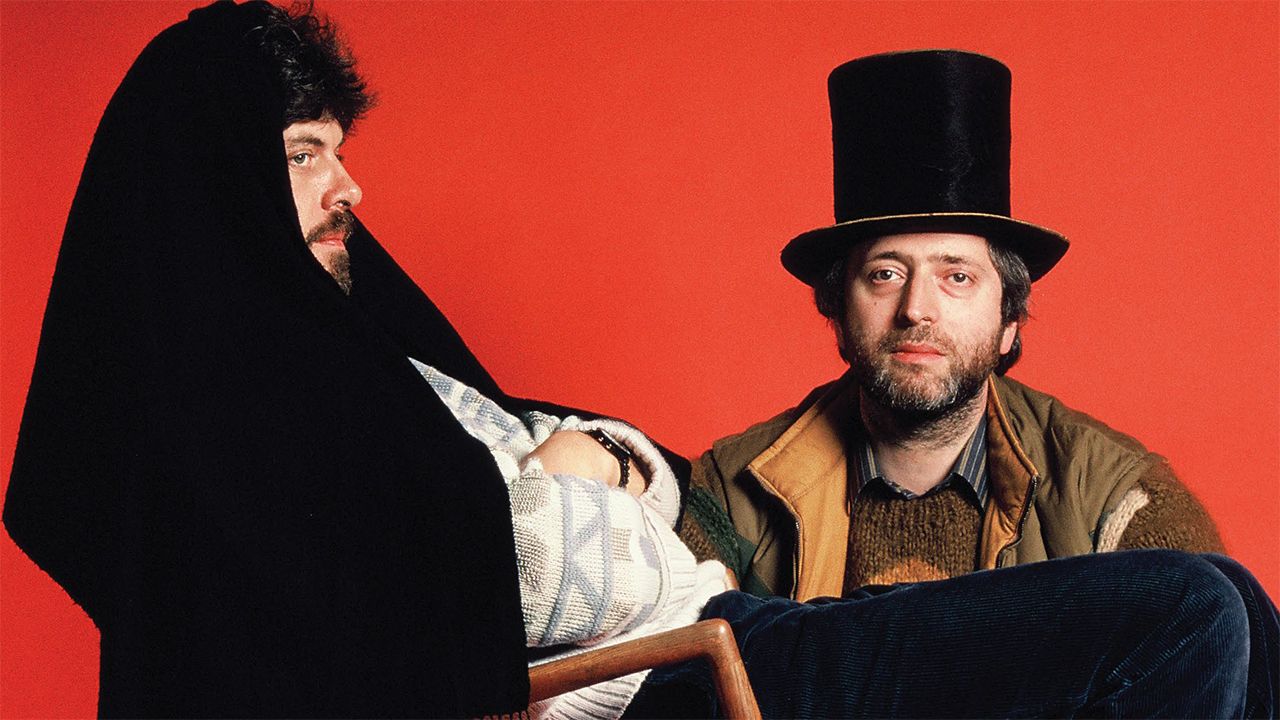
The success story of The Alan Parsons Project is an unlikely one. The duo didn’t look glamorous, they never played live, they wrote progressive, orchestra-heavy suites of music at the height of punk, and hardly anyone knew who they were… and yet they sold 50 million albums. This is how it happened.
Tales Of Mystery And Imagination may not have made the commercial splash that Alan Parsons and Eric Woolfson were hoping for, but a year or two after its release that was all water under the bridge. Why so? Because Clive Davis of the then-new American label Arista offered them a multi-album deal, eventually issuing a run of nine records that took them through the 70s and all the way up to their split in 1990, making the two men highly respected and highly rewarded for the rest of their careers.
At the age of 77, Parsons is as busy as ever touring and recording, winning a Grammy in 2019 for a reissue of the Project’s 1982 album Eye In The Sky and receiving an OBE from Queen Elizabeth II two years later.
Sadly, Woolfson passed away in 2009, but his fruitful post-Project career in musical theatre and his ongoing reputation as a songwriter without parallel continue to give his fans and family great pleasure.
Most songwriters and producers fail to achieve half as much as Parsons and Woolfson did. How did fame and fortune come their way, when they did their best to remain out of the limelight?
The Alan Parsons Project sounded like no other group
Asked why the Project hit such a chord with the public, Parsons reasons: “We succeeded in having an original sound, which I think is unusual, even in the 70s. Tales Of Mystery And Imagination set the theme for the entire future of the Project, establishing a big-sounding style with lots of orchestra.
“We were, I think, unique in that no other band had ever really done that: it didn’t sound like a band; it sounded like a production. I don’t think people visualised a bunch of long-haired rock’n’rollers when they heard our music. What’s more, I’ve always said that our albums could have been recorded in any order. I think they’re reasonably timeless.”
Their guest musicians were the best in their fields
Pilot, who supplied most of the backing tracks for the Project’s songs over their 14-year career, should not be underestimated. They may have only enjoyed one significant hit under their own name – the Parsons- produced Magic from 1974 – but as a backing band, they were flawless, restraining their skills most of the time but capable of endless melodic beauty when required.
As for the guest singers, where do we begin? Over the years the Project benefited immeasurably from the silken larynxes of Allan Clarke and Terry Sylvester of The Hollies, Chris Rainbow of Camel, Clare ‘The Great Gig In The Sky’ Torry, Colin Blunstone of The Zombies, Gary Brooker of Procol Harum, John Miles, Lenny Zakatek of Gonzalez, the actor Peter Straker, Cockney Rebel’s Steve Harley and many others.
The home hi-fi boom
You may remember the precious laminated-wood stereo system that you (or your dad) installed in the living room in the 70s or 80s. Home hi-fi stacks were a massive status symbol back then – Abigail’s Party style – and it’s remarkably easy to take the mickey out of the prestige that people assigned to their £200 Sony or Panasonic amp, turntable, equaliser and, after 1982, CD player.
However, that domestic access to high-fidelity recordings was perfect for music as precision-engineered as that of the Project. A promo film for Philips compact discs featured Woolfson and Parsons in the studio, discussing the benefits of the new medium.
They had serious record company backing
The late Russ Regan of 20th Century Records had vision, but Clive Davis of Arista had vision and a ton of money to invest. Of the former, Ambrosia bassist and fellow Regan signing Joe Puerta reflects: “You have to give Russ credit for having the vision to think that the Project could work. He liked ideas that were a little bit out of the box, and he had a great history for finding talent: he’d signed Elton John and Neil Diamond.
(Image credit: Getty Images)
“But on this one, he was taking a gamble. The fact that he was a small label with a lot of control helped, because it was a spinoff of the film company, so he signed a lot of people that had been forgotten or just not considered.”
And Clive Davis? Any record company exec who had the power to summon Steven Spielberg to a meeting is someone to be reckoned with. As he wrote in his 2013 memoir The Soundtrack Of My Life, the success of the Project’s second album I Robot in 1977 gave him a cunning idea. “I asked for a meeting with Spielberg to discuss the music for Close Encounters Of The Third Kind.
“I played I Robot for Spielberg and [composer John] Williams, set forth all of the group’s credentials, and asked if there was any way we could incorporate their music into the film. Steven and John were very polite and respectful, but of course there was no way in the world it was going to happen.”
Their name sounded like the future
The Alan Parsons Band? The Eric Woolfson Project? The Woolfson-Parsons Collaboration? None of these titles would have worked as well as The Alan Parsons Project, which is a bit unwieldy and sounds a bit like a school science assignment, but has the intended effect of being both enigmatic and scholarly.
As the years passed, Woolfson expressed mixed opinions about the duo’s official title, but he later came to terms with it, reasoning: “The decision to call it The Alan Parsons Project was mine, based on the fact that although the Project was Alan and I, he had a higher visibility in the industry as a result of having worked with major artists such as Pink Floyd and Paul McCartney. In addition, I ran the business affairs of the venture and was the manager of the entity, and I thought it would be better for that reason not to identify myself too prominently.”
Asked about the title today, Parsons acknowledges it as the reason he became a widely known name. “The name ‘Alan Parsons’ didn’t mean anything before that,” he says. “I was just a line of small print on The Dark Side Of The Moon. Did people really know the name of the guy that produced Magic by Pilot, Come Up And See Me by Cockney Rebel and Music by John Miles? I’m not so sure they did. The average record buyer would not have known my name until they heard The Alan Parsons Project.”
They had vision, money, and the vision to spend the money the right way
Drummer Stuart Tosh remembers how had the Project worked: “The mood in the studio was fairly intense, because time is money, and we were trying to get the music down on tape the way Alan and, in particular, Eric wanted it, in as few takes as possible. I can’t remember how many tracks we got done in a day, but I’m sure it was more than one. The general work ethic was, ‘Let’s get on with it.’”
Then again, the musicians played hard as well as worked hard. Parsons: “During the Tales Of Mystery sessions, Eric and I went to Paris. That was not only a great trip because we managed to get hold of Debussy’s original score for The Fall Of The House Of Usher; but we also went to a restaurant called La Tour d’Argent, where we drank a bottle of Château Mouton Rothschild from 1945. Its label was marked with a V for Victory sign because it had been bottled in the last year of World War II. That bottle cost about £75. You’d probably pay £7,500 for it now!”
(Image credit: Getty Images)
Such largesse also extended to the musicians, says Tosh: “Eric was a bit of a wine collector and a very generous man. We used to go up to [chic French restaurant] Keats in Hampstead, where the menu was good, but the wine list was exceptional. Bottles would appear on the table, and just as you were ready to leave, more bottles would appear. We’d get back to Abbey Road not particularly capable of doing anything, let alone singing a backing vocal.”
Their anonymity was an asset, not an obstacle
Why dress like a rock star anyway? Mike Oldfield didn’t, and look what happened to his first album, 1973’s massive Tubular Bells º arguably a kindred spirit to Tales Of Mystery And Imagination in its recipe of studio savant-plus-guests. People knew what Oldfield looked like, though, whereas the average person in the street would be pushed to identify Parsons or Woolfson if you showed them photos.
Parsons notes: “My visual imagery was not particularly important to me or anybody else. We were anonymous artists, and it didn’t matter what we looked like. We were just the names behind the music.” This gave them great freedom. Without an image as such, the Project’s music couldn’t be categorised, and without a category there could be no expectations.
“People knew who they were, and there were pictures of them around, but they didn’t need to look like rock stars for the Project to be a success,” says Sally Woolfson, adding: “The ‘Mystery’ part of the first album title really embodies them. The two of them were a bit of an enigma.”
All of this indicates why demand for APP material remains high after all this time, especially in the surround-sound era. Parsons has remixed several of the albums for Dolby Atmos as part of the reissue series managed by Sally Woolfson; a deluxe box set of Tales appeared in 2016 with comprehensive notes by Prog editor Jerry Ewing; and a 50th-anniversary edition is en route from the Cooking Vinyl label.
But it’s not just prog fans who enjoy the music: the Project transcended its genre decades ago, pulling in listeners from a wider demographic than readers might think. As Sally explains: “I really love the fact that we have a massively increasing younger audience. We’ve doubled our TikTok and Instagram social media figures in recent years, and there’s something like a million new listeners a month. It’s incredible.
Eric’s grandchildren sometimes talk about the Project with their peers, and they’re often astonished that more and more of them say, ‘Oh yeah, I know that.’ Now, I never heard that when I was a child. None of my friends knew about the Project, so the fact that young people do now is very pleasing. Dad would have been over the moon about that.”
Not bad for a pair of blokes who never craved the limelight. Sometimes, it pays to let genius speak for itself.
The Alan Parsons Project book is due for release this autumn via Rocket 88 and it’s available for pre-order now in Classic and Signature editions.
(LouderSound)
Leave a Reply