The illustrator’s crowded scenes are so densely packed and filled with tiny details, stories, hopes and wishes.
Look closely at Saehan Parc’s illustration portfolio and there’s always more going than the first glance lets on. There’s a market stall scene stuffed with dozens of tiny shoppers, baskets and stray cats; or a public bath rendered from directly above, packed edge to edge with bathers in steaming water. There is no white space or gaps left empty – and we love it!
Saehan’s path to where she is today began with a big jump. At 21, she quit art school and moved to France, enrolling at HEAR – the Haute École des Arts du Rhin – to study narrative image-making and printmaking through to 2017. It was a shift from how she’d worked before. “I used to work in digital mostly. Then I learned the fun behind manual work here, which I’m still doing after years.” Not long after graduating, Korean publisher Jjokk Press commissioned her to write and illustrate a 16-page comic. Still finding her footing, Saehan presented her now-signature geometric style for the first time, unsure how it would land. “It surprisingly worked well,” she says, “so it gave me courage to continue.”
Editorial collaborations followed, then a conversation with publisher Editions 2024, who asked if she had a children’s book project in the works. She didn’t – but the question got her started anyway. A month later she had a story and sample pages ready, and Papa Ballon was published in 2021, her first children’s book. Two more followed, Coucou Sommeil and Bibimbap, both now translated beyond France and Korea.
Inspiration for Saehan rarely comes from picture books alone, and there are many nooks and crannies out there which might spark an idea. “Music, movies, art shows, novels, poetry,” she lists, “especially music I think, not only music itself but also the aesthetics of related visuals.” Her process splits depending on the job: commissions go through a rough croquis stage – a rapid, preliminary sketch of a human figure, which is a technique typically used in live drawing – before the final illustration; whereas personal work skips the sketching process altogether. “I don’t have croquis or sketch on paper; I start directly on the line work with normographe, then to the colouring,” she says, using the technical drawing tool to keep her lines precise even without a pencil guide first. “I like playing with this kind of spontaneous process without undoing it when it’s for my own.”
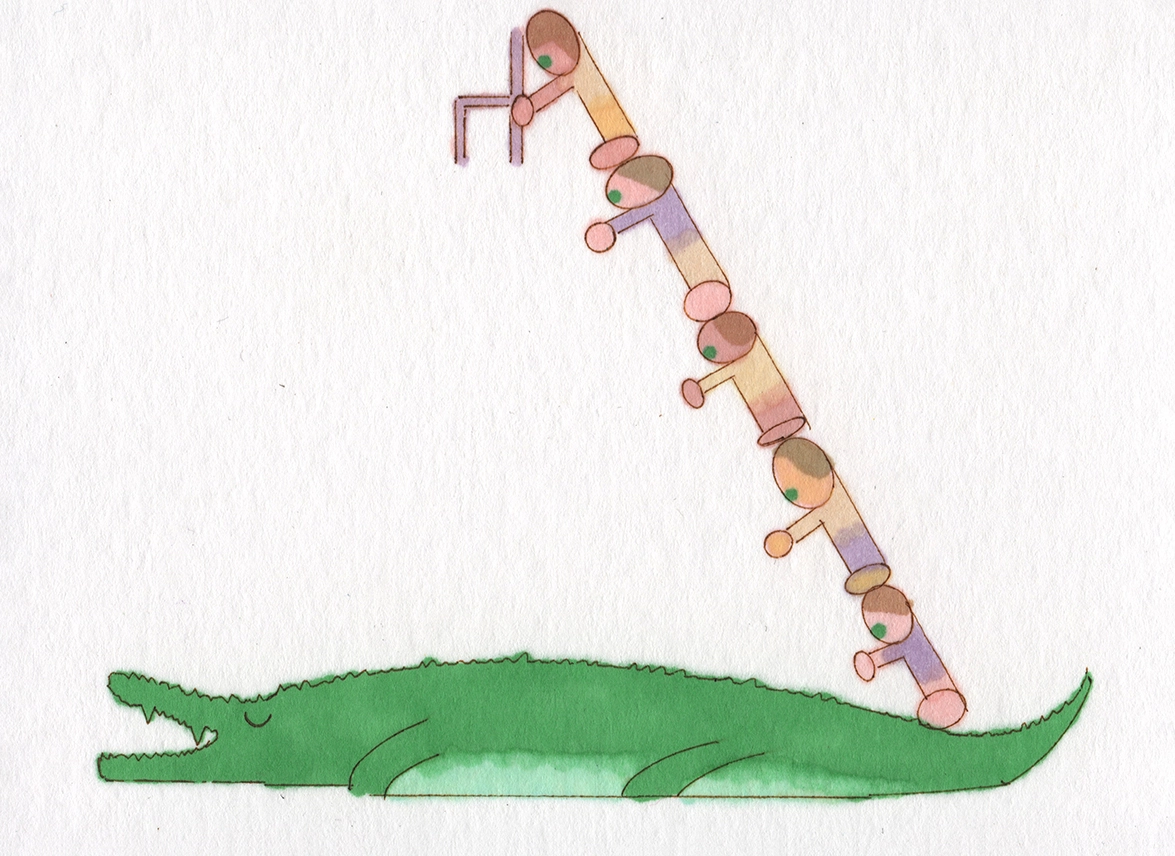
That spontaneity shaped her recent solo show at Cusp Dot in Hangzhou, where two pieces – a crocodile flattened beneath a diagonal stack of tiny figures, and a pair of patterned trouser legs flanked by rows of painted eggs – grew directly out of the structure of Chinese characters. Both are among her favourites from the show, built from that same instinct for pattern and repetition seen across all that she makes.
When asked about how she wants her audience to respond to her work, she says there’s no loaded meaning, especially outside of text-driven children’s books. What she wants is arguably harder to pull off, but not impossible at all: “I hope that it makes the audience want to draw too, because it seems funny. I think I can say that it’s my only wish.”
Leave a Reply