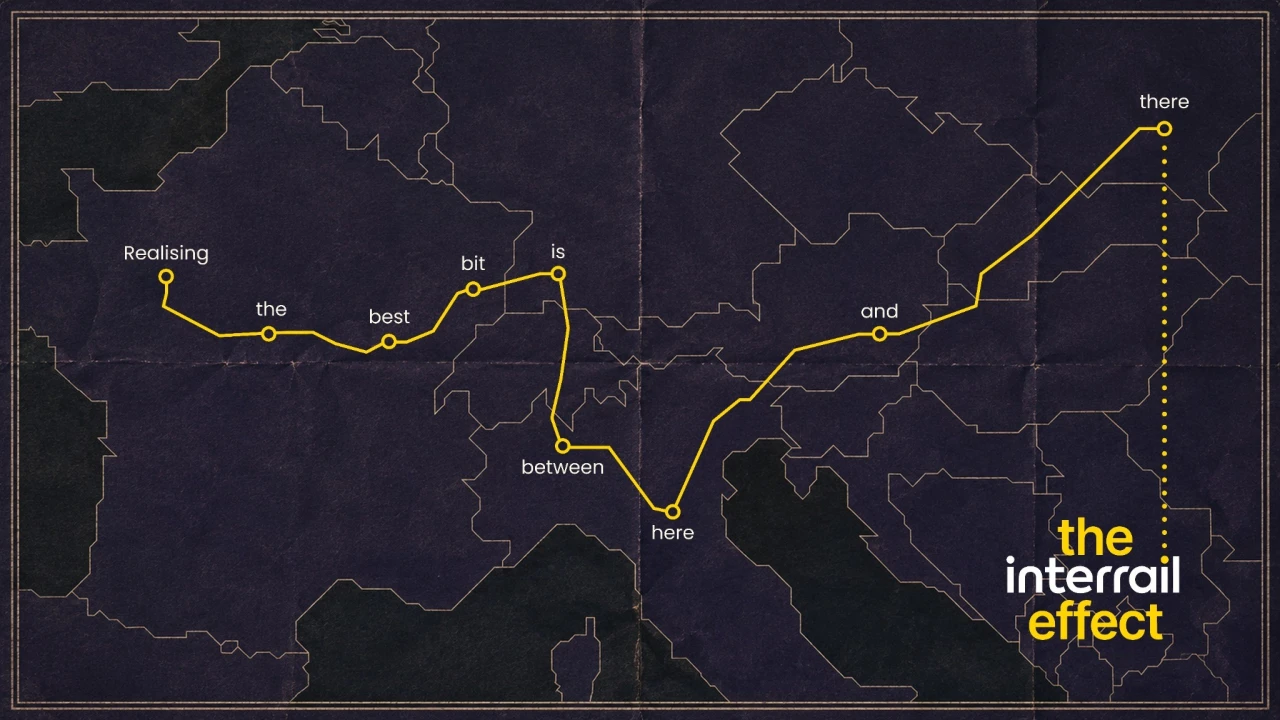
This clever poster turns a sentence into a train journey: a simple but effective design trick, delivered in style.
Let’s be honest, we all know what a travel ad looks like. Beautiful scenery, with not a bulldozer or screaming infant in sight? Check. Catchy yet ultimately bland and empty slogan? Check? Smiling, impossibly attractive people? Check.
Of course, there’s nothing wrong with that. Holidays for most of us are just a welcome break from everyday life, and a little bit of fantasy never did anyone any harm. And I’ve got nothing personally against impossibly attractive people; some of my best friends count among their number.
But if you’re trying to sell consumers on something they wouldn’t normally do, and in fact might be nervous of doing in a foreign country where they don’t speak the lingo, you’ll need to work a little harder.
That’s exactly the challenge that the global brand consultancy We Are Pi, working with social agency Butterfly Effect, were presented with. They were approached by Interrail B.V, the Dutch company behind the European rail travel scheme that makes it cheap and easy to travel across the continent with a special pass.
As well as boosting the scheme, there was also a bit of brand housekeeping to do. Up until this point, Interrail B.V. had two brands for essentially the same rail pass: Interrail for people living in Europe, Eurail for visitors from elsewhere. The latter needed to be folded into the Interrail brand, following the business changing its name from Eurail B.V. to Interrail B.V. earlier in the year.
Better than flying
The campaign indirectly challenges the notion that because flying is quicker, it’s better. Instead, it leans into the idea that the longer journey isn’t an inconvenience; it’s part of the adventure, via a brand concept they’ve dubbed The Interrail Effect.
This was backed up by a customer survey in which around 70% of Interrail customers said their trip changed how they see the world. A similar number considered the experiences more impactful than other types of travel, and around a quarter considered it much more impactful than other holidays they’d taken.
To get this across visually, the launch poster shows a stylised map of Europe. Running across it is a single yellow line representing a train route; only the stops aren’t cities – they’re words. Joining them together gives you the sentence: “Realising the best bit is between here and there.”
It’s a common design trick, but it works because it forces the reader to make a bit of an effort. Had the sentence been instantly legible, it wouldn’t make half as much impact.
There’s a nice extra touch too: the journey doesn’t end with the last word; the line continues, albeit it’s now dotted and straight. It’s a subtle way to evoke the idea of exploring and making it up as you go along, without beating people over the head with the idea.
Creator-led campaign
Another element of the campaign is a series of short video clips made by 30 creators from the US, Canada, Australia and Europe, who were asked to travel across the continent with Interrail over summer and share their experiences.
These clips sit in a comfortable space between standard YouTube shorts and glossy, cinematic films. The former would have been a bit “So what?”, the second would have seemed a bit overblown for a target audience that’s likely to be sleeping in the cheapest hostel. The sweet spot they’ve reached feels, in the words of Goldilocks, just right.
Ultimately, there’s nothing particularly new in this campaign, but at the same time, there didn’t need to be.
As Özlem Birkalan, chief brand and commercial officer at Interrail, puts it: “‘The Interrail Effect’ isn’t something we invented. It’s something travellers have described to us for decades, in their own words, after every journey. What’s changing is that we’re finally building the brand around it. Not around where people travel, but around what travelling like this does to them.”
The campaign launched globally on 10 September in the UK, Australia and the US, and will roll out across a mix of paid, owned and earned channels including paid media, organic social, EDM, partnerships and PR as well as participating creators’ own Instagram, TikTok and other social platforms.
Leave a Reply