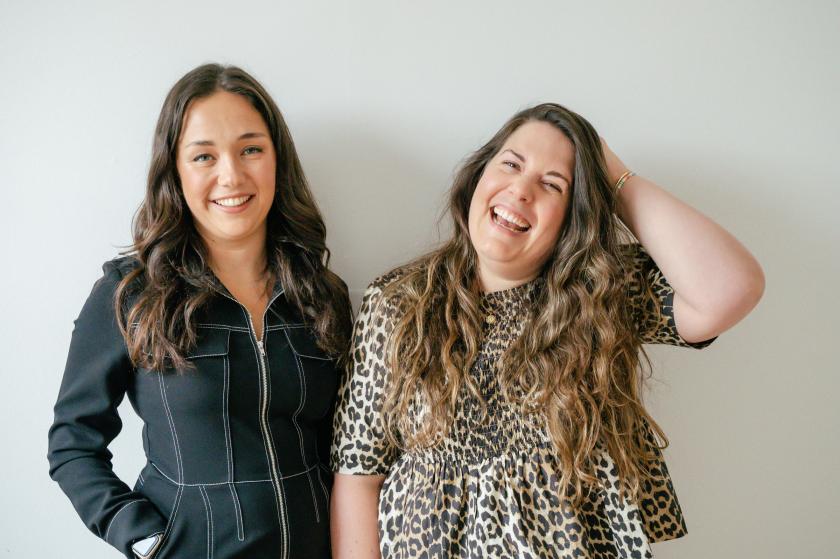
The founders of the branding world’s fastest-growing sisterhood on impostor syndrome, a cheetah called Beyoncé, and why they stopped tiptoeing around their big idea and started shouting.
Picture an awards ceremony in London three years ago. Round tables of ten, and at nearly every one the same arrangement: eight women huddled together, clapping, nervous and excited, sipping a drink while the winners are read out. And then, somehow forming the “head” of each round table, two men on their phones, looking up only when a winning agency is called, at which point they go to collect the trophy and pose for the cameras. Most of those eight women wait back at the table to congratulate them on their return.
“I felt like I was in an episode of Mad Men,” says Tamira Hamden. “And not in a fun, sexy way. Just… awful.” She was there as a client guest, her own brand nominated. What she remembers is the maths of the room. “I was trying to reconcile being 60 years on from when that was set, and having moved barely anywhere.”
That night planted a seed. A couple of years on, it’s grown into Women in Brand – a global community for women in brand strategy, marketing and design that more than 5,000 of them have now joined, with events from Birmingham to Sydney, an annual Summit, a podcast, and a rallying cry printed across the top of the site: “Brand isn’t a boy’s club anymore.” Or, as the founders put it: “We’re not here to beg for a seat. We’re building our own table.”
I sat down with Tamira and her co-founder Victoria Montgomery to find out how you build a brand for brand people (the toughest audience going, surely), what it costs to run a community on top of two full-time jobs, and why they very nearly didn’t.
Whispering, then shouting
For a long time, Women in Brand was an exciting idea they talked about rather than something they actually did. What was holding them back? “Honestly, I wish I had a more interesting answer than ‘perfectionism’,” she says. “Well, maybe I do – maybe I am honest and say what always sits behind perfectionism: fear. Impostor syndrome, our old friend. Why should it be us that built this thing? How could we ever hope to take on something as systemic as representation in an industry which lives and breathes on nepotism and gatekeeping?”
The kick up the backside, as it turned out, came from a complete stranger. The three of them – Victoria, Tamira and Mimi Hayton – met at a branding conference in Lisbon. “Mimi has this incredible way of calling bullshit quite quickly,” Tamira says, “even and especially when the bullshit is our own baggage.” She became their first proof of concept, the validation that there was something here worth building. “We got chatting, she said ‘I’m in, you have to make this happen’.” A few months later, in a café in East Oxford, Mimi sat down with them and sketched out their first roadmap. She’s now their content lead, and their lead for Manchester.
The ‘who’ and the ‘where’
Building something genuinely inclusive meant wrestling with two dilemmas early on: whether to stipulate gender identity at all, and whether being London-centric would reinforce all the wrong ideas about what a brand career has to look like.
Victoria is clear on the first one. “You can’t be everything to everyone, and unfortunately the stats on gender disparity in the creative industries don’t lie,” she says. She and Tamira have had countless conversations, mostly with men, that begin “but why do women even need a community?” – and they’ve got very good at answering it. “But when it feels like you’re fighting an uphill battle in that conversation, you quickly realise: maybe it’s just not for them. And maybe the change can only happen in numbers, with the women who live it and feel it every day, and want to change it for the better.”
The ‘where’ they answered with geography. Events have run in Birmingham, Manchester, York and Sydney, with a virtual platform so the community isn’t only for “those living on the Elizabeth Line”. The guiding principle is that you get out what you put in. Which is why, at Women in Brand, the members are also the teachers and the brand sponsors are as much part of the pack as anyone else.
Victoria knows there’s a tension in building a safe space you have to opt into. “One day we hope to get to a place where women don’t need to feel like they can only be their true selves in these dedicated communities,” she says. “But until then, Women in Brand needs to exist to champion those women and provide the unfair advantage that we’ve been missing for too long.”
From the stage to the strategy deck
Before marketing and brand leadership, Tamira trained as an actor. She’ll tell you it prepared her for every pitch she’s ever landed. “The red thread that connects all of us in strategy is that we’re good storytellers,” she says. “And thank goodness, because there has never been more need for what we do – just ask Anthropic.” Acting, at its foundation, is the practice of communicating clearly and being in the business of generating belief, or at least suspending disbelief. “But more than that, it taught me about empathy, about reading and transmitting nonverbal cues. It taught me a hell of a lot about negotiation and influence. How to read power dynamics, and how to play with them.”
She’s got a bee in her bonnet, too, about how undervalued an arts education is. Much of the industry’s current anxiety, she points out, is about protecting critical thinking in the age of AI… a skill she thinks is being wrongly conflated with criticism and scientific reasoning. “Critical thinking is something you engage with deeply in any creative work: what is happening behind what is seen or read? What choices am I making, and what will their effects be on my audience? It has given me everything – my whole approach to my work. I can’t imagine having done anything else.”
Her half-Palestinian heritage shows up in the build, too. “Existing between cultures is never to feel 100% belonging 100% of the time,” she says, “particularly when one of those cultures is in material threat of being forgotten.” For a long time that “perma-exclusion” was a chip on her shoulder. “I’ve been too white for Arab spaces, too Arab for white spaces.” Now she relishes it. “Belonging is something that can be cultivated within you. It’s a feeling that can multiply when you find your people. And that’s exactly how I hope the community shows up for our pack – particularly for those who have to fight to make themselves heard and to justify why their work matters and why it’s worth investing in. I hope Women in Brand is at least one place that feels like home.”
‘When you are young, they assume you know nothing’
Victoria came to the mission from her own experience of being underestimated. It’s the subject of a Substack piece she titled ‘When you are young, they assume you know nothing’. She landed a senior in-house brand role before she turned 25. Her own team championed her; the problem started the moment she stepped outside it.
“That first glance you receive, where the – usually – white man sizes you up and immediately decides you can’t possibly be beneficial to talk to in the networking break: it still happens now,” she says. She had the thick skin to push through it and do the extra work of “proving” her place in the room. Yet plenty won’t. “I can totally understand why young women are dismissed once and frightened to stick their head above the parapet.”
But she isn’t complaining: “I passionately believe innovative outputs only come from diversity of thought, so your age, gender, cultural, ethnic or economic background should be a powerful differentiator if you’ve got the talent. We all have a responsibility to ensure all those voices are represented at the table – because it’s the right thing to do, and it will produce great work.”
Two founders, one table
So what does each bring that the other doesn’t? “Despite identical personality colour charts, we often come at problems differently,” Victoria says. “Where Tami can be more of a visionary, I can bring more big-picture pragmatism – but those roles flip daily. And fortunately our wobbles surface at different times, so we can be there to support one another. It’s a Taurus x Cancer kind of thing.” What never wobbled, she says, was the long-term vision: to build the home for women in brand who want to learn, meet others, and see a fairer future for the discipline.
The biggest thing they’ve disagreed on? Tamira points to what they did with their first meaningful injection of sponsorship. She wanted to charge ahead and build the online community platform – “our digital version of the old boys’ club” – there and then. Victoria, rightly, worried about running before they could walk, and whether they could keep up with the costs. “I am more of a ‘charge forward and worry about the details later’ type of gal,” Tamira admits. “Told you I was half Arab.” They settled on taking the big swing: a make-or-break year, and see where they land.
“It was a huge amount of trust that she put in me in that moment, and I’m grateful for it,” Tamira says. “And messaging her earlier this year that the community was breaking even for the first time and sustaining its own platform costs… that was a big moment for both of us. It’s a year on from that chat now, and we’re still here.”
A cheetah called Beyoncé
Branding a network for brand people must be the hardest brief imaginable. Everyone’s a critic. So how do you find a voice that survives that audience? “Jesus, it stays tough,” Tamira laughs. “But I can say with my hand on my heart, our voice is our voice. It’s why people who listen to the podcast always comment on how cosy it feels.” She and Victoria are, by their own admission, fangirls. “We genuinely get a buzz from watching people shine. When we say ‘pull up a chair, queen’ – honestly, that might have even been lifted directly from an event. I still have some Liverpool-isms in me from drama school.”
The identity itself is the work of designer Shauni Lane, whom the founders warmly credit for something “sensitive” and “timeless”… built to outlast a single cycle of social media design trends. And yes, there’s a cheetah, and yes, she’s called Beyoncé (“because who else”).
Shauni chose a cheetah, Tamira explains, because cheetahs don’t form hierarchies; the females self-govern and move through the world independently. “We thought it was a beautiful symbol of something rare and against the grain – a little storytelling Easter egg within our brand system.” The unofficial side effect: a brand uniform of cheetah print, and a tendency to “trip and fall into GANNI and Oliver Bonas”.
“We wanted our world to feel sophisticated, not elitist. It had to feel credible, not corporate,” Victoria adds. “A place you can pull up a chair on a Monday at 9, or a Saturday at 12, and feel great about it.”
The response was positive – one particular bit of feedback from an attendee stuck with them: “I felt my shoulders physically drop when I entered the room.”
So how true is “brand isn’t a boys’ club anymore”?
It’s the line on the site – but the founders are the first to admit it’s aspiration, not a done deal. “Sadly, that is a big bold rallying cry, and remains far from true,” Tamira says. She can point to real progress: “We have Cindy Gallop now. We have Zoe Scaman now. Visible women who use their power to affect change, who are doing industry-shaping work alongside it all.” But for every one of those, she reckons, there are ten familiar-looking agencies founded by “the usual suspects”. “I can fill another awards ceremony with the same table plan. So we’re far from there. But they can’t burn us all.”
That mix of clear eyes and refusal to be discouraged runs through everything they’ve built, right up to this year’s Summit at The Old Library in Birmingham in May, with speakers including Ama Hill, Janine Hearn and Oyin Akiniyi, from the likes of Chivas Brothers and Vans. “The two Summits we’ve hosted so far have been the most validating moments in our founder journeys,” Victoria says. “If you’ve not been part of one yet, you should have FOMO.” The point is to geek out on the topics shaping the industry, keep it affordable – “literally 10x less than other industry events” – and keep it authentic, with “no gilets or awkward limp handshakes in sight”.
She realised it was working during a lunch break. The room was buzzing after a panel with sponsor RESISTER and a line-up of Nat Cortazar, Ama Hill and Janine Hearn on building fair creative briefs. “If you’d told Tami and me back in Lisbon in 2023 that we were going to make that happen, we’d have been in awe of ourselves.”
The unglamorous bit
None of this happens on company time. Both founders are building Women in Brand around full-time jobs, and they’re refreshingly open about the cost. “Building a business takes grit and resilience,” Victoria says. “Building a bootstrapped organic community on top of full-time jobs? That’s only possible with a team that unequivocally believes in the idea, passionate early supporters, and lots of iced caffeine.”
Yes, there have been moments they nearly packed it in. “One of the things about being so clear on your mission is the self-sabotage you can do under the guise of ‘we’re not doing this well enough, we aren’t moving fast enough’,” Tamira says. When the “5-to-9 shift” bites, or a sponsorship falls through, or a booked speaker hits a clash, they turn to each other.
She keeps coming back to something a podcast guest, Asmah Mansur-Williams, told them about creating in partnership: “If you want to go fast, go alone. If you want to go far, go with somebody.” As Tamira puts it: “For every crappy unglamorous moment and every new grey hair, about 30 pinch-me WhatsApps are saying ‘can you believe we get to do this?’”
Where they land on AI
AI has been a running theme in their events and end-of-year predictions, so I naturally asked for their thoughts. Victoria is optimistic about what she calls “the renaissance of the in-house brand guardian”. For a while, she says, brand was first out of the door in any budget cut, and a lot of talented women lost roles or burned out. “I’m convinced AI is showing execs that long-term brand protection is crucial as discoverability changes at a rate so fast not even the technofeudalists who built the models can keep up.” LLMs “being built by men for men” bring their own rage, she adds, but she believes this era rewards exactly the quality control, human storytelling and empathy that in-house teams can champion.
Tamira is an optimist too – “a bit of a ‘what’s next?’, Labrador-energy kind of gal” – but she worries about the pipeline. The current chatter about “taste” and great storytelling, she argues, mostly protects those already established in their careers.
“For those starting out, it’s much, much harder. And that disproportionately affects women, because we outnumber men at every level in this industry except when you start looking at leadership and ownership.”
The job of mentors and leaders, she says, is to protect that pipeline and build better pathways in. “We have to be vigilant about how branding gets done, about representation in the rooms we create, and about not cutting corners because it looks easy, cheap and fast.”
For the woman with the talent but not yet the network
So what would they tell an ambitious woman early in her brand career who doesn’t yet have the network? Victoria goes first. “You hold the power to reach whatever career goals you have, and it’s never too early, or too late, to invest in your education and network. Find circles like ours where you’ll be wholeheartedly welcomed and championed. Ask questions and find kindred spirits.” One thing they’ve learned from their own members: there’s no linear path through brand, “which means there are countless possibilities for you”.
Tamira’s advice is shorter. “Find a group of co-conspirators early. Put yourself out there and meet people. It’ll feel weird at first, but you’ll get used to it – and creating in community is one of the last bastions we have against what feels like an inevitable tech onslaught. It’s far from inevitable.”
As for what’s next, it’s expansion, on their own terms: more world-class brand thinking from brilliant women, brought to communities outside the traditional city hubs, online and offline, at a price that doesn’t gatekeep. They want to work with the agencies and brands “brave enough not only to lean into that, but to run towards it”. There’s a dream in there too, only half a joke: WIB Summit x LA, one day.
Given how far they’ve come from that awful night at the awards do in 2023, you wouldn’t bet against them.
Leave a Reply