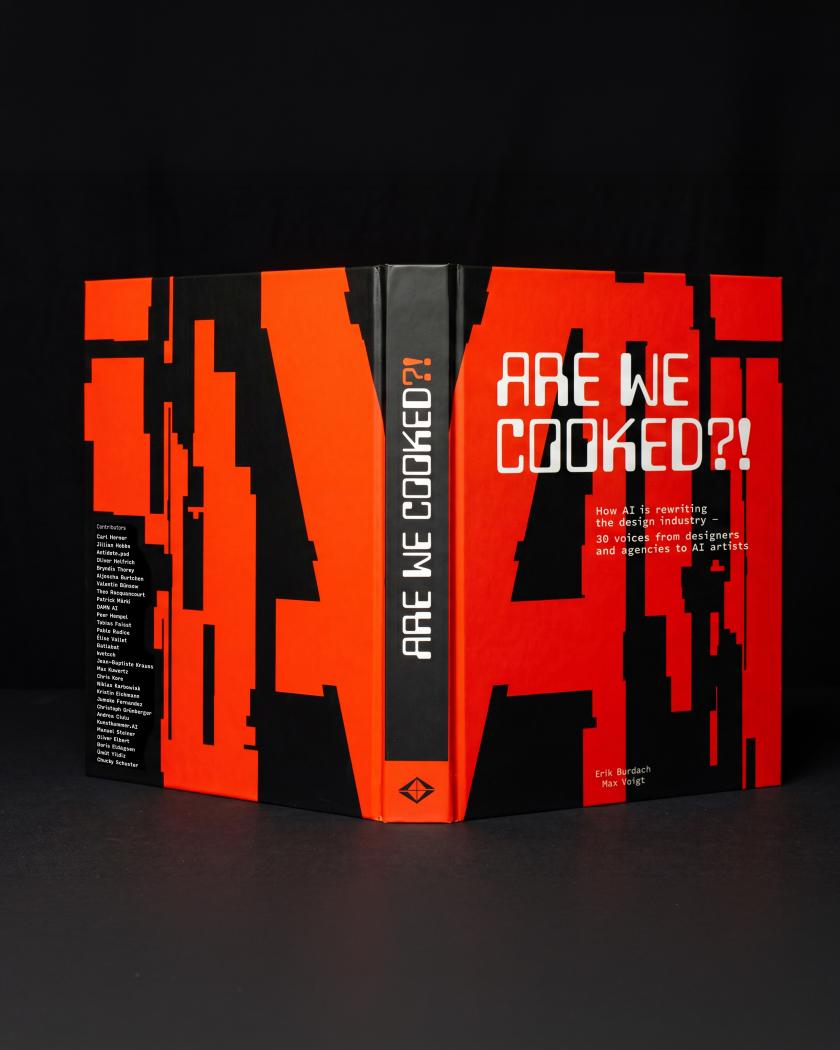
Studio Sprengsatz interviewed nearly 50 designers and agency heads about AI, then turned the best 30 into a book that refuses to give a straight answer.
Every design conference now has its obligatory AI panel, and every panel ends the same way: a moderator asking “so, are we cooked?” and a room full of nervous laughter. Max Voigt and Erik Burdach, two communication designers who graduated from their bachelor’s degree only a few months ago, decided to stop laughing and start asking properly. Their answer to the panel-circuit small talk is a 240-page hardback that takes its title directly from that same nervous joke: Are we cooked?!.
What makes it fascinating isn’t so much the premise as the method. Rather than commissioning a single thinkpiece or interviewing a handful of friendly contacts, Max and Erik conducted nearly 50 interviews with agency leaders, independent artists and AI provocateurs, then whittled the results down to the 30 sharpest.
The contributor list reads like a cross-section of the industry: Kurppa Hosk, Mutabor, KMS TEAM and 27BUCKS sit alongside LVMH, independent voices like Boris Eldagsen and Jumoke Fernandez, and a scattering of studios such as kvetcch and Batlabat. Few books manage to get that many creative professionals to speak candidly and on the record about the thing they’re all super-worried about.
The project began, sensibly enough, as their final university assignment. What turned it into a book was a realisation that will feel familiar to anyone who’s sat through an industry roundtable: every single interviewee wanted to know what everyone else had said.
Senior creative directors with decades of experience were just as hungry for other people’s takes as the graduates asking the questions. That curiosity, more than any grand editorial vision, is what convinced Max and Erik there was an audience for a compiled, cross-referenced set of perspectives rather than another solo opinion piece.
No easy answers
The book’s design leans into that discomfort rather than smoothing it over. Its cover, a jagged red-and-black composition that looks like a corrupted skyline, sets the tone before you’ve read a word: this isn’t a tidy trend report.
Inside, each contributor gets a spread built around a single pull quote, several rounds of rapid-fire questions and, in a nice touch, a mock “file evaluation” readout scoring each subject’s enthusiasm, ambivalence and abstraction level, as though the designers themselves have been run through the very tools they’re being asked about.
Boris Eldagsen, the artist who won and then deliberately forfeited the 2023 Sony World Photography Award to make a point about AI-generated imagery, gets the book’s starkest line: “AI can replace everything that is just ‘good enough’.”
It’s a useful reframe of our anxiety. The question isn’t whether AI can do design; it’s whether most commercial design was ever aiming higher than “good enough” in the first place. Elsewhere, Boris argues that large agencies still have a future precisely because branding was never just image generation. It’s knowledge transfer, client management and understanding a target audience: all the unglamorous groundwork that no prompt can shortcut.
Then there’s Andrea Ciulu, whose contribution is reduced, with admirable editorial nerve, to a single spread and a single line: “Get drunk, AI can’t.” It’s the funniest moment in the book and arguably the most serious one too.
Underneath the joke sits a real argument that recurs across the interviews in less punchy forms: whatever AI eventually gets good at, it won’t be getting good at being human about it. The unplanned tangent, the bad decision made at 1am that somehow becomes the campaign’s best idea, the shared hangover that bonds a creative team… none of that is easily automated, and none of it shows up on a capability benchmark.
Metaphors for AI
One of the book’s cleverer editorial devices is what Max and Erik call the “metaphor radar”, a spread that catalogues how differently their 30 subjects reach for language to describe AI itself. One contributor calls it black magic. Another sees a weak intern who needs everything explained in painstaking detail and still makes mistakes.
Someone else calls it fast food: quick but ultimately unsatisfying. Someone else again calls it a dream machine, or an exoskeleton, or, memorably, the tools of the devil. Boris, typically direct, settles on “enabling technology” and describes the future in one word: uncertain.
That spread alone is worth the price of the book, for anyone who has sat in a client meeting and realised that half the room is using the word “AI” to mean five completely different things. If an industry can’t agree on its own metaphors, it’s no wonder it can’t agree on strategy, and the book is honest enough not to try to force consensus where none exists.
Indeed, that refusal to resolve the tension is the book’s entire ethos. Max and Erik set out to ask questions robust enough to survive the next software update rather than chase whatever tool happens to be trending this quarter, and the interviews reflect that: less “which model did you use?” and more “what is design actually for?”.
A useful kind of discomfort
There’s something reassuring about a book that doesn’t try to sell you a conclusion. Most AI-and-creativity content right now splits into two camps: breathless evangelism or defensive dismissal. Neither is much use to a designer trying to figure out what to actually do on Monday morning.
Are we cooked?!, in contrast, feels like a room full of experienced, thoughtful people disagreeing with each other in public, which is roughly what the industry needs more of and gets far too little of at actual conferences.
Whether the book itself proves prescient hardly matters. Its real value is in capturing a specific, anxious moment through 30 different lenses, at a scale and level of candour that no single panel discussion could match.
Studio Sprengsatz is currently running a Kickstarter campaign for a limited first edition of 500 copies. And that feels about right for a project this specific: not a mass-market verdict on the future of the industry, but a snapshot of what its most interesting practitioners were actually saying to each other, when nobody was performing for a stage.
Leave a Reply