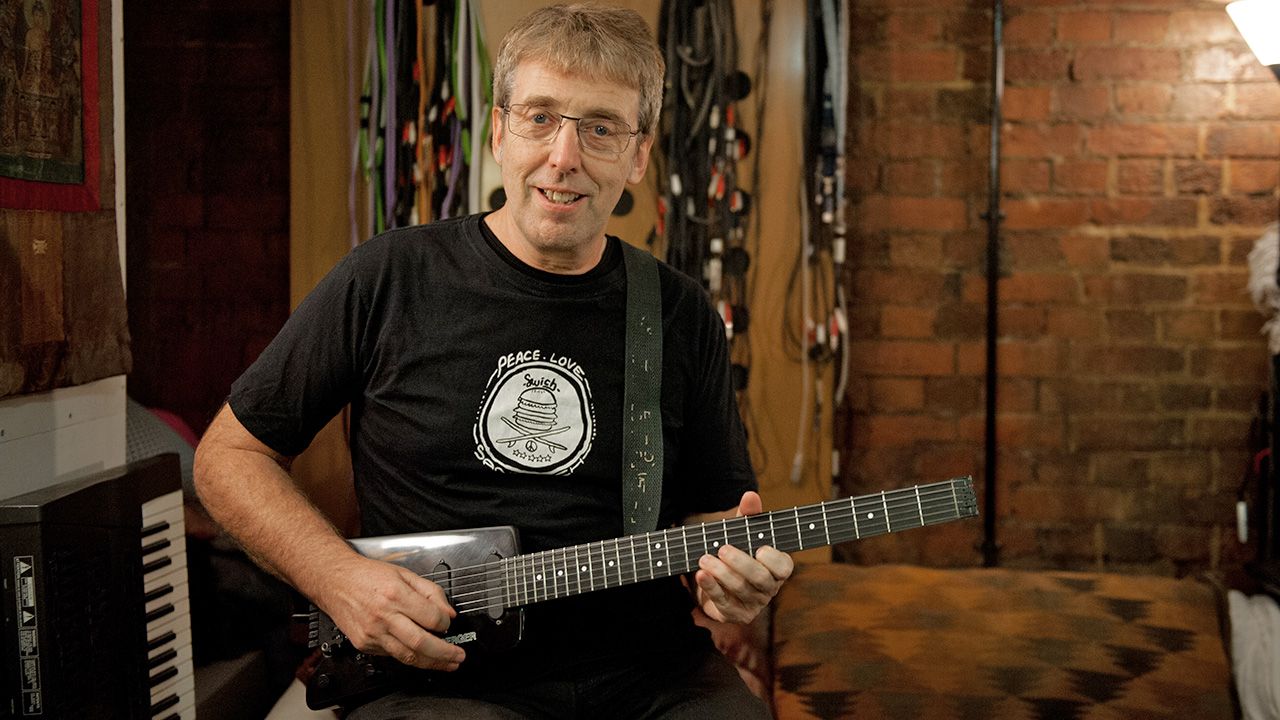
In 2016 Steve Hillage released 22-disc box set Searching For The Spark 1969-1991. It proved the ideal moment to look back on a career that’s included spells with Gong, Khan and System 7, moving from psychedelic prog to dance and ambient music, and producing albums for Tony Banks, It Bites, Simple Minds and others.
You were only in Gong for a relatively short time in your overall career.
It might have been a short time but it felt like an eternity!
How do you look back on that time and albums like 1973’s Angel’s Egg and 1974’s You?
It was a strange and amazing experience. It was completely exhilarating, sometimes exasperating. The band that made Angel’s Egg and You, I’d say, was the best band I’ve ever been in. Ever. It was seven strong individuals, all good at what they did, making the whole greater than the sum of the parts.
What stands out for you from Angel’s Egg?
There are many good bits. Other Side Of The Sky was all one take and us playing live. It was just, you know, wow! In terms of my own playing I’d say there were two pieces – the solo on I Never Glid Before and the solo track I did, Castle In The Clouds. In particular that one was a launch pad for my whole subsequent development in the world of ambient music. Hats off to Daevid Allen, because he put together the order of the tracks and wove the story around it all.
After Gong, were you surprised at the way your solo career took off with 1976’s L album?
I thought L was going to do alright – although I couldn’t quantify what “alright” meant. Then we got the Hyde Park show, another thing that fell out of the blue. Our first gig in front of thousands of people – fucking hell! That was a real baptism by fire.
It really seriously disturbed me, actually. I felt really weird singing my songs about peace and love and there’s fighting in front of me. I tried to berate them over the mic and in the end I just thought, “Fuck it, let’s just finish the set!”
We managed to get through the set and it seemed to go down pretty well. It was a mad experience, but it was very good in terms of timing for the release of the album and that helped enormously. It took off from there.
There’s always been an uplifting quality within your music. Was that something you consciously worked at?
It’s not something you can necessarily work at with a technique, but obviously the whole aim of the game was to create what we might call an “enhanced experience” for the listener. If that’s what you get then we’re happy. It means it’s working. It’s a bit like the modern equivalent of shamanism. When you attune yourself to a certain energy and channel it through what you do with your music – it’s that. Most artists do it, though not all do it consciously. It’s part of art, really.
If you’re making music and you appreciate that aspect of the musical experience, you try to maximise it if you can. We found certain ways we could achieve that. We’re still very much of that orientation in what we do now, although it’s more instrumental-based and more connected to ambient and dance music. We haven’t lost that hunger to go for that aspect.
Has there always been a connection between your music and heightened, euphoric states, such as what’s often encountered at dance gigs?
Yes. That’s very much what led us into the whole dance thing. To a certain extent the dance thing grew up around us. At the end of the 80s we found that to be our musical home. But we never rejected what we’d done before; it was just part of a chronological progression.
On the tour we did for Green in 1978, and the first year we played at Deeply Vale, we had a very interesting experience at a gig in Plymouth. Before we played there was a disco and the DJ had a pre-release copy of Kraftwerk’s The Man-Machine. The audience loved it – they were dancing away. We were kind of gobsmacked.
We tend to associate German psychedelic music with sitting down cross-legged with a big, conical joint. Sancing to it hadn’t really occurred to us! We said, “My God, it’s the future! This stuff’s going to be massive.” We had a kind of ‘eureka!’ moment; we didn’t know what to do with it, but that’s when we had it.
Were you surprised at the way the dance and ambient chillout scene adopted and adapted Rainbow Dome Musick?
When we did it in 1979, for us it was a special project uniquely for that event. We thought it was good and we were very happy with it – we had no real prediction of how it would be viewed 10 or 20 years later.
Posterity isn’t something you’re thinking about when you’re making an album.
The pressure was on to do anotherproggy album like L. But I wanted to move in more of a funk direction with electronics
Not at all. One of my aphorisms is you’re only as good as your last gig or your last album or track or mix or whatever. You’ve got to focus on what you’re doing at the time.
What would you regard as the really pivotal album for you?
Motivation Radio [1977] because that’s where I did a left turn. All the pressure was on me to do another more obviously proggy album like L but I didn’t want to do that. I wanted to move in more of a funk direction with more electronics. I found Malcolm Cecil the perfect producer for that. It didn’t do at all well in America, but it definitely changed things for me.
Are there any of your releases you feel are underrated or haven’t quite got the attention you think they deserve?
It’s very difficult to answer that. They’re all steps along the way. I met Steven Wilson recently and one of his favourite albums of mine is For To Next [1983]. Maybe the sound is a little harsh, but I’m really pleased with the songs and the lyrics on that one. Some of them are a little darkl but they say the same sort of thing as my earlier records in a much more subtle way.
I was writing this stuff at the time of the Falklands War and that had a bad effect on me – all that patriotism. I thought, “This is the pits!” So I was seeing things in a somewhat darker way, although my idealism was undimmed.
If you could go back and speak to your younger self, about to embark on a career as a professional musician, what would you say?
I’ll answer that with something Daevid Allen told me. Soft Machine had the same management as Jimi Hendrix; and one day, Daevid was in the toilet with him at the Speakeasy club. Jimi looked at Daevid and said, “Hey man, stay with your thing, stay with your thing.” So that’s what I’d say to myself: “Stay with your thing!”
(LouderSound)
Leave a Reply