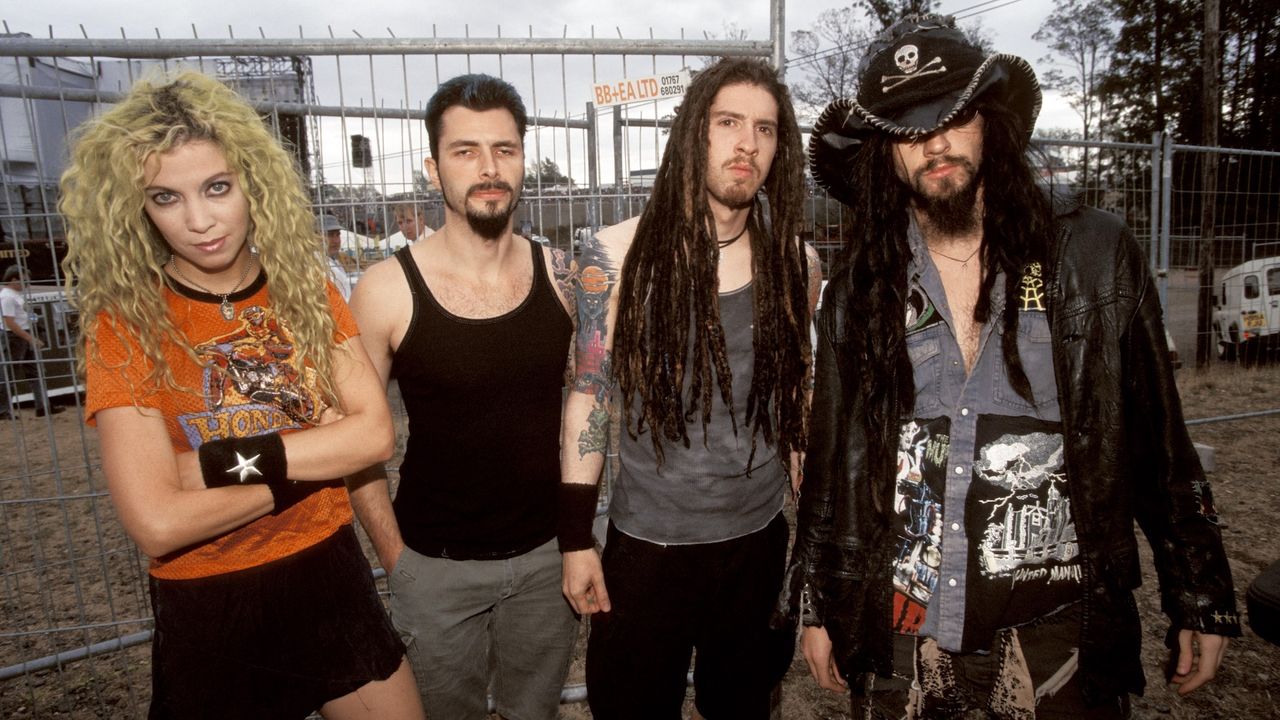
Over the course of three albums, White Zombie gradually left behind their noise rock leanings to become that metal band you could dance to at your local rock club. According to J. Yuenger – their fifth guitarist by 1989 – this evolution wasn’t by accident, either.
“The change in sound and attitude began well before I joined,” Yuenger told Revolver. “When I met them, they were adamant about becoming a ‘real’ metal band. They didn’t want to become more normal, but they did want to be more accessible, to play to a wider audience.”
“I was never happy with just playing at CBGBs in front of 300 people for the rest of our lives,” band co-founder and vocalist Rob Zombie told Metal Hammer. “I had bigger aspirations. I thought, ‘This scene has limitations. We like heavy metal, we look like a metal band, we’ll just beef up our sound and start playing metal shows.’”
That beefed-up sound was fully realised on 1992’s La Sexorcisto: Devil Music Volume One, their third album and first for Geffen. It was recorded in New York City’s 321 Studios with producer Andy Wallace (Slayer, Nirvana) over the course of a month. But with three years between their God of Thunder EP and their major label debut, the band were fully prepared once they entered the Midtown Manhattan recording facility.
“Riffs and riffs and riffs,” remembers bassist Sean Yseult in an interview with VWMusic. “A ton of hard work in Ivan’s [de Prume, drummer] basement non-stop. Suffice it to say, after many years, we had honed our sound and ideas. With Thunder Kiss ’65, J. was over at me and Rob’s apartment, playing the opening rhythm over and over, then after a while, adding those classic descending thirds… it was an ‘aha!’ moment.”
“It was our most normal song. A song that a normal person might enjoy,” Zombie would later tell Rolling Stone. But whether a normal person would appreciate a song featuring a sample of Russ Meyer’s, sexploitation film Faster, Pussycat! Kill! Kill! is anyone’s guess. However, the deceptively simple groove of the four-minute song, coupled with Zombie’s half-snarled, half-grunted B-movie, “motor-psycho nightmare” lyrics, would invoke chaos in whatever venue they played.
“Playing it for the first time, writing as we went along, made it one of the easiest songs we ever worked on together,” Yseult told Gut Feeling‘s Gregory Adams. “Rob had the beat, J. wrote the main riff over it, and I wrote the breakdown in the middle. Seeing audiences react was just incredible. J. would start quietly with the single note, the rhythm, and people would yell, then wait with anticipation. When the drums and bass would kick in at the end of the opening riff, it would be total mayhem! Mosh pit insanity. It was really exciting to watch every night.”
The artwork for White Zombie’s 1992 album, La Sexorcisto: Devil Music Volume One (Image credit: Geffen)
The single was released on March 23, 1992, one week before La Sexorcisto: Devil Music Volume One. Even for a major label signing, it seems that the label had reservations about ploughing even a modest amount of money into a band of metal misfits obsessed with cheaply made horror and science fiction.
“Geffen didn’t even have a budget for us to make a video, while other bands that barely sold a record were getting outrageous sums of money to shoot videos,” Yseult told Adams. “We finally talked them into giving us $15,000 to make the Thunderkiss ‘65 video, which was barely enough to cover the price of the film. Nobody got paid, not even the director.”
Beavis and Butt-head is what kicked it over into the psycho, million-selling thing.
J. Yuenger reflects on La Sexorcisto’s significant bump in album sales
This is not a story where a single catapults the band into fame overnight. White Zombie basically lived in their van, toured the club circuit and sold a very respectable amount of albums the hard way. But thanks to two teenage metal critics in Highland, Texas, the band blew up like that dude’s head on the film Scanners.
“Before Beavis and Butt-head ever put us on their show, we’d sold a quarter of a million records and were doing really well by ourselves,” Yuenger told The Virginian-Pilot in 1995. “Beavis and Butt-head is what kicked it over into the psycho, million-selling thing.”
“Thanks to MTV, thanks to Mike Judge and Beavis And Butt-Head and [Headbangers Ball presenter] Riki Rachtman, we got on heavy rotation,” remembers Yseult. “A lot of people say, ‘Oh my god, you owe your fame to two cartoon characters!’ But they liked the Butthole Surfers, they liked Iggy Pop, they liked us… we were keeping good company, I didn’t mind!”
The single’s success pushed La Sexorcisto: Devil Music Volume One up to number 26 on the US Billboard 200, and remains the band’s most popular song on Spotify with over 173 million plays.
(LouderSound)
Leave a Reply