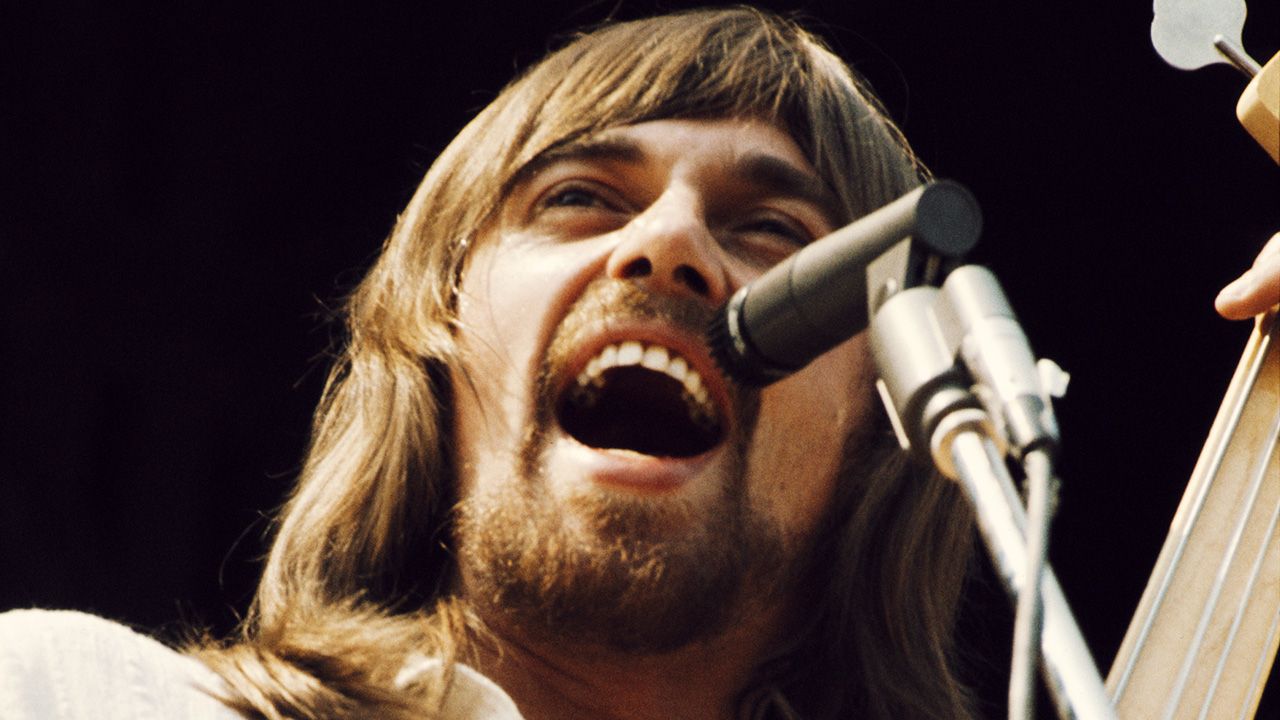
In 1970 Robert Fripp was on the verge of quitting what was left of King Crimson. It looked like third album Lizard had been their last, until vocalist Boz Burrell was hired – and then, by a twist of fate, became their bassist too, as Prog explored in 2021.
Raymond ‘Boz’ Burrell had already made the front page of Melody Maker when he entered the world of King Crimson. The singer had been rumoured to be replacing Roger Daltrey in The Who while the band had been in temporary disarray in 1965.
When Burrell was invited to join Robert Fripp’s band, he found another organisation in disarray. The line-up who’d made 1970’s Lizard was disintegrating, and Fripp – who’d already had to rebuild the band once before – was close to giving up.
“It was so traumatic that at one point Robert couldn’t handle it any more,” saxophonist Mel Collins recalled in 2021. “He told me that if I wanted to carry on with Crimson, I should do the auditioning. All I can remember is Robert giving up completely, saying, ‘There’s no hope.’
“So there I am in this little rehearsal room, auditioning bass players and drummers on my own. As a green saxophone player who didn’t really know the tunes that well, it was unbelievable to be thrown into this situation – but I was hungry to do it. When I think about it now, I can’t imagine how I did it.”
(Image credit: Getty Images)
Once Collins found drummer Ian Wallace, Fripp and lyricist Pete Sinfield saw light at the end of the tunnel. Future Roxy Music vocalist Brian Ferry was tried out but they passed on him, and instead selected Burrell, feeling an instant connection with his performance and character.
He’s come on board as vocalist; but, like his immediate predecessor Gordon Haskell, he’d wind up playing bass too – something he’d never done before. The plan had been for future Steeleye Span member Rick Kemp to be bassist, and early rehearsals went well. The spirit in their underground studio was said to be much more positive and fun than it had earlier been. But after three days Kemp dropped out, feeling the music wasn’t for him.
“That was the lowest point,” Wallace said. “When we got that message, we were all sitting in the basement, and it was pretty much that Crimson wasn’t going to happen. That was it, really; the band was all but finished.”
If one of the bassists who auditioned to replace Kemp hadn’t left his instrument behind, the next stage of development might never have taken place. Burrell picked it up, played a few notes, and that was enough for Fripp to decide they’d found their new low-end provider.
“We had had plenty of competent professional musicians audition, but they didn’t have the feel,” Fripp told NME at the time. “Boz felt the bass parts while he was singing, whereas the musicians could play it but couldn’t feel it. And if he could feel it, it could only be a matter of time before it crept down from his head through his hand and into his fingers.”
After a week of trying it out, King Crimson were go again. They performed a four-day residency in Germany in April 1971, replete with expansive improvisations, then a UK tour the following month where the material was tightened up. Then, as the members felt the need to express themselves with their own music, they began to write what would become fourth album Islands.
It was a key turning point for Crimson, steering the music and vision towards a future that even Fripp doubted they’d had. Yes, he found himself as last man standing when the grouping came to an end with just one album to their name, and there were more mountains to climb in the times ahead. But Burrell’s contribution to the band seemed to provide a lasting source of energy, even if it took Fripp a while to be able to face it.
They really loved Boz. They said he had an amazing groove and an amazing vibe – that he really made those things sing
Jakko Jakszyk
21st-century Crimson lead vocalist Jakko Jakszyk saw Burrell’s line-up perform on that 1971 UK tour. “I love Boz’s voice,” he told Prog. “I know it’s maligned by some of the Crimson aficionados, but I don’t really get that. Both Mel and Ian were incredibly defensive about that; they really loved Boz. They loved his bass playing too, even though it wasn’t overly technical. They said he had an amazing groove and an amazing vibe – that he really made those things sing.”
Jakszyk was delighted when Fripp decided to include material from the Burrell era in the new reincarnation. “I think finally he could hear the music in those pieces. He’d avoided them not so much because he dismissed the value of the material or the content, but because of the hellish memories he has of trying to bring that particular music to life.
(Image credit: Getty Images)
“I think he hated that period for so long because, in his head, it represented this torturous process that he didn’t want to revisit. Obviously remixing it has helped him come to terms with it all; and certainly playing this stuff again has made him re-evaluate it – which is why it was such a joy to do it.”
Burrell, Wallace and Collins joined Alexis Korner’s blues band Snape, before Burrell became a founding member of Bad Company in 1973. He later performed with Alvin Lee and Family’s Roger Chapman, then with Tam White. The Scottish singer was with Burrell in 2006 when he collapsed and died of a heart attack in his Marbella home at the age of 60.
(LouderSound)
Leave a Reply