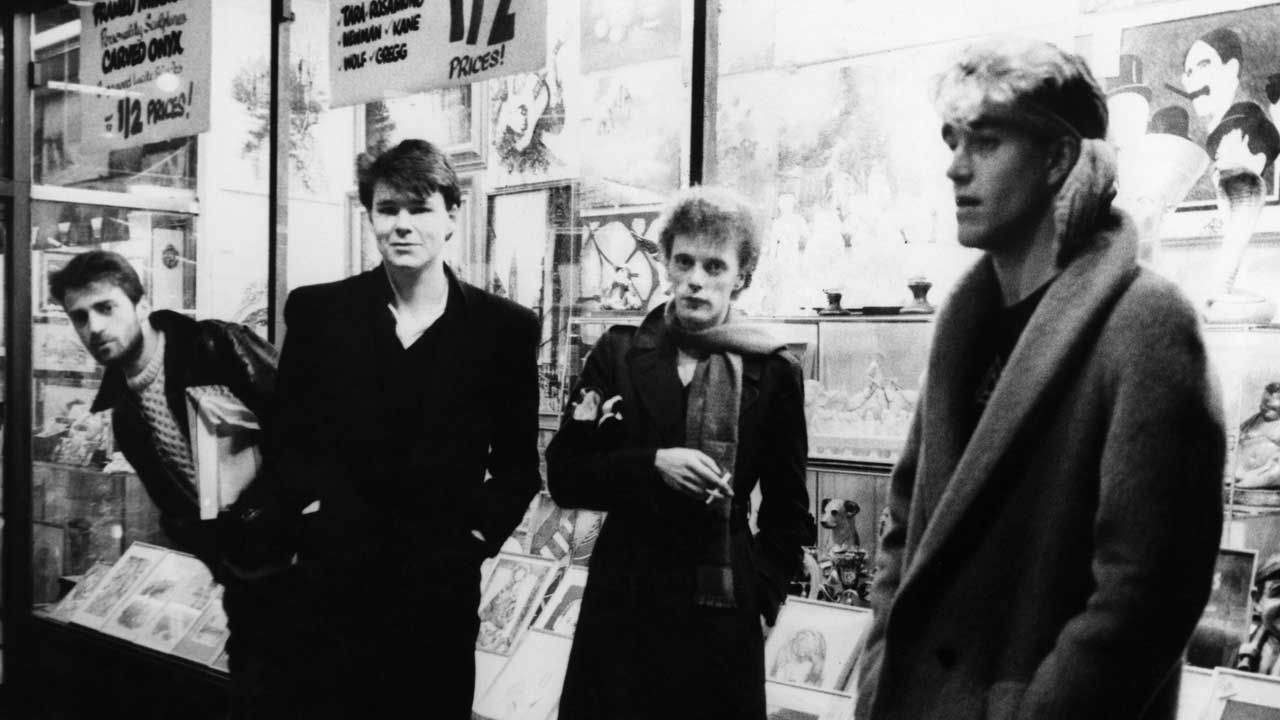
(Image credit: Virgin Records)
Into the Valley
Scared To Dance
Of One Skin
Dossier (Of Fallibility)
Melancholy Soldiers
Hope And Glory
The Saints Are Coming
Six Times
Calling The Tune
Integral Plot
Charles
Scale
Heading south from Scotland to London just as punk became new wave, singer Richard Jobson was still in his teens and late Big Country guitarist Stuart Adamson just 20 when Skids crashed the Top 20 with their 1979 debut Scared To Dance.
Jobson’s more pretentious artpunk leanings have aged rather well, especially the yelping Brechtian waltz-rocker Dossier (Of Fallibility) and discordant, Kraut-ish ear-bashers like Zit.
At the time, the critics hated it. “It had a high production value, and at the time people found that kind of offensive,” Jobson told Classic Rock. “Stuart was influenced by Bill Nelson and Nils Lofgren – that guitar-led thing – and he did guitar solos.”
Adamson’s jagged post-punk guitar style, raw yet disciplined, still resonates more than 40 years later, from U2 to the Manic Street Preachers; indeed, U2 later covered one of the finest tracks here, the impassioned Celtic war cry The Saints Are Coming.
Stream on SpotifyStream on Apple Music
Every week, Album of the Week Club listens to and discusses the album in question, votes on how good it is, and publishes our findings, with the aim of giving people reliable reviews and the wider rock community the chance to contribute.
Other albums released in February 1979
Inflammable Material – Stiff Little FingersFrenzy – Split EnzGeorge Harrison – George HarrisonLive (X Cert) – The StranglersThe Great Rock ‘n’ Roll Swindle – Sex PistolsRickie Lee Jones – Rickie Lee JonesAmbient 1: Music for Airports- Brian EnoBreakfast At Sweethearts – Cold ChiselDon’t Throw Stones – The SportsEnlightened Rogues – The Allman Brothers BandThe Feeding of the 5000- CrassForce Majeure – Tangerine DreamUnder Heaven Over Hell – Streetheart
What they said…
“This debut had some good tunes, courtesy of pre-Big Country Stuart Adamson, like The Saints Are Coming and, of course, the wonderful Into the Valley. Of huge importance to Skids fans is that the CD reissue includes the original live B-side to the latter, TV Stars, a song which will mean nothing to anyone who didn’t grow up watching British television, but a whole heap to those who did.” (AllMusic)
“Using loud guitar and semi-martial drumming for its [The Saints Are Coming] basis, Jobson’s hearty singing sounds like an 18th-century general leading his merry troops down from the hills into glorious battle. Two other standouts on the LP (Into the Valley and Hope And Glory) maintain the style but are different enough to keep things exciting. (Trouser Press)
“There’s something grounding about holding a record like this in your hands – a piece of history that never demanded attention but deserves it. It’s the kind of album that rewards you for coming back to it, the kind that feels different depending on where you are in your life. And maybe that’s the real mark of a classic: not fame, not chart positions, but the ability to speak across decades with the same urgency it had on day one.” (Vinyl Vibes)
What you said…
Philip Qvist: I always felt that Stuart Adamson didn’t get the accolades that he deserved as a guitarist and composer, although I have to be honest and say that I am far more familiar with his work as leader of Big Country, rather than when he was a member of Skids. Yes, I had heard of Skids, and their more familiar songs such as Into The Valley and The Saints Are Coming, but Scared To Dance is a new one to me.
Besides the above songs, I quite enjoyed the title track, Melancholy Soldiers, Scale and Dossiers. The songs do sound alike though, so my interest did wane at times. Richard Jobson was never going to win any Lyricist of the Year awards for this album, but the musicianship makes up for that.
It won’t be an essential addition to my playlist, but it was still a pleasant enough album to listen to, so I will score Scared To Dance a 7. I have been told that The Absolute Game is the band’s best record, so I will give that one a spin as well.
John Davidson: I was 14 when Skids’ single Charles appeared on the turntable at the youth club where my mates and I met up. They were a local band, and my big sister’s flatmate at university went to school with them so they really felt like they were ours.
By the time Scared To Dance came out, they’d already grown in fame and stature, appearing on Top Of The Pops ( the pinnacle of UK youth culture in 1978). Not bad for a group of scrappy youths from mining villages in the industrial heartland of South West Fife (Scotland).
They were teenagers themselves when most of these songs were written, and it shows at times. Simple three-minute pop-punk, but with a secret weapon. Stuart Adamson could play guitar and sounded like no one I’d ever heard before.
Jobson’s lyrics vary from the pretentious to the profound – and don’t miss out on downright daft along the way – but Adamson’s guitar work elevates this above the ordinary, even on the lesser tracks.
Come for Into the Valley and The Saints are Coming, stay for Scared To Dance and Sweet Suburbia, and if nothing else, marvel at the guitar work of Stuart Adamson, who went on to found Big Country and achieve modest mainstream success with his signature guitar style.
Mike Canoe: I live to hear albums like Scared To Dance, a “new to me” album from a scene and time period that I am immensely interested in but haven’t had the chance to fully explore. Apparently I saved Into the Valley to a playlist at some point but, as is often the case, too much music and not enough time and I never circled back to explore more.
I recently read John Robb’s Punk Rock: An Oral History and the Skids get a few mentions. Most notably, Jake Burns, the lead singer of Stiff Little Fingers, notes how they went to see the Skids since the two bands were always getting grouped together and, as Burns put it at the time, “These guys are miles better than us!” Another book, The Alternative Jukebox (and the one that introduced me to Into the Valley) describes the Skids as “a literate guitar band” and, even if they came too late to be true punks, “the Skids’ more open sound came as a breath of fresh air.”
As someone who wasn’t there or even aware of them until much later, these descriptions hit the mark. A talented band that would have been playing some kind of music, the Skids sound better to me than a lot of “anyone can do it” bands that cropped up after the first wave of punk. Stuart Adamson and Richard Jobson strike me as a good songwriting team in addition to being a fascinating guitarist and compelling singer. And they were backed by a strong rhythm section.
This album has quickly become one where my favourite song is the one currently playing, which at the moment is Integral Plot, but could just as easily be Melancholy Soldiers or The Saints are Coming or Charles or the title track or even the non-album singles like Sweet Suburbia (A side) or Open Sound (B-side).
Until recently, I didn’t appreciate UK punk the way that I did the scenes in New York or LA. My loss. Fortunately, it’s easy to make up for lost time and Scared To Dance is a great place to start.
Chris Elliott: The UK new wave pretty much coincided with my pre-teen taping songs from the Top 40 on a Sunday evening. Into the Valley remains as fun as it was then; the rest is fine and reminiscent of a period. The reality is new wave produced a heap of great singles and not many great albums. This fits the description. Not as many hits as the Undertones, not as cool as the Buzzcocks. But it’s fun if forgettable.
It made me nostalgic for a compilation, and the reality is that – bar a few exceptions – a compilation is definitely the best way to approach new wave (and most of the indie pop that followed).
Robby Jackson: A nice hidden gem. They sound like a very talented band forced to play punk. So they did, and even better.
Mark Herrington: 1979, and I bought a few albums, but not this one. It was certainly a year when bands were trying new directions, i.e. Tusk (Fleetwood Mac ) and the many goth, electronic and new wave releases.
This album has its classic moments, but there is also a fair bit of filler. It feels like a melting pot of different styles at times, which sometimes hits the spot and sometimes misses. In particular, there is great guitar, with hints of Big Country to come.
Other bands back then produced better variations on the theme as punk faded and other trends emerged. Overall, it doesn’t really grab me like some of the albums I bought in ‘79 like Overkill, Fear of Music, Replicas, Cool For Cats and Black Rose.
Greg Schwepe: An album and group I had not heard of or heard before…so always something potentially new each week here at the Classic Rock Album Of The Week Club!
I would describe Scared To Dance by The Skids as 53 minutes of melodic punk, if there is such a thing. Enough chugging downstrokes on the guitar to keep my head bobbing the entire time.
This was a good, fun listen with Hope And Glory probably my favourite track. Dossier (Of Failibility) would be the only track I’d skip if I’d listen to the album again (note the “if” there).
Now, about halfway through, I started to remember hearing The Skids mentioned in something I had read. With a little help from Mr Google, I found that member Stuart Adamson would go on to be a part of Big Country, a band I had heard of before and owned a lot of their catalogue at one time. I thought something about that guitar tone sounded a little familiar to me.
7 out of 10 on this one. Was enjoyable when I listened, but not enough to bring me back for a second time.
Final score: 7.31 (29 votes cast, total score 212)
Join the Album Of The Week Club on Facebook to join in. The history of rock, one album at a time.
(LouderSound)
Leave a Reply