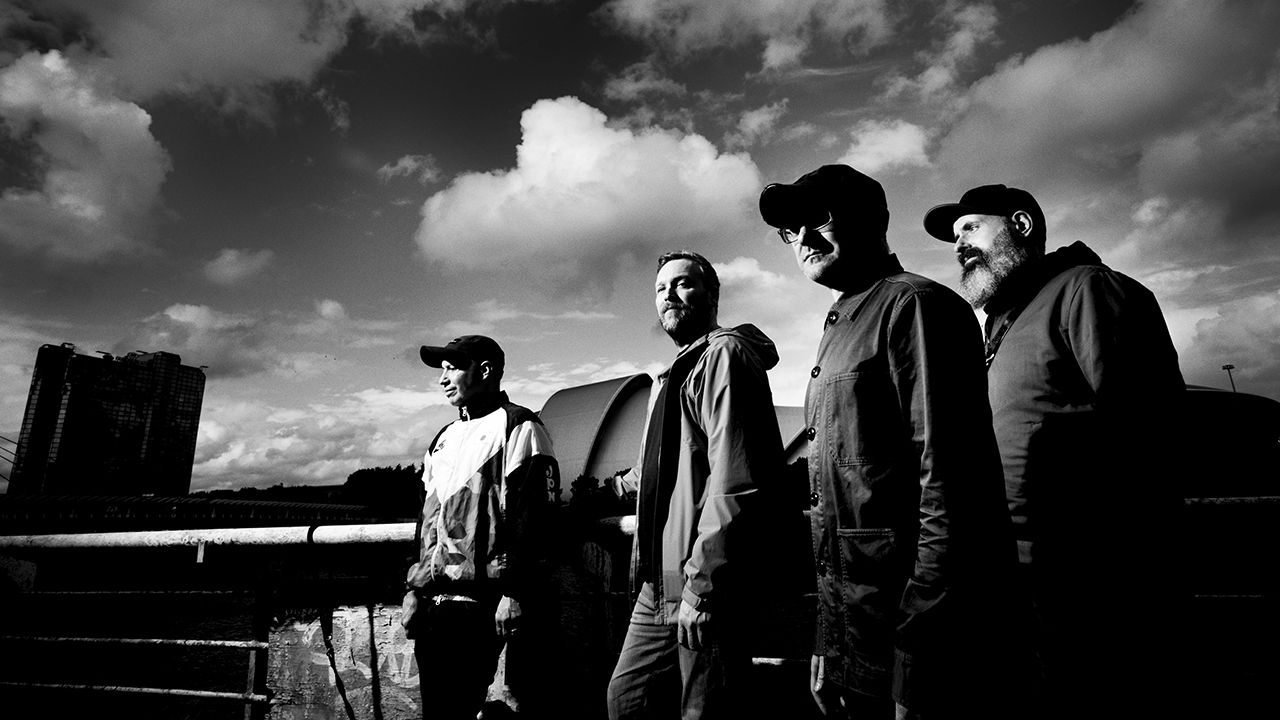
For the uninitiated, Mogwai are a post-rock band from Glasgow of three decades’ standing. They’re masters of the genre and are able to switch from moments of vulnerability to sheets of howling feedback at the stomp of a pedal. They’re probably louder than most bands you could care to mention, and to witness them live is something akin to a religious experience.
We’ve got a feeling that some sections of the metal community have them pigeonholed as a band for 6 Music-loving, coffee-nerd soundtrack collectors, and while they’d be partially right, we can’t help but feel some of you are missing out. And their song titles evoke more than a page of lyrics could.
Here, then, are 10 heavy Mogwai songs for metal fans. You lucky, lucky people.
My Father My King (EP, 2001)
A promotional sticker slapped on this 2001 single (if you could call it that) simply read: “two parts serenity and one part death metal”.
With a running time of 20 minutes and 12 seconds, My Father My King was released six months after their 2001 album Rock Action. Based on a Jewish prayer called ‘Avinu Malkeinu’ – translated as ‘Our Father, Our King’ – the song was something the band had been working on for an album by producer Arthur Baker, which never materialised.
After closing their set with the song for several years, the lengthy instrumental was recorded by Steve Albini over four days at London’s Mayfair Studios. It was the only time they would work with him, and guitarist Stuart Braithwaite paid tribute to the producer following his death in 2024.
“He was a very pleasant person to be in a room with,” he told The Guardian. “He didn’t eat anything apart from chocolate Hobnobs for the entire [time] that it took us to record the song – apparently you can’t get them in the US.”
The sticker’s description of the recording was exactly right. It offers moments of delicacy, hard volume, and gargantuan sheets of squall, and ends on a wave of sludgy distortion. It remains an intense highlight of the Scottish post-rockers’ three-decade-long career.
Like Herod (Mogwai Young Team, 1997)
Originally titled Slint, after the Kentucky band of the same name, this instrumental is guitarist Braithwaite’s favourite song on the band’s 1997 debut album. Recorded as a four-piece in Hamilton, the song wasn’t named after the cruel king prone to acts of biblical violence but something far more uneventful instead.
“Like Herod was something someone misheard when they actually meant to say ‘light-headed’,” he explains.
It’s a post rock masterclass of quiet-loud dynamics and is a staple of their set today. Multi-instrumentalist Barry Burns was yet to join the band at this stage but recalls a moment of shock while listening to the studio recording.
“My ex-girlfriend and I, we used to listen to that album, and Like Herod came on and we were just dozing off to sleep, and then the fucking loud bit comes in,” he remembers. “I didn’t have anything to do with that tune, and when we play it live I just love playing it, it’s so much fun. You see all these people in the front row who have obviously never been to a show before and they get such a fright! I mean, it’s just a noise but it’s really fucking funny… it’s almost like a wind-up.”
Should you wish, an even more intense, 18-minute version can also be found on Government Commissions: BBC Sessions 1996–2003.
Batcat (The Hawk Is Howling, 2008)
Taken from their fantastic album The Hawk is Howling, Batcat is a beast made out of droning riffs, a wall of fuzz, and a particularly hostile performance by drummer Martin Bulloch.
“We haven’t done too many really heavy songs over the years, and this is maybe the best one,” Braithewaite tells The List. “It has a really demented structure and it’s fun to play, it shouldn’t really work but it does. What’s a batcat? I don’t know. People assign their own really profound ideas to our titles, which I really like.”
The video is disturbing, too.
Glasgow Mega-Snake (Mr. Beast, 2006)
“We had this idea to promote Glasgow by genetically modifying a sea-creature and somehow making it into a rollercoaster,” Braithwaite once told this writer. “People will flock to Scotland when it’s made.
“We wrote the song in the hope that we can sell it to Channel 5 when they do The Making of the Mega-Snake programme,” he added. “We’ve got it sewn up.”
Unfortunately, the Glasgow tourism board never pursued this ambitious idea and the programme was never commissioned, which is simply Scotland’s loss.
Song-wise, it’s a dense wall of riffs that attacks your ears – much like what an outsized urban snake would do if it was approached on Sauchiehall Street.
Christmas Steps (Come On Die Young, 1999)
Named after a steep, Grade-II cobbled street in Bristol, this nine-minute instrumental is exactly the sort of song you’d use to illustrate building tension. It begins with a fragile guitar line, which gradually evolves into a staccato riff backed by thunderous drums, before quietly fading out. Their Slint influences are proudly worn on their sleeves here. We wouldn’t be surprised if they wore Spiderland t-shirts in the studio, to be honest.
Old Poisons (Every Country’s Sun, 2017)
Taken from their album Every Country’s Sun, this song began life as a fully fledged electronic demo created by Barry Burns (complete with programmed drums, guitars, and keyboards) which the band then transformed into this woozy, distortion-packed stomper.
“That’s a banger,” Braithwaite told Dazed. “That’s a lot of fun to play. And it’s not too hard for me! I’m not playing a hard bit. I’m not saying I’m some kind of virtuoso, but I can just enjoy the music rather than worry about what my fingers are doing.”
Old Poisons is Mogwai at their most, what’s the thing people say these days? “Aggy”. The song is brooding and bellicose before fading out, only to deliver another round of riffs to your chops.
Sweet Leaf (Do the Rock Boogaloo single, 1998)
In 1999, Mogwai shared a split single with Norfolk indie rockers Magoo, released by Fierce Panda.
The enthusiastic liner notes on this 1998 treat outlined the reasons for featuring two Black Sabbath covers: “The concept is seethingly simple — release two old-school Black Sabbath boogaloos vamooshed by a couple of the swiftiest sonic yooofers around… as we celebrate the darkest riffs, the deepest moods, the longest hair and the richest of foods. Mammoth drums! Massive solos! Huge hairy balls! Yes!”
We’re not sure whose hairy balls they were referring to, but Magoo chose Black Sabbath’s eponymous song from their 1970 debut, while Mogwai picked Sweet Leaf, with Braithwaite performing vocals. It’s loose and performed in the spirit of the original, complete with those hacking coughs.
“I think Black Sabbath are probably the best heavy band of all time,” Braithwaite told The Quietus. “But the thing people forget about Sabbath is that they had a swing. A lot of heavy rock is very rigid and stiff, but Bill Ward and Geezer Butler had this jazz-influenced groove. It’s heavy, but it bounces.”
Ratts of the Capital (Happy Songs for Happy People, 2003)
Making its live debut in Athens, this rodent-themed banger begins with a delicate, hypnotic guitar line. Over the course of eight minutes, it gradually builds into a monolithic wall of feedback, before fading out once more. It’s like being caught at high tide and tossed around in the waves, before being returned to shore. If there were a sound for a moment when there’s not enough time to panic, but you can feel the anxiety trapped in your throat, it would be found here on Happy Songs for Happy People.
We’re No Here (Mr. Beast, 2006)
According to drummer Martin Bulloch, this existential song title was inspired by his brother mishearing a Celtic chant for manager Martin O’Neill. The weight of We’re No Here makes its presence known just before the one-minute mark. It’s slow and hypnotic and even if the volume is down, it still sounds loud. It’s that kind of song. For its sheer heft, the Mr. Beast track was featured on the Miami Vice soundtrack (the 2006 one) and an episode of Top Gear (Season 9 Episode 3’s American Road Trip).
San Pedro (Hardcore Will Never Die, But You Will, 2011)
Whereas songs like My Father My King and Batcat are propped up by riffs built like concrete plinths, this highlight from Hardcore Will Never Die, But You Will is pacy and nervy. It also has quick washes of black metal guitar if Darkthrone hailed from Pollok Country Park rather than those frosty Nordic forests. Former guitarist John Cummings told The Quietus that it was fun to record: “It’s probably the easiest song we’ve ever written. It’s basically just one riff played over and over again with different degrees of volume and panic.”
(LouderSound)
Leave a Reply