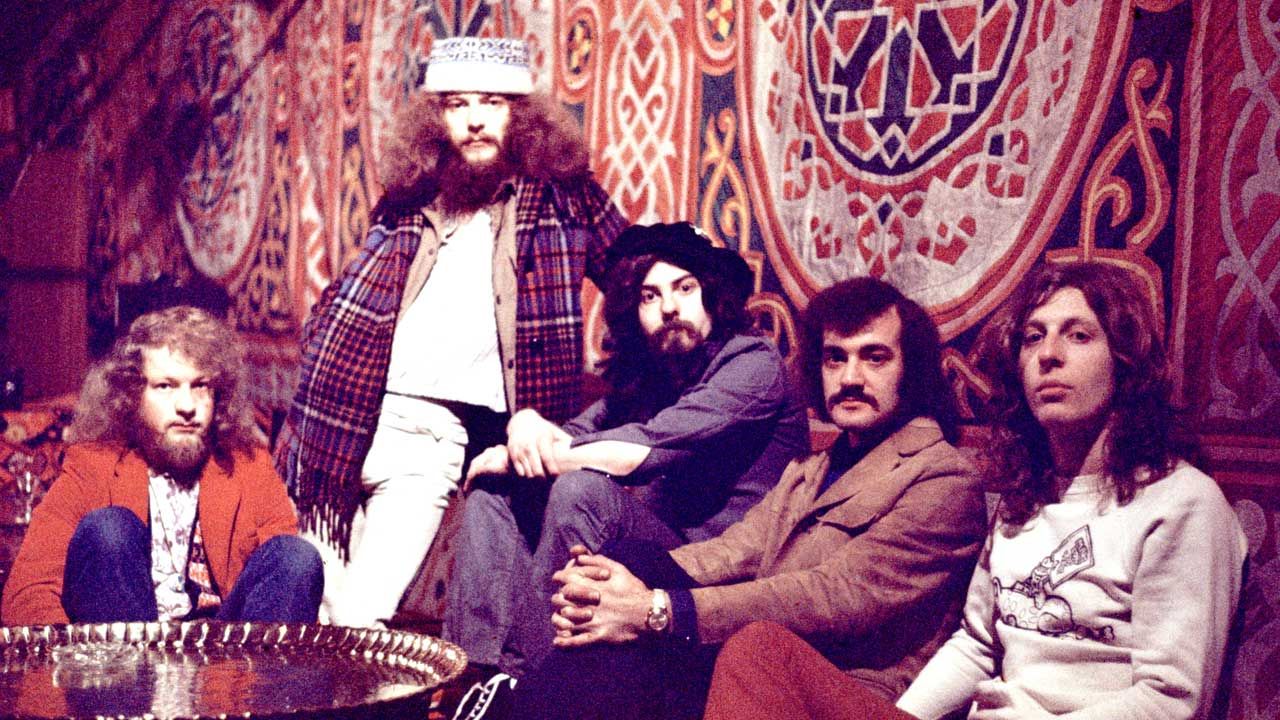
In 1969, Jethro Tull had a Top Three UK single with Living In The Past and also a No.1 album, Stand Up. They hadn’t yet breached the US Top Ten, though, coming close a year later with the folky/experimental Benefit. That accolade would come in 1971 with Aqualung. And what would become Tull’s best-selling album began with one of their best-known riffs.
Ian Anderson recalled that, like much of the album, the title track emerged as a result of the singer-songwriter approach he brought to the project. “That came out of an acoustic jam; you’ve just got to have the imagination to hear that. You have to know that you can make it sing.”
Tull recorded Aqualung at Island Studios in London, and while the final arrangement of the title track explored the many styles they had brought together previously, with folk and rock in the mix, it also had a more metallic edge.
In both tone and theory, the distinctive six-note guitar intro shared much DNA with the doomy, imperious riffs associated with the nascent Black Sabbath, even containing ‘The Devil’s Interval’ itself, the tritone. Indeed, Tony Iommi had briefly been in the band in ‘68, replaced by long-time Tull alumnus Martin Barre.
As well as livening the song with a brilliant solo, Barre brings heft and menace to Anderson’s tale of the heavy-breathing titular homeless person who’s ‘Sitting on a park bench/Eyeing little girls with bad intent’. But as the music broadens out and the album’s prevailing acoustic aesthetic comes into play, Anderson treats the ‘poor old sod’ with some sympathy, as he bends to pick up dog-ends on aching legs.
“Aqualung is a song about homeless people, but more importantly it’s a song about our reaction – those of us that are fortunate enough to have homes, to have a degree of wealth and happiness and family and friends and support,” said Anderson. “It’s about our reaction of guilt, distaste, awkwardness and confusion, all these things that we feel when we’re confronted with the reality of the homeless, whether it’s the slightly Chaplin-esque tramp figure on the Aqualung album or whether it’s a 17-year-old criminal, drug-addicted or working in the sex trade or whatever it might be.”
Anderson has credited his then-wife, photographer Jennie Anderson, with much of the song’s earthy, quasi-Dickensian lyrical content. She had also given him early inspiration by showing him a set of photographs she had taken of homeless men in London while at art school.
At six and a half minutes, Aqualung didn’t lend itself to AM radio play, and never came out as a single. But then Tull were already way past the stage of striving for hit singles.
“It was too long, too episodic,” Anderson said later. “It starts off with a loud guitar and then goes into more laid-back acoustic stuff.”
“Many of the songs mix acoustic and electric moments, in such a way that the album became the blueprint for a lot that’s happened since,” said Barr. “Honestly, I don’t listen to it, except for reference. When you’ve played a song like Aqualung for so long live and very loudly, it’s good to go back and remind yourself what it should sound like.”
Barre’s biggest challenge came in the shape of Led Zeppelin‘s Jimmy Page, who was working on their fourth album in the studio next door, and paid a visit just as Barre was recording his guitar solo.
“We’d locked ourselves away, and I hadn’t seen Jimmy at all,” Barre told Guitar Player in 2015. “Finally he walked into the control room to say hello, just as I was recording the solo to Aqualung. In those days, if you didn’t get a guitar solo in one or two takes, it might become a flute solo. It was, ‘Go in there and do it or else.’
“And here was Jimmy, waving like mad – ‘Hey, Martin!’ – and I’m thinking, ‘I can’t wave back or I’m going to blow the solo!’”
The title track set the tone for Jethro Tull’s most iconic collection of songs, which hit No.7 in the US and No.4 at home. And in 2004, the band revisited it, playing the entire album for a radio audience of just 40 people in Washington, DC. Aqualing Live was released the following year, with royalties going to appropriate homeless charities.
More than a decade later, Anderson recorded a new version of the song, entitled Aquafugue, with the UK’s Carducci Quartet. Released on the 2017 album Jethro Tull: The String Quartets, it featured Anderson playing Barre’s iconic six-note riff on his famous flute, an instrument that hadn’t appeared on the original.
“The idea of having the string quartet play it as a fugue to introduce it and then to kind of get into the obvious payoff rendition that the fans would recognise was a little bit of arts meets crafts,” Anderson told Songfacts. “I think you’ve got to try and balance it up so that it’s not all too clever. You’ve got to mix it up a little bit.”
Along with Living In The Past and Locomotive Breath, Aqualung remains one of Jethro Tull’s essential musical moments, as well as one of the all-time great prog anthems.
(LouderSound)
Leave a Reply