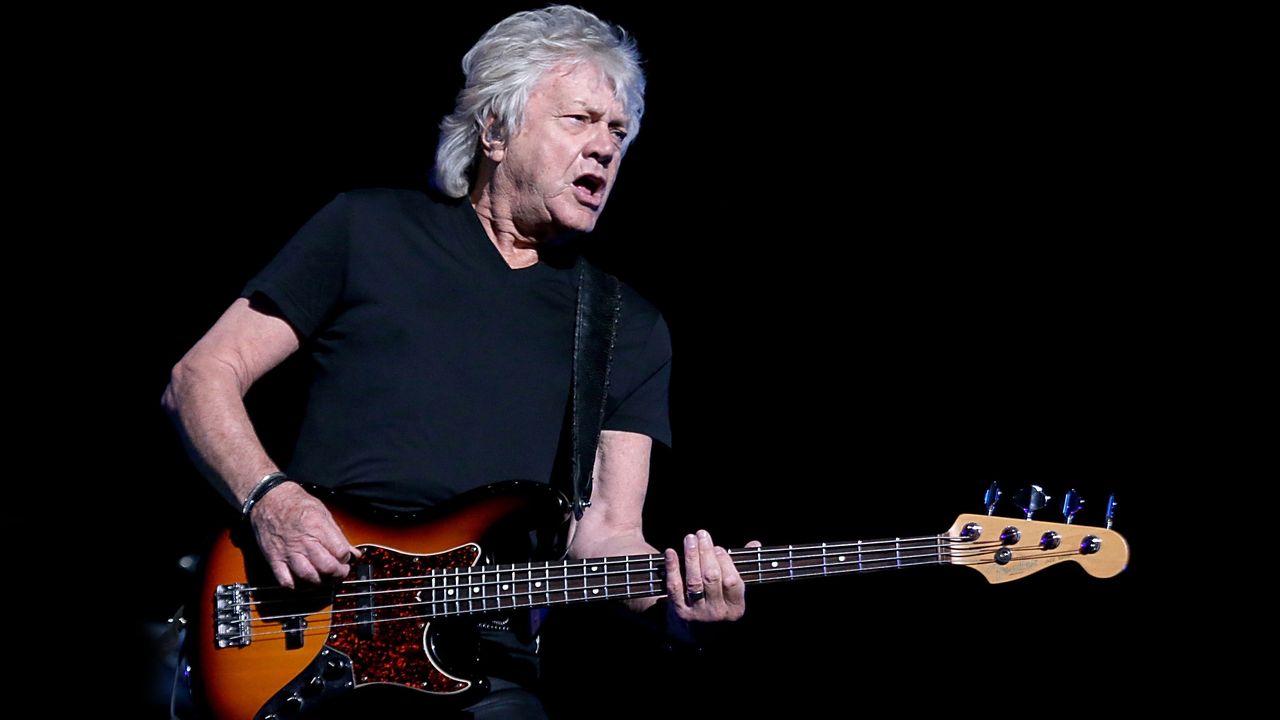
As long-serving co-vocalist and bassist with The Moody Blues, John Lodge helped keep the Moodies’ flame burning even after the band had stopped touring. Born on July 20, 1943, his distinctive falsetto harmonies and bass-playing helped shape the band’s iconic sound and cement their status. In addition to gigging right up to his unexpected death in October 2025 at the age of 82, he also released a handful of solo albums, including his 2023 updated version of Days Of Future Passed, which was praised by critics and fans alike.
Right to the very end, John Lodge, The Moody Blues’ bassist, co-vocalist and songwriter never lost his passion or drive for playing and recording music. “I play music every day,” he told this writer in 2024. “I’ve loved it since it took hold of me when I was 13. And I love writing songs and discovering something new all the while.”
It was precisely that sense of wonder and exploration, coupled with a technical finesse and melodic flair, that propelled Lodge from his earliest musical beginnings until his final days. And in anchoring The Moody Blues for 50 years, he helped the band become one of prog rock’s most pioneering, enduring and biggest-selling forces. His bass playing was never just about rhythm; it carried a tunefulness and emotion that set him apart from so many of his contemporaries.
Lodge’s story began in Erdington, Birmingham, where he was born on July 20, 1943 to working-class parents, Olive and Charles. While there were no instruments, gramophone or sign of Lodge’s future talents, his musical curiosity was piqued when his uncle made him a cat’s-whisker crystal radio just at the moment when electrifying new sounds came sweeping from across the Atlantic.
“My first real musical encounter was rock’n’roll on Radio Luxembourg 208,” he recalled. It was through that crackling static that a lifetime’s obsession began as Buddy Holly, Little Richard and Jerry Lee Lewis took up residence in the young Lodge’s imagination. By his early teens, his fascination evolved into active experimentation. During lunch breaks from Central Grammar School, he would sit in Eddie’s Café listening to those same artists belting out of a Rock-Ola jukebox.
Fascinated with the left-hand lines of the rock’n’roll pianists that he heard, he began translating them to the bottom four strings of his acoustic guitar – and so unwittingly developing the distinctive and melodic style that would come to define his playing.
But it was at a performance by local act The Tremors that Lodge experienced the revelation that would change his life – the sight of a real electric bass. Soon after, he made his way to Jack Woodruff’s music shop in Birmingham and bought a Tuxedo bass, which soon gave way to the sunburst Fender Precision bass that underpinned many of The Moody Blues’ most celebrated recordings.
His path to The Moody Blues was set in motion in the early 60s. Joining El Riot And The Rebels, he formed lifelong friendships with future Moodies bandmates Roy Thomas and Mike Pinder, while the band cut their teeth in a fiercely competitive local scene that also included The Spencer Davis Group and various factions of The Move such as Carl Wayne And The Vikings.
Though he turned down an offer of turning pro by joining The Moody Blues in favour of continuing his mechanical engineering studies at the Birmingham College Of Advanced Technology, Lodge never stopped playing, honing his craft with a variety of local bands.
In the wake of The Moody Blues’ struggle to follow the global success of their 1964 hit Go Now and the lukewarm response to their debut album The Magnificent Moodies the following year, the band began to lose momentum. Disheartened by their inability to recapture that early success, singer-guitarist Denny Laine and bassist Clint Warwick both left. It was then that Lodge – along with singer-guitarist Justin Hayward – accepted the invitation to join, marking the beginning of a bold new era for The Moody Blues.
After famously being told that they were the “worst fucking band in the world” by a disgruntled audience member after a show in Stockton, the band set about reinventing themselves. Recognising their core sparks of four voices, Hayward’s acoustic guitar, Thomas’ flute, Lodge’s melodic bass playing, Graeme Edge’s drumming and a desire to write their own material, their new direction was cemented with the introduction of Mike Pinder’s strange new tape-based keyboard, the Mellotron.
While many commentators have, over the years, cited that as the band’s secret weapon, it was the combination of these elements that truly created the magic for which the band became known. As Lodge later noted, regardless of who wrote a particular song, it would become a Moody Blues number by virtue of the individual members’ contributions in bringing it to life.
We weren’t thinking about being pioneers. We were just young and couldn’t believe our luck recording our own music
John Lodge
In 1967 that alchemy came into its own. When Decca asked them to fuse Dvořák’s New World Symphony with pop for their new Deram imprint – a label set up to show off the company’s advances in sound fidelity – the band saw their moment. Instead of following orders, they filled the studio with their own songs, resulting in their groundbreaking second album Days Of Future Passed. It’s widely acknowledged as one of the very first progressive rock albums.
“We weren’t thinking about being pioneers,” Lodge recalled. “We were just young and couldn’t believe our luck recording our own music.”
His early compositions were small in number but big in impact. His main writing credit on the album – the urgent, propulsive Lunch Break: Peak Hour – hinted at the energy and invention he’d soon bring to the band’s sound. He wasn’t content to simply hold down the bottom end. Treating the instrument as a melodic engine, he soon established himself as one of the true bass innovators of the era.
Graeme Edge, Ray Thomas, John Lodge, Mike Pinder and Justin Hayward in 1971 (Image credit: Getty Images)
His approach came fully into focus with Ride My See-Saw (1968), a song whose surging energy often brought their concerts to a euphoric close. By the following year, on Eyes Of A Child, Candle Of Life and Send Me No Wine, Lodge had broadened his palette as a songwriter, while keeping his bass lines rooted at the heart of his sound. And as his confidence grew, so did his voice – either blending harmonies or taking the spotlight – to stand with Hayward not as a foil, but as a true counterpart.
Fuelled by a combination of youthful exuberance and a formidable creative drive, The Moody Blues released three albums in short order – In Search Of The Lost Chord (1968), On The Threshold Of A Dream and To Our Children’s Children’s Children (1969). Between the recording sessions, the band also completed two successful North American tours. These were the heady days of flower power and psychedelia, and while Lodge’s bandmates and musical peers sought to find meaning via chemically-altered states of consciousness and Eastern philosophies, the bassist found comfort in his Christian faith.
They launched Threshold Records, one of the first artist-run labels and set about signing other artists
Notably, unlike many of the musicians of the time whose words were treated with almost mythical reverence, Lodge never claimed to hold the answers to the social, political and philosophical questions of the day. Indeed, The Moody Blues’ final two singles before their 70s hiatus – the Lodge-penned Isn’t Life Strange (1972) and 1973’s I’m Just A Singer (In A Rock’n’Roll Band) – found them sailing against the prevailing tide of The Big Artistic Statement, which, somewhat ironically, were both big statements to make while entirely in keeping with Lodge’s clear-eyed view of the world.
By the end of the 60s, The Moody Blues were looking to take full control of their destiny, a move precipitated by Decca’s marketing team suggesting a cover of Somewhere Over The Rainbow. With the blessing of Decca chair Sir Edward Lewis, the band launched Threshold Records, one of the first artist-run labels. Initially designed as a home for their own albums, the band set about signing other artists – with Lodge discovering and producing Trapeze, featuring Glenn Hughes and Mel Galley, who’d later find fame with Deep Purple and Whitesnake respectively.
Though he enjoyed the experience, the label’s success alienated Lodge. “It got too big,” he later recalled. “I remember later going to the Threshold Christmas lunch and, apart from the band, I didn’t really know anyone there!”
The passing of time has obscured just how huge The Moody Blues were as the 1970s began; this was a band so ambitious they ended up reshaping the sound of live music itself. Touring American arenas alongside Canned Heat and Jefferson Airplane, they found their lush, orchestral sound struggling to fill the space. Enter young Philadelphia engineer Gene Clair, whose ingenuity would change everything. He built the Moodies the world’s first hanging PA system – a breakthrough that brought power and precision to their live shows and became the blueprint for modern touring.
That newfound clarity was evident in the studio. On A Question Of Balance (1970), the band stripped things down, chasing the immediacy of the stage. The result was leaner and more direct – from Lodge’s driving Tortoise And The Hare to the lilting Minstrel’s Song, along with his bandmates’ contributions – a record that fused technical innovation with a human touch.
They brought together prog aficionados with mainstream pop fans, which Lodge would attribute to their ‘truthfulness’
The band’s six-year hiatus between Seventh Sojourn (1972) and Octave stemmed not from internal tensions but maturity. While Pinder wanted to move to the US, Lodge didn’t want to miss his children growing up, though he did find time to record Blue Jays with Hayward in 1975, while his solo album Natural Avenue two years later saw him cutting loose with Faces’ Kenney Jones, among others.
The Moodies’ renewed commercial success throughout the 80s found them in the unusual position of bringing together serious prog aficionados with mainstream pop fans, something that Lodge would later attribute to the “truthfulness” that lay at the heart of their music. But as the musical landscape shifted in the 1990s with the rise of MTV, they made the strategic choice of leaning into touring and releasing long-form live videos rather than pushing new albums. Their reputation as a live act grew – and Lodge’s role remained vital as his voice and bass playing continued to provide the band’s foundation.
Playing into his 80s, he never lost the enthusiasm and passion that music had given him since childhood; and his pride at being inducted into the Rock & Roll Hall Of Fame in 2018 was enormous. His final release, the EP Love Conquers All, was both a celebration and an acknowledgment of the health challenges he’d recently faced. With his wife Kirsten, son Kristian, and his son-in-law, Yes singer Jon Davison, all contributing, the record became a family affair.
Lodge’s passing leaves an undeniable void, but also a legacy for the ages. Unburdened by trends or sell-by dates, his songs remain timeless and his bass lines continue to burrow deep into both the ear and the heart. Through them, the joy, curiosity, and humanity that defined his music live on, resonating as vividly as ever.
(LouderSound)
Leave a Reply