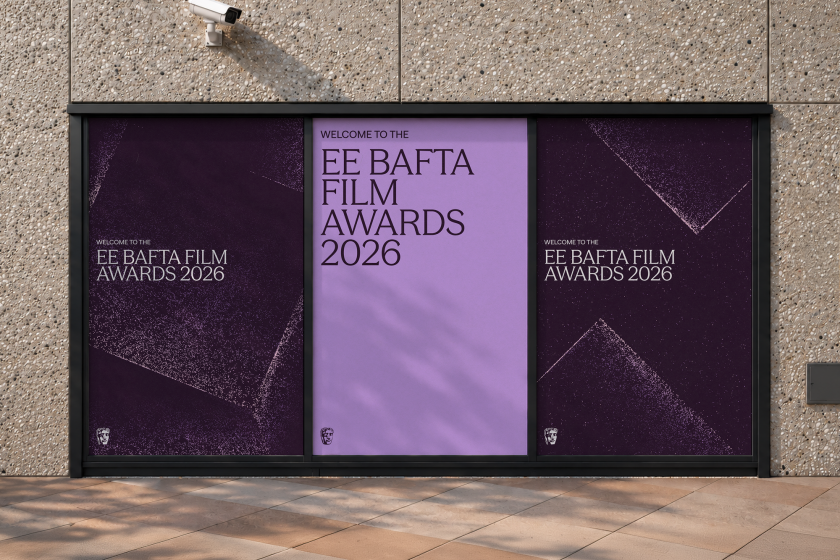
The award-winning studio has given BAFTA’s various ceremonies a single visual language – flowing coloured particles that gather into interesting forms. And it was all built in Cavalry.
Here’s something worth remembering the next time you watch someone lift a BAFTA: every single winner started with a rough idea. A scribble or hunch, a half-formed thought that somebody then spent weeks, months, sometimes years turning into the finished piece on screen. It’s a lovely notion, and it’s the exact idea that Studio Kiln has built an entire identity system around.
Since last October, the London studio has been working with BAFTA on a new visual identity that pulls its four separate awards ceremonies – Film, Television, Games and Television Craft – under one creative roof, without losing what makes each of them distinct. The whole thing runs on a particle system: flowing streams of coloured particles that come together to form BAFTA’s distinctive facets, tracing that journey from initial idea to finished work. Rather than hand-animate any of it, Kiln built the entire framework in Cavalry, so a single adaptable system can generate motion, digital and print assets across every award and format.
Four ceremonies, one family
The tricky part, of course, is respect. Four ceremonies, four very different worlds, one identity that has to serve them all equally – even though it would have been easy to let the glamour of Film quietly become the “main” one. “The biggest challenge was making sure every ceremony felt equally refined and crafted, just in its own way,” explains Megan Mardon, one of the designers on the project. “Film naturally lends itself to something cinematic and heightened, so there was a risk of that becoming the ‘main’ identity, with the others feeling like variations on it rather than standing on their own. The guests should feel like every award is just as special.”
Kiln’s answer was to keep the underlying story identical – the particle behaviour, the movement, the type system and the overall art direction – while letting shapes and colour do the differentiating. “They had to feel part of the same family, but shift enough that Games could feel complex and kinetic while Craft felt intricate and focused, without one award ever feeling less than the other,” adds Megan.
For fellow designer Edoardo Albertini, the balancing act was as much emotional as technical. “The biggest challenge for us was really figuring out how to honour BAFTA’s historic prestige while leaning into its more avant-garde, creative spirit,” he says. Each award got its own system of faceted shapes and an expanded palette, all tied back together by a shared texture in the particle artwork and anchored by a strict typographic system.
The genuinely hard bit, he admits, was finding the visual sweet spot: “We had to balance the raw, messy kinetic energy of our procedural particles with the sharp clarity of the artwork, making sure you could feel the energy forming those facets without one element drowning out the other.”
Why Cavalry, not After Effects
Now, for the motion designers reading this, here’s the obvious question: Why build all of this in Cavalry rather than in After Effects like everyone else?
“We went with Cavalry over more traditional motion software because it has this incredible ability to export versatile vectors right out of a procedural system,” Edoardo explains. The team built a physics-based rig – manipulating forces and resistances – that could capture the concept’s movement in a way that scaled across both screen and paper. Megan puts the appeal more simply: they wanted a system that felt alive.
“We could build our world of particles once, determining how they behaved, formed and moved, then let that same system generate everything from a 30-second film to a static poster, rather than rebuilding the idea from scratch for every touchpoint. The real joy of Cavalry is the balance it strikes between the control you have and the surprise of the outcome.”
Of course, working this way means you don’t fully control what comes out, which is part of the fun. Print was the hard part, though. The whole identity is built on movement, so freezing it into a single still image without losing that movement was really tricky.
Kiln’s fix was rather elegant. “Central to this were the ‘streams’ we created,” says Megan, “denser rivers of particles that felt intentional and alive.” When it came to choosing the still images, the team hunted for the exact frames where those streams were at their most prominent, cutting through the linear facets and edges. Edoardo describes the same trick as capturing “all those underlying forces and the fluid nature of the motion inside a single freeze-frame”. Either way, it took hours of tweaking the motion rig so that even the static moments still felt like they were breathing.
Handing over the keys
There’s a lovely discipline to the ending of a job like this, too. A client the size of BAFTA needs to run this identity long after the studio has moved on, which means the handover matters as much as the work.
So Kiln provided more than a folder of finished files. Alongside usage guidelines came a curated suite of artworks for each award, “ranging from quiet to more expressive,” as Megan puts it, ready to drop into all sorts of formats rather than leaving BAFTA’s in-house team to generate fresh variations every time. The type system does the heavy lifting on flexibility: simple and specific enough to flex either way, so the artwork can take centre stage and the type recede, or the type can step up while the artwork stays quiet.
“That built-in flexibility from both sides meant the system could adapt to new formats and layouts without us, or the BAFTA team, …needing to rebuild anything,” she says. So BAFTA’s team can keep building with the system themselves, long after Kiln has gone.
It’s a smart, generous piece of design thinking and a nice bit of poetry, too: an identity about turning raw energy into something refined, crafted by a brilliant studio that does just that. The new system rolls out this week.
Leave a Reply