Gemma Phillips spent 12 years at Saatchi & Saatchi before going it alone, and her solo work has already reached the House of Commons. We explore how she gets away with saying the unsayable.
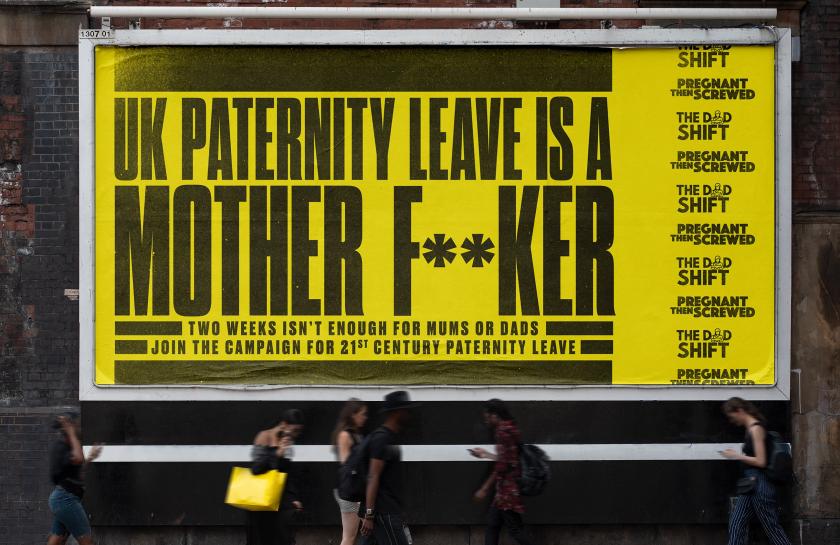
There’s a particular skill in making a brand swear on a billboard and have it feel like the most reasonable thing in the world. Here’s a great example. See the words “UK paternity leave is a mother f**ker” on Gemma Phillips‘s poster, and you don’t think “how crude”. You think “well, yes, actually”.
It’s typically brilliant work from a woman who spent over a decade as a creative director at Saatchi & Saatchi. Since 2022, she’s been a consultant creative director for the campaign group Pregnant Then Screwed, which was centred on paternity leave (specifically post-C-section) and the impact of unequal parenting on women.
Yet Gemma’s not being edgy for the sake of it. It’s less that she’s found some answer, more that she’s not afraid of the thing a lot of brands still shy away from. The rude bit isn’t the risk. The risk is being boring.
As she puts it: “Brands have an instinct to sugarcoat. Maybe they think we can’t handle the truth. But we’re already living the truth; that’s the irony. The grit is where it’s at.”
The streak you can’t fake
Gemma says she can spot a client with the right attitude almost immediately. “I look at the work they’re already doing,” she says. “Who’s taking risks? Who’s trying to do something differently? Who’s willing to say the thing that no one else is saying? Who wants to change things, rather than do more of the same but with nicer design?”
That said, clients who don’t already have that instinct aren’t write-offs. “You can definitely guide clients to have a greater appetite for risk,” she stresses. “Especially ones with smaller budgets, as they can’t afford to sit on the fence.”
Often, she says, it comes down to one thing: encouraging clients to have real confidence in their brand, and sharing your belief in what it could be (not what it is now).
How motherhood made her braver
Gemma’s recent work—the CV shredder, the swearing billboards, the out-there nappy adverts—all circles back to one theme: how brands talk to women, and mothers in particular. She arrived at this not as a clever positioning strategy, but from lived experience.
“Becoming a mother can be one of the most radicalising processes you’ll ever go through,” she notes. “Not only in one singular moment but several hundred moments that permanently change you. Fertility struggles, postpartum, returning to work, navigating how your new life fits back together, or doesn’t.”
That, she says, made her braver, both creatively and strategically. Yet this isn’t an experience exclusive to mothers. She thinks the same shift happens to many women as they move into their 30s and 40s, whether or not they choose to have kids.
“Weirdly, brands often want to speak to women like they are these very homogeneous beings,” she points out. In contrast, she says: “I’m down for the weirdness, the complexity and the messy humour.”
Getting parliament to notice
The Career Shredder, a literal machine that devours the CVs of mothers pushed out of work, didn’t just make an impact: it was raised in the House of Commons. But in retrospect, that shouldn’t have been too surprising, because from the outset, Gemma wanted to go all-out.
“Before we even had an idea, we knew the work had to be blunt,” she recalls. “It had to be as visceral as possible. It had to manifest in physical form what millions of women feel and experience in the workplace. For everyone else, it had to make visible the damage pregnancy and maternity discrimination causes, both to women themselves and the economy as a whole.
The campaign’s foundations were firm. “We had a ‘great’ statistic: 74,000 women pushed out of work every year in the UK,” Gemma recalls. “And the most shocking part: it’s up from 54,000 in 2016. Everyone assumes it must be getting better, but it’s actually getting worse.”
Finding the funny
Big Pant Energy, her toddler-toilet-training campaign for Peachies, is the joyful flip side of the same coin. The comedy, she insists, was never something the agency had to invent.
“The funny is already there,” she said. “It’s being shared over WhatsApp and through conversations millions of times a day. There’s always humour in the struggle: that’s what I’m drawn to time and time again.”
Some people might shy away from that approach when approaching a serious subject. But Gemma counters: “Humour can be incredibly respectful because it acknowledges reality. It’s a sign that you genuinely understand the audience; you’re one of them, not a machine hovering above them, selling them something they know isn’t true.”
Similarly, the “motherf**ker” paternity leave posters resonated with fathers, deliberately pulling them into a debate usually framed as a women’s problem.
“If fathers don’t have the opportunity to be equal carers from the start, mothers end up carrying the consequences in their careers for years afterwards,” Gemma explains. And that, she argues, hits the gender pay gap and economic productivity—so whether or not you have children, your finances will be affected.
In short, the fastest way to improve outcomes for women and the economy as a whole, she believes, is to support equitable parenting.
Is the industry changing?
Gemma is a mother of three (twins, then a third), and she’s refreshingly unsentimental about the challenge. “It’s the age-old struggle: work like you don’t parent and parent like you don’t work,” she says. “How can you square that maths?” Ultimately, she thinks it might be possible to excel at both for a short time, but not sustainably, even with excellent paid childcare, until there’s systemic and cultural change across workplaces.
Until that happens, though, she believes it helps for women to keep their career options open and flexible. “It doesn’t have to be binary: you don’t have to choose one and stick to it,” she believes. “I hope we can see more women, and importantly, men, pursuing and being permitted to have more squiggly-line careers. If you dig deeper into many people’s career paths, it’s rarely the stable trajectory we all want to project.”
On whether the industry has actually changed or just got better at sounding like it has, she responds: “Both. There has been real progress: Covid and social media have definitely been accelerators of that. Conversations that would have been career-limiting ten years ago are happening more openly now.” But, she warns, “a family or flexible working policy is only useful if people feel able to use it, especially those in leadership positions, without career-limiting consequences.”
As for what’s next, she’s not changing tack. She’ll keep “helping brands find the courage to say the thing everyone is thinking, but nobody has quite said yet”. And who wouldn’t want to see more of that?
Leave a Reply