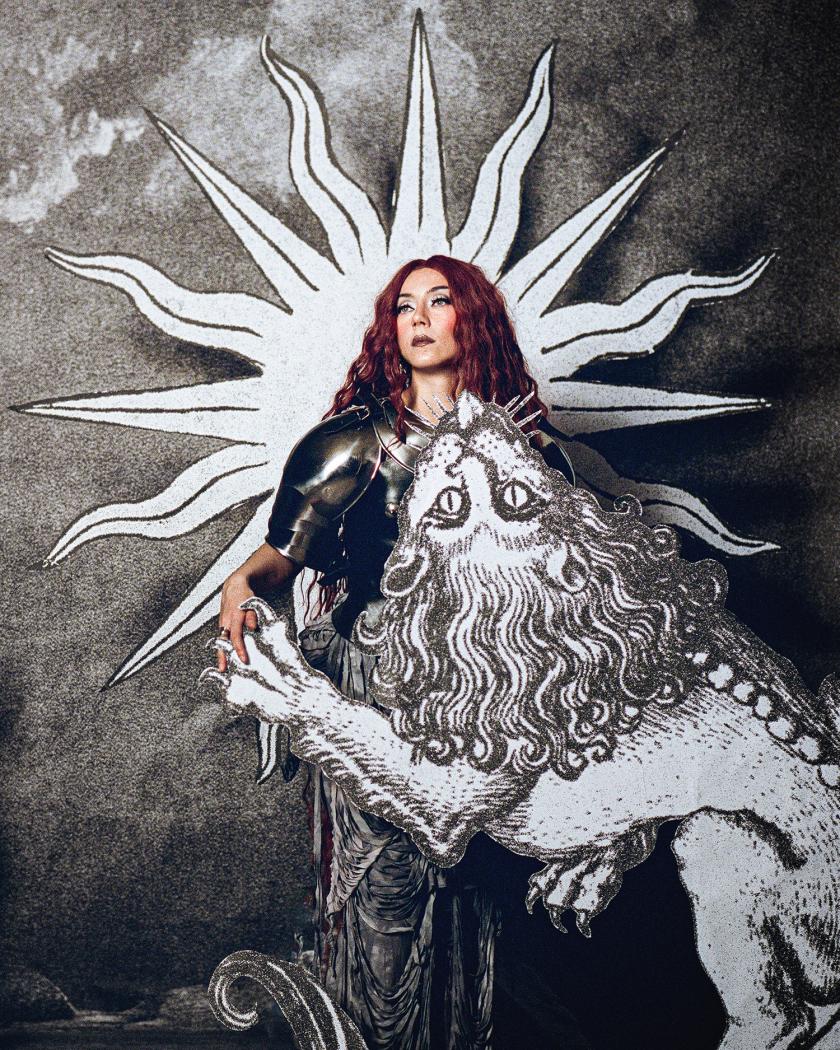
artist portrait. Photography by Brian Lockyer
The London-based artist draws on archival imagery and a nomadic upbringing to create work that feels unfamiliar and impeccably handmade.
Born in Belarus, raised in Estonia, and having spent a significant portion of her life in Malta before settling in London, Jana Frost describes herself as a “third culture kid” – and that layered, peripatetic identity runs through everything she makes. “There’s always been something in me that’s drawn to the symbols and stories that travel across cultures, that mean something to people regardless of where they’re from,” she tells Creative Boom. “I think that’s partly why I became so fascinated by symbolism, how the same archetypes resurface across completely different traditions, and how symbols carry meaning almost subconsciously, before you’ve even had time to analyse them. That feels very connected to how I make work.”
Jana studied Fine Art, with a focus on sculpture and ceramics, but the physical demands of the medium made it difficult to sustain while moving frequently. Collage offered a way forward due to its portability and immediacy, while still allowing her to think spatially and construct worlds. Over time, those instincts towards scale reasserted themselves. “The collage work started expanding into physical space,” she explains, “into sets and installations – almost like returning to sculpture, but through a different language.”
artist portrait. Photography by Brian Lockyer
Portrait, Photography by Sophia French
Her practice now sits somewhere between collage and set-building, and her ideas tend to begin in a subconscious place, like dreams, feelings she can’t yet articulate or an image that won’t leave her alone. “If something creates a sense of curiosity in me, I’ll keep digging into it,” she says, “researching, collecting references until it forms into something I want to express visually.” Folklore, mythology, the origins of fairy tales, and the psychology of collective storytelling all feed into the work. So too does cinema, particularly the era before digital editing or CGI, when filmmakers had “almost no tools, no digital editing, no CGI, no safety net. I think that era represents a kind of peak of human creativity under constraint,” Jana says. “The idea that limitation forces invention – and that the most atmospheric worlds are often built from the simplest means.”
Jana’s process starts with a sketch, followed by deep archival research – digging into old illustrations, library scans and historical prints – before she moves into digital assembly to test composition and scale. Then comes the printing, cutting, stitching and placing. “And that’s where it gets unpredictable,” she says. “There’s a constant conversation between the digital and the physical, and the final work always carries the evidence of that – the seams, the joins, the slight imperfections.”
Vogue BTS
Vogue, Photography by Elio Nogueira
Vogue, Photography by Elio Nogueira
Vogue, Photography by Elio Nogueira
Time also springs up as a recurring motif. Jana is drawn to early collage techniques where artists would reprint compositions using a press, causing the ink to bleed and merge until the original and the new elements became indistinguishable. In her own work, she places archival imagery alongside the new – sometimes this involves photographs she’s taken herself – to produce what she calls “a kind of temporal confusion”. Working predominantly in black and white, or within a restrained palette, she deliberately removes obvious time markers. “It’s quite similar to how dreams function,” she says. “There’s no clear timeline – it’s more like a collage of memories, references and emotions all existing at once.”
Among her recent projects, her directorial debut – a music video titled Godless Man – stands out as a formative moment. “Everything was practical, in-camera and deliberately imperfect,” she says. “It reminded me why I work the way I do. There’s something that happens when you build something real in front of a lens that you can’t replicate digitally.” A Vogue editorial followed after this, and was the first time she took her physical cutouts abroad. “These very fragile, very handmade things are travelling to be part of something at that level,” she says. “It felt like a confirmation that the work belongs in those spaces.” More recently, a collaboration with Canon brought her to Uzbekistan for a full immersive installation, while her animated collage videos have begun to attract commercial interest. “It suggests that handmade, tactile animation has a real place in contemporary visual culture,” she says, “not just as a novelty – but as a genuine language.”
Behind the scenes
Behind the scenes
Jana Frost, Godless Man (Copyright © Jana Frost, 2026)
Jana is not especially interested in directing how people interpret what they see. “I want the work to feel slightly unsettling but also familiar – like something you recognise emotionally, even if you can’t fully explain it,” she says. Once the work is in the world, she considers it no longer hers. Currently, she is deep in a series of short films shot on 16mm, each exploring a different symbolic world through the same visual language.
Alongside that, she operates as a full creative director on a number of commercial projects, shaping entire visual narratives from concept to final image. “That feels like the direction everything is moving: building complete worlds,” she says, “rather than individual moments within them.”
Leave a Reply