‘Guard Dog’, the 2022 debut album by Alec Duckart (aka Searows), was an almost instant cult classic. A heartbreaking portrayal of fragility, honesty, and vulnerability, tracks such as ‘Roadkill’ revealed a songwriter who could develop multitudes within even the most stripped-back of tracks. He won fans all over the world, gained comparisons to everyone’s favourite sad girl, Phoebe Bridgers, but still gave him the space to discover where he was going next.
“I have a lot of issues with ‘Guard Dog’,” Alec admits, “just because I learned a lot about how to make music better really soon afterwards. It was made on GarageBand, I literally had one mic, and it was the first time I felt like I was able to produce something myself.”
He continues, “It’s hard to listen to, honestly. I feel like over the last three years since it came out, I have thought so much about what I want to do and how I want to do it.”
That experience, the positive parts of the album process and the parts he wanted to work on going forward all led to his second offering, ‘Death in the Business of Whaling’.
“It’s about fear and death and your own nebulous personal identity”
A love letter to Alec’s rural Oregon home, sandwiched between the rugged Pacific Coast and the redwood forests of the USA’s northwest, it’s an album that breaks Searows out of the folk box, opening up avenues into alt-rock and Americana, tied together by a quivering, ominous sense that you’re being watched.
This new Searows chapter was beckoned in by ‘Dearly Missed’, a lead single that stomped into view and demanded your attention. The production-light sounds of ‘Guard Dog’ gave way to crashing drums, borderline thrash guitar, and a vocal that soars while sounding on the verge of breaking apart altogether. Searows went away as a folk star-in-waiting; he returned a force to be reckoned with.
“I was excited [to release ‘Dearly Missed’] but also very afraid,” Alec recalls. “I was so excited about that song through the whole process because I’ve never done that before; I’ve always wanted to but never had the means or maybe thought I wasn’t capable of it.”
The importance of confidence can’t be overstated when it comes to ‘Death in the Business of Whaling’. The tracks which sound the most similar to ‘Guard Dog’, not least opener ‘Belly of the Whale’ and ‘Kill What You Eat’, stand taller and bolder than anything we’ve previously heard from Searows.
A single acoustic guitar and layered vocal are replaced by a vast increase in instrumentation – not least the double bass, which takes pride of place behind Alec on this call – but also in the production, which, while deliberately not clean-cut, certainly adds a layer of polish which would have felt out of place on the endearingly organic first record.
“I feel like every song has its own instrument evolution. I was listening to so much ambient music, a lot of soundtracks and doom-folk, stuff with heavy guitars but also fiddle or banjo. Obviously, things were added in the studio with someone having an idea, but there was also a lot of stuff in the demo where I made my own makeshift version of where I wanted these additional instruments to come in.”
This was the first time that Alec worked with other musicians and producers to create Searows’ songs, helping to dissipate some of the perfectionist tendencies that helped Alec create such a wondrous debut on such a small budget.
“For the most part, I was working with a producer and engineer called Trevor Spencer in his studio in a barn in Washington,” he explains. “The fact that I didn’t take the mixes we’d done for the day to listen to at home meant I didn’t have to obsess over it in a way that negatively impacts the process for me.
“I can’t leave it if it’s on my own computer; I just keep listening to it and being like, ‘Okay, I should add this thing, then this, then this’, until I hate it. Even with vocals, I’ll do the same line over and over again until it sounds exactly how I imagined it, even if it’s worse than what we had – so it’s good I didn’t get to do that this time!”
The energy not spent stressing over every note and nuance allowed more space to focus on an overarching theme for ‘Death in the Business of Whaling’, one that took Alec out of what he calls a “literal, personal, almost diary type album” and into the world of the concept album, although maybe not in the obvious, signposted way that you’re used to. In fact, it’s so subtle, so deft, that Alec himself has some trouble trying to describe it.
“So, like, there’s this character, but more like a presence of something, either you are chasing it, or it’s chasing you. It ended up being a symbol of so many different things. I feel like it was sort of about fear and death and your own nebulous personal identity, trying to figure out who or what you are as a person. It’s like, it’s you, and you’re it; it’s the different feelings and experiences you’re either chasing after or running from.
“I don’t know, it gets so convoluted and meta. I feel like I went into [the album] with the idea of like, ‘I’m going to need to explain something about this in the future’, and I feel like I still don’t even know how to do that. I guess this is why I write songs, because I can’t explain myself when I try to talk it through.”
“I’m very excited to have more fun, for it to be louder”
It may seem unlikely, but his description of the all-seeing phantom in the dark is actually pretty accurate. The idea of someone pulling the strings, making minute changes that have drastic consequences, ties the record together with an unsettling, febrile feeling that you need to start running and not look back. At points, such as ‘Hunter’ and ‘Junie’, the spirit actively stalks their prey, while in ‘Photograph of a Cyclone’ and ‘Dearly Missed’, they allow the chaos to unravel without altering the course.
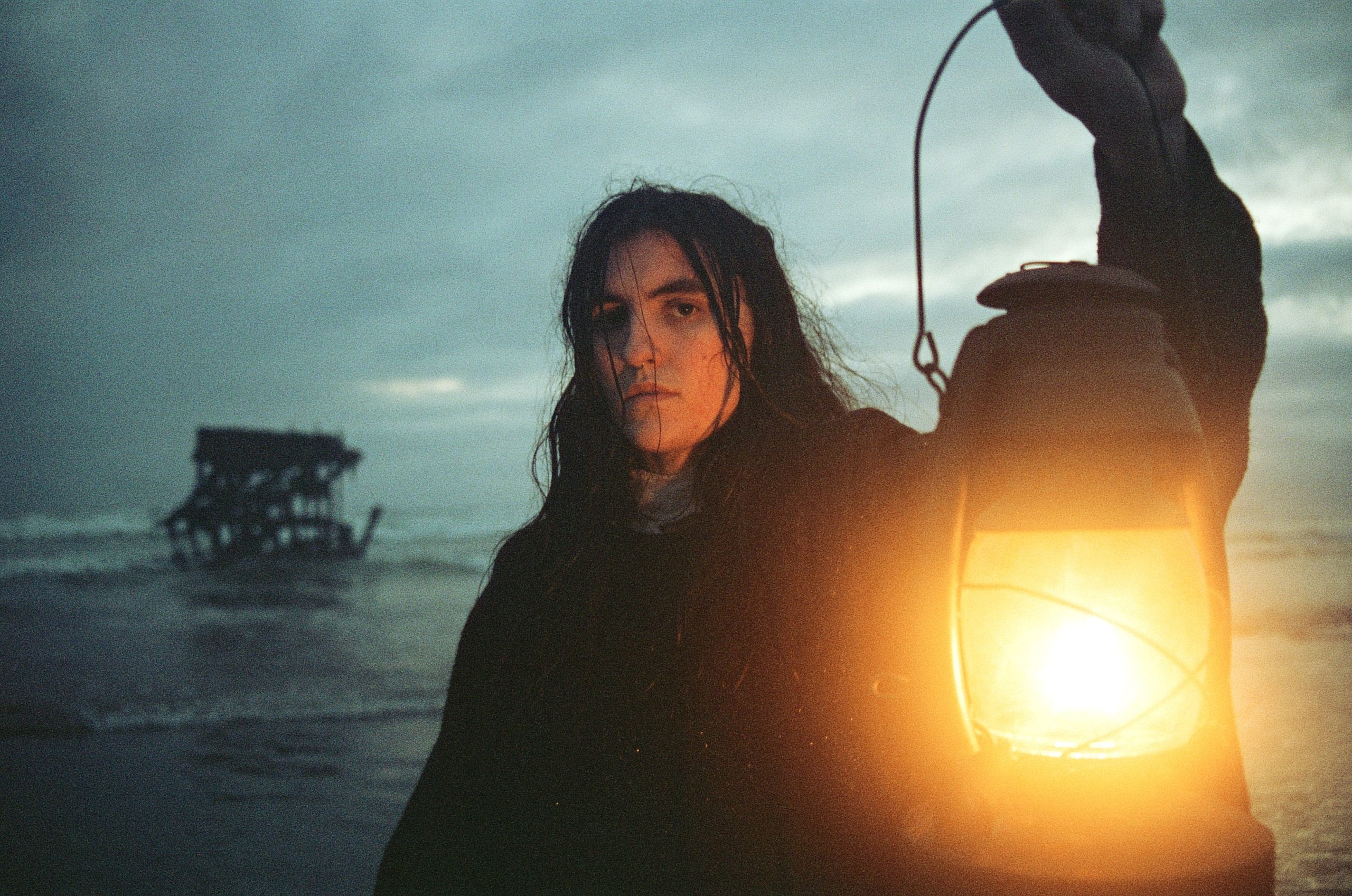
In many ways, that character is embodied on the album cover by Alec himself, standing proudly on a shipwreck as a moody sky circles above and a black sea spits and swirls at his feet. The stark cliffs, untameable ocean, and vast open spaces of the Oregon countryside all helped to embolden the record’s sounds and shapes.
“I didn’t even really realise how much my sound and what I wrote about was influenced by where I live and where I grew up; this was the first time making a project where I was very aware of that.
“All of my visions of what I wanted for this record are just right here where I live. It feels so nice to live in a place where I’m like, ‘Yeah, I can go take pictures at this shipwreck on the Oregon coast’, but also making the album in the woods and the country was so perfect for the record too.”
Despite the marked growth in belief and technical ability, Alec remains the same songwriter he was. He still retains the ability to tear open a narrative with a single line, to weave together personal and metaphorical experiences to turn an introspective moment into a universal feeling. And, by his own admission, none of that would have been possible without ‘Guard Dog’.
“I feel like [‘Death in the Business of Whaling’] is so much more like my vision, I guess, than ‘Guard Dog’ was. But, as many issues as I have with ‘Guard Dog’, I’m glad that it sounds the way it does, and it was the first thing that I did.
“I don’t think I’ll ever make an album that sounds like that again. I will probably make another album that’s like a lot more homemade and stripped back, but it won’t sound like that because I know more about producing and recording.”
Alec hasn’t only learned more about the technical aspect of making music, he’s also gone to new lengths to improve his live show, one for which he admits, “I’m going to a lot of preparing in the next few months”.
“I feel like I toured a lot last year, and it was hard to maintain, doing a show that’s that slow and quiet. I’m very excited to have more fun, for it to be louder and have more going on. But quite a few of the songs are a lot more vocally challenging than previous songs, so I really gave myself a challenge there.”
By tying the music to a more stable dock, anchoring tracks in a way that he hasn’t before, Alec has created a record which feels like him coming in from the cold; he’s stepped off the ship and onto solid ground after three years in the wilderness. That concept, that feeling of regaining your balance after being stuck on a spinning wheel, is something that he hopes listeners will enjoy as much as he has.
“I feel like my only real hope for the project, or the only one that’s concrete enough to say, is just that people hear it and understand it, but understand it in whatever way they need to understand it. I want them to feel everything that I put into it and what my intentions were, but I more so want it to be very specific to whoever listens to it.
“It is so many different things that I think people will relate to it in ways that I can’t even comprehend. People will see their own lives and their own experiences that I have no concept of, and feel like I wrote it specifically for them. Yeah, I feel like that is ultimately what I want people to get from it.”
Taken from the February 2026 issue of Dork. Searows’ album ‘Death in the Business of Whaling’ is out 23rd January.
Order this issue
This is a physical pre-order. All copies will be dispatched before 6th February 2026
Please make sure you select the correct location for your order. For example, if you are in the United States, select ‘Location: US & Rest of the World’. Failure to select the appropriate location for your delivery address will result in the cancellation of your order.
Leave a Reply