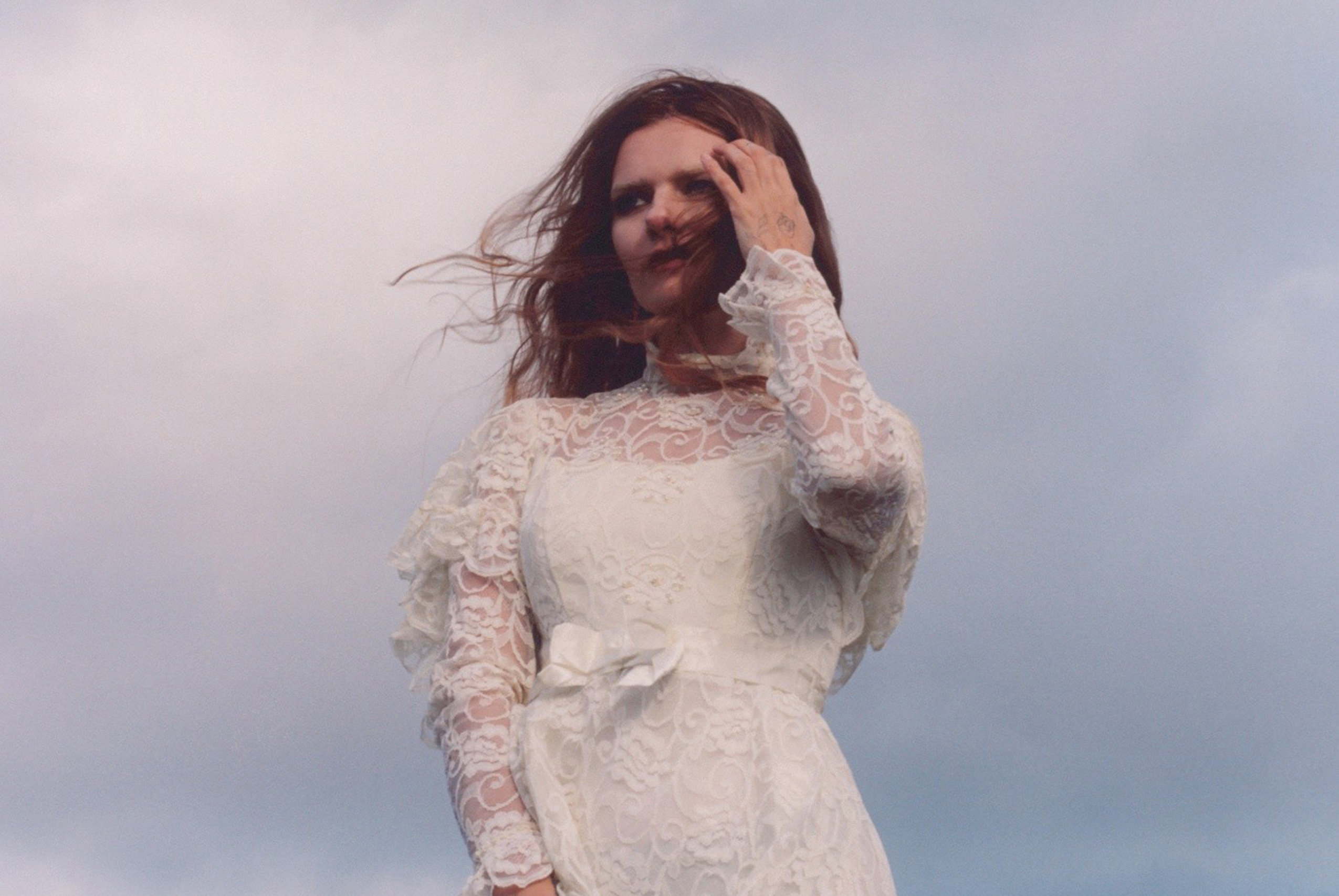
If Rosie Carney’s name has been floating through your peripheral vision lately, it might be thanks to a certain Ross MacDonald of The 1975. But while her fourth album, ‘Doomsday… Don’t Leave Me Here’, was co-written and co-produced with Ross and longtime collaborator Ed Thomas, this is very much her world – just expanded and turned all the way up.
Right now, though, things are deceptively gentle. “Today I have been hanging out with my four dogs and my nephew, which has been loads of fun.” It’s a wholesome snapshot from an artist whose latest record is steeped in existential dread, female rage and the kind of love that aches because it has nowhere to land.
Rosie first emerged in 2019 with the sparse, vulnerable folk of ‘Bare’, later reimagining Radiohead’s ‘The Bends’ before swerving into the rockier edges of 2022’s ‘i wanna feel happy’. Along the way, there have been milestones that still glow. “Ah, wow, there’ve been many, many highlights,” she says, reflecting on the journey so far. “I think one that jumps to mind was when I opened for The Milk Carton Kids in the Barbican in London back in 2018. I don’t know, there’s something about that particular venue and gig that’s just etched into my brain. I was also wearing this pink suit that rocked my world. And making my latest album, of course.” It’s a neat summary of her trajectory: from pink-suited breakthrough moments to the scale of what she’s just created.
Across each release, she’s mapped grief, heartbreak and isolation in increasingly vivid detail. ‘Doomsday… Don’t Leave Me Here’ continues that emotional throughline, but it marks a decisive shift in sound. “Thematically, it continues the emotional territory I’ve explored in my previous albums,” she explains, before pointing to the bigger picture. “Sonically, this record feels like a real step into a new world. I’ve always wanted to create a bigger and more expansive sound, but it’s never really clicked until I started working on this album. This feels like the moment where those ideas finally came together. I’ve really felt my own evolution within this body of work.”
That evolution took shape in the studio with Ed and Ross. The ambition had been simmering for years, but the breakthrough came quickly once the three of them began working together. “The desire to make something bigger had already been there for a while, so it felt like a natural progression for me. The foundations were already in place, but it wasn’t until my first session with Ed and Ross that I really got to explore that curiosity properly. From that first session to the last, it just felt right, and everything clicked, and the direction made complete sense.”
Ed has been part of Rosie’s creative orbit for nearly a decade. “I have always really enjoyed doing sessions with him, as I always learn so much.” Ross’s involvement, however, initially gave her pause. She describes herself as “super fussy about who I work on my own music with,” admitting she was “a bit apprehensive” at first. That hesitation didn’t last. The chemistry was immediate. “The way I describe this album to people is like a tapestry of musical backgrounds. Making it was such a collaborative process, and I believe we all created a space within it to really express ourselves freely and with this playful curiosity. They’re also both funny as fuck.”
“There’s been so much life between that lost album and this one”
The record’s scale feels like a direct response to the headspace she was in while making it. Rosie has spoken about experiencing “severe existential dread, and feeling like I’m about to die,” a period where everything felt claustrophobic and uncertain. Rather than retreating into minimalism, she leaned into noise. “Up until this album, my music has mostly been sparse and intimate, so there was a part of me that was worried that I’d be washed out by the loudness of the production,” she says. Instead, the opposite happened. “The noise is exactly what helped me to turn inward and really listen to what it was I was trying to say. It acted as an armour for me, so I felt safe to say whatever my heart was feeling in a more confident and straightforward way. It helped me to let go of a lot pain – just pure catharsis.”
Armour is a fitting image for a record called ‘Doomsday… Don’t Leave Me Here’. When asked what “doomsday” looks like to her, the answer is stark but poetic. “A barren and rugged landscape, I’m alone, but I feel and see the presence and the shadows of people and past versions of myself around me. It looks like grief and the overflowing of love that has nowhere to go.”
Some of those feelings date back to a shelved shoegaze project she and Ed worked on pre-COVID. Revisiting that material was initially disorienting. “At first it felt really weird, kind of like looking at an old picture of myself,” she says. But distance brought clarity. “The songs Ed and I had started back then were quite prophetic. I was writing and singing about things that didn’t really make much sense to me back then, whereas now I understand exactly what I was trying to say. There’s been so much life between that lost album and this one, it’s like I needed that time to grow and develop before returning to them.”
The journey to release wasn’t straightforward. She describes “a lot of false starts in the build up to releasing this album,” along with hurdles that left her feeling “really lost and left behind.” Watching other artists move ahead while feeling stuck was destabilising. “Where I do believe that good things take time, when that time turns into years, it becomes really disorienting. Structure is so, so important to me.” Still, the delay had an upside. “Being left to sit with a body of work without just quickly putting it out into the world can make you grow to appreciate it more. These songs are really important to me.”
For all the sonic ambition, her aspirations remain inward. Asked where she hopes the album might lead, she doesn’t talk about accolades. “I want every album I make to lead me back to myself.”
At the moment, that self is being rebuilt. She’s recently been “a bit uprooted” and is piecing things back together. “I’ve had to almost start to rebuild parts of myself both in and out of music,” she says, hinting at something new already taking shape. “I’m currently working on something so, so special to me, though. I haven’t quite left the world of ‘Doomsday’ just yet, but I’m looking at it from a different view.”
There’s also a clear-eyed honesty about what it means to sustain a creative life. She’s moved back home to Ireland and is about to start work outside of music again. “It’s not the most glamorous move, but I think it’s important to be honest and transparent about the reality of being a musician, especially these days – the financial side of the industry can be incredibly unpredictable. Sometimes you have to create your own stability while you keep pushing the music forward.”
‘Doomsday… Don’t Leave Me Here’ may conjure images of barren landscapes and emotional wreckage, but it’s ultimately about endurance. About turning distortion into protection. About letting the noise shield the softness at its core. Bigger and louder than anything she’s made before, it captures Rosie Carney not at the end of the world, but standing firmly in it, and choosing to keep going.
Rosie Carney’s album “Doomsday… Don’t Leave Me Here’ is out now.
Leave a Reply