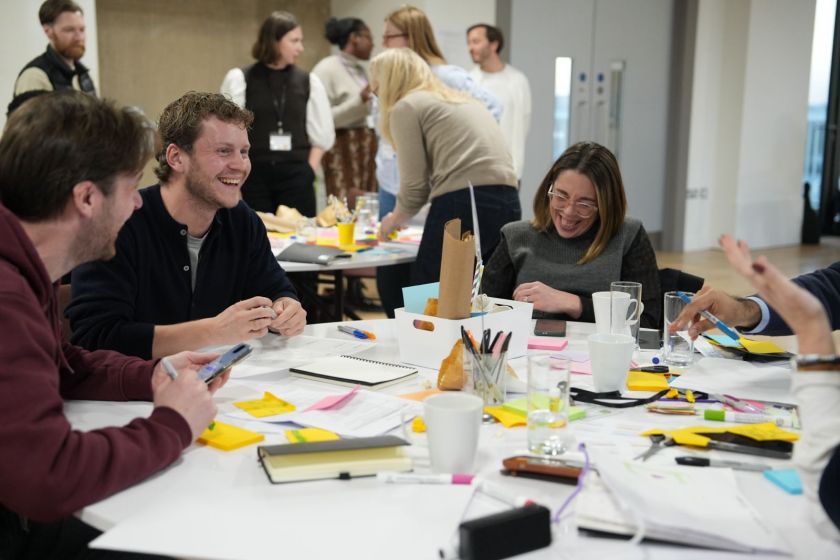
No laptops, no Slack, and a live brief for children’s literacy charity BookTrust – Special Projects’ executive course at the Royal College of Art is the antithesis of the modern boardroom, but that’s precisely the point.
I arrived at the Royal College of Art with my laptop in my bag and my inner productivity gremlin firmly in charge. Two minutes in, it was clear neither would be needed.
Special Projects’ two-day executive course on design thinking, hosted at the RCA, is radically analogue by design. No one is tapping away at keyboards, and instead, there are paper templates, thick markers, Post-its, and a room arranged for collaboration.
To get everything done in two days, the course had to be relatively fast-paced. It wasn’t too intense, though, and it left plenty of room for curiosity and conversation.
It’s also not a course designed for designers. The room is filled with people who already influence the world: leaders, strategists, operators, founders, and those close to decision-making. Having that mix means everyone can learn from each other and from the course itself, says Special Projects partner Clara Gaggero-Westaway, who teaches the programme alongside studio co-founder Adrian Westaway.
When asked what draws people to the course, Clara explains: “I think it’s that perception that design is not a small discipline.
“It’s not like just an aesthetic pursuit, it’s very much an attitude to solve problems – an attitude to see frustration in a more positive light – and that applies to everyone.”
An executive course that starts with permission
There was a moment early on when you realised the course wasn’t just about teaching tools. It’s giving people permission to talk about “magic” in a business context and to admit confusion. It actually encourages you to sit with discomfort rather than rushing to eliminate it.
Clara is candid about why that matters, saying: “We come out of an era where speed and efficiency are the number one parameters.
“We tried to bring back the human aspect, the magic, the delight. It’s not a frivolous thing – it’s an important thing.”
It’s important to note that this only landed so well with a group of executives because it’s backed up by process.
Why the analogue thing actually works
There wasn’t a no-laptops rule imposed across the two days, but I didn’t see one in sight the whole time. The nature of the course and the practical teaching definitely encouraged better collaboration.
“Physical tools are usually more conducive,” Clara explains. “You are around the table, you can see each other in the eyes… The screen is a bit of a divider.”
It also forces you into a type of thinking that’s harder to fake. You can’t outsource your thinking and attention, and because you’re making things together, the work becomes more social and more human. That’s important because one of the main ideas underpinning the course is research before ideas.
In plenty of organisations, “research” becomes either a grand, slow, expensive endeavour or something that’s skipped altogether, but here it’s demystified. We were taught to treat research as an active, accessible skill, whether that’s mapping journeys, looking at parallel markets, documenting what you see, or simply talking to people. Then, you distil those insights into opportunities.
One of the most striking moments came through short, structured interviews: twenty minutes with an expert, twenty minutes with a user, then immediate synthesis. Clara has heard the same reaction repeatedly: “Oh my God, we learned so much from these interviews,” she says, describing how participants often speak to just a few people and still experience those “tiny fireworks” of insight.
The live brief
Crucially, the course doesn’t rely on hypothetical scenarios. The brief is real and charitable. This time it was a live challenge for BookTrust, the UK children’s literacy charity.
It really helps with the enthusiasm because you’re not solving a made-up problem for a made-up customer. You’re exploring how to help families build reading for pleasure into daily life, or how to support multilingual households, or how to keep kids engaged after age six, when many parents stop reading with children once they can read independently.
Clara’s reasoning is direct: “We have 30 amazing brains in one room, and I felt it would waste their thinking on a fictitious brief,” she says. A charitable brief, she adds, means participants can “learn and give back simultaneously”.
BookTrust’s presence also keeps the course grounded, reminding you that design thinking isn’t a corporate parlour trick. Used well, it’s a way to make complex systems more humane.
The double diamond in context
Each day follows a three-part rhythm: inspire, hands-on, and reflect. In the mornings, guest speakers build context; in the afternoons, you work; and then you slow down and reflect. Towards the end of the course, we even wrote letters to our future selves that were sent months later.
The guest lineup also offers useful perspectives, from the foundations of design thinking to startup speed and enterprise realities. Professor Emeritus Jeremy Myerson (who helped shape the Design Council’s double diamond) talks about design thinking as a bridge between creativity and innovation, and the danger of treating any process as a paint-by-numbers solution.
That nuance matters, particularly because design thinking comes under fire every few years with headlines like ‘Design Thinking is Dead’.
Can everyone be a designer after a two-day course?
One of the most refreshing parts of my interview with Clara was how plainly she addressed the backlash towards design thinking. She doesn’t pretend the critique doesn’t exist, and she doesn’t overclaim what the course can do.
“I think there was this message that everyone can be a designer once they learn design thinking, and I think that’s an oversimplification,” she explains. “We don’t say we’ll make you into a designer in two days. We say we’ll teach you a way of approaching problems and a new mindset.”
Her analogy is spot on: “You can learn how to cook a dish from the book of a great chef, but it doesn’t mean you are a chef.”
If anything, the course fosters more respect for design expertise, not less. It teaches non-designers a common language to collaborate with design teams, understand when to give freedom, and recognise when specialist expertise is needed.
Frustration, reframed
If I had to sum up the course’s thesis, it would be that frustration isn’t a failure.
Clara described how organisations often deny or hide frustrations, especially when problems are complex, but a design mindset changes the relationship you have with those tensions. “Frustration doesn’t have to be something negative,” she says. “With the design mindset we teach, you can say ‘I have the tools to explore it, and then solve it.’”
As someone who lives with deadlines, client requests and constant context-switching, I wasn’t sure whether a two-day course would stick with me, but it has, and I’m sure the executives in the room felt the same. I came away with a repeatable way to approach messy questions by looking beyond the obvious problem, talking to real people, prototyping quickly, and treating delight as a serious business input.
The teachings across the two days were always valuable, occasionally magical, and maybe even a little bit radical in the way they challenge typical boardroom culture. Not because they offer neat answers, but because they change the way you look at the questions.
Leave a Reply