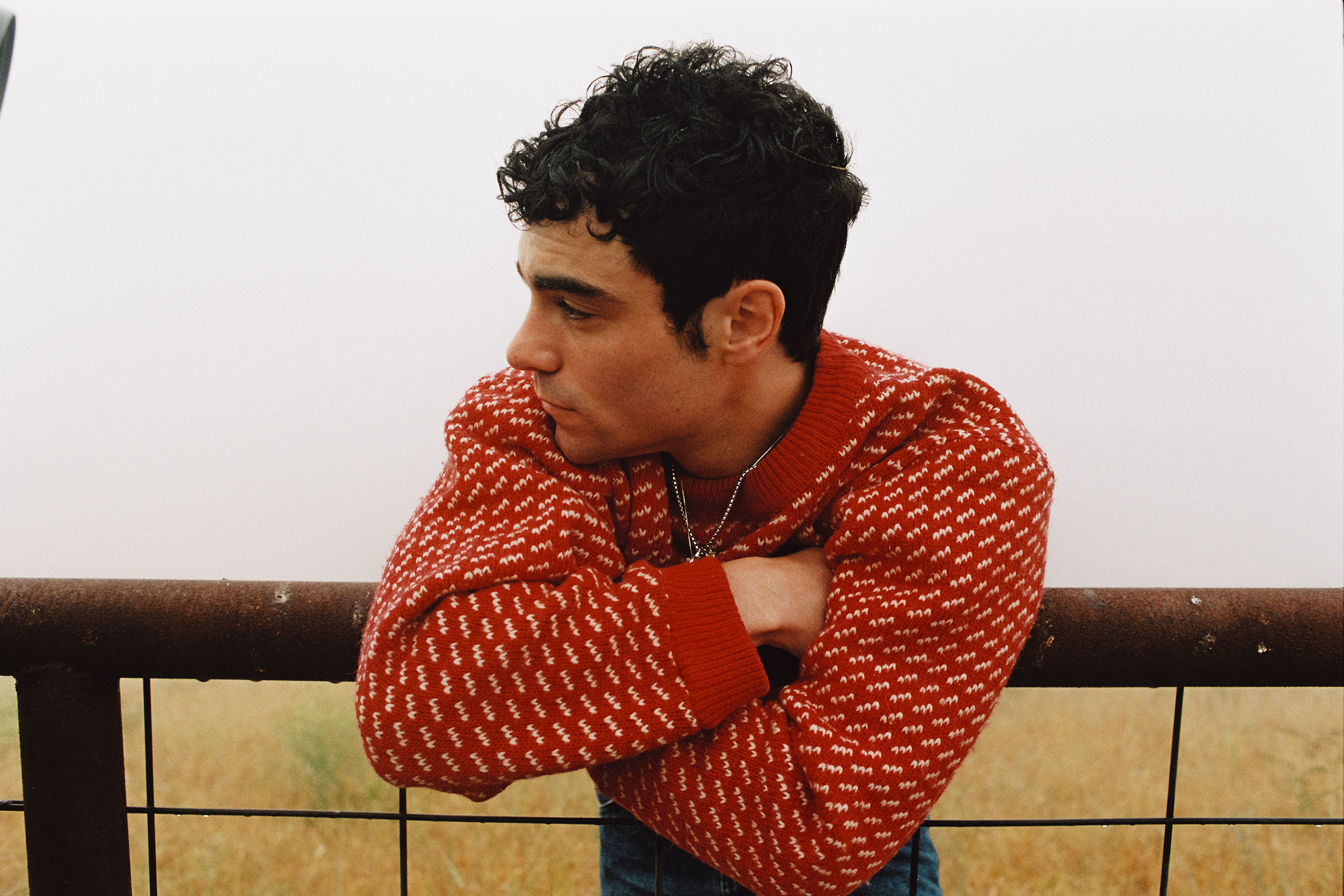
“There’s gold under the rust,” sings Del Water Gap on ‘How To Live’, the lead single from his third album, ‘Chasing the Chimera’. In one line, he encompasses the world of this record. Peeling back the layers, excavating years of hurt and confusion, and learning to move forward even amidst pain and the bittersweet. It’s finding hope amidst all the hardship and clinging to it fervently, even when the world feels as though it is closing in around you, even when everything you want seems out of reach.
To chase a chimera is to be in pursuit of an improbable, unrealistic dream. However, there’s also a mythical idea of a chimera that is a creature built from various parts: lion, goat, serpent, and monster. The former might’ve prompted the album title, but it’s entangled with the multi-facetedness of the latter, too. Grappling with different versions of himself and how they all might exist as one, ‘Chasing the Chimera’ sees Del Water Gap documenting each path taken or untread in unflinching detail.
“If it’s hard, it’s probably worth doing”
To best show those conflicting ideas and thoughts, there was a real need to do away with any pretence. At the album’s core is a longing for closeness, and that was particularly important when it came to his listeners. To achieve that intimate authenticity, he had to pull back the curtain and shine the spotlight on Holden Jaffe, the man behind Del Water Gap.
“Something I have been really working on with this album is to try to insert more of myself into my artist project,” explains Holden. “I obviously use a project name. Del Water Gap is me, but it’s me with certain dials turned up and certain dials turned down. I’ve been really actively trying to be more vulnerable and give my fans more access to the version of me that I think my friends see. It can be very nerve-wracking and feel very exposing in some ways, but I’ve had the real feeling making this album that if something is hard, it’s probably worth doing. I had a lot of trouble making my album, a lot of trouble writing in the way that I was writing. I think it brought up a lot of feelings of fear of being found out, and a lot of fear of what it would be like to really show a soft side of myself and it be rejected.”
In many ways, the album offered a kind of exposure therapy, something Holden has continued to push himself with as he launched this new era. He spent the best part of last year touring with Niall Horan, growing more accustomed to bigger stages and performances that allowed him to push down parts of reality and hide behind his showmanship. The antithesis of that ushered in ‘Chasing the Chimera’. Hosting an evening in a community garden in his home of New York, a closer, more relaxed setting saw him debut these new songs, an environment that proved surprisingly intimidating.
“Playing a show like I did in the garden has that same effect. Being on a stage, elevated above people, wearing certain clothing and having lights and a performance facade is a much easier ask for me as a performer than being in front of 50 people right up close with nothing to hide behind. It was really special. I’m pushing myself to do more of that, and I think those types of experiences just align with the spirit of the record and where I am.”
Daunting it may have been, but it was fitting to the rawer, more visceral version of Del Water Gap. Unravelling years of experiences, of thinking and of being, he does not stop until he leaves you with the absolute core of who he is. There is no room for hiding here, no masking of truths or shying away. A different kind of writing process was needed to facilitate this more vulnerable state of artistry, and the best fit was the one he began his career with – words first, everything else second.
“I came up in record-making that way,” Holden reflects. “It’s more of an old school style of making records, of really sitting down and writing and finishing the written part of the song first, then approaching the recording process. That’s what I always did, starting when I was 15 years old, up until I signed a record deal… I’m a very sensitive person, and I think I’m also just an introvert. I really do need space and time in my personal life, and I think that’s reflected in my creativity too. Being able to just go and get a house with a friend of mine, and wake up, run in the morning, read a bit, and really approach writing in this slow and gentle way, I think allowed me to soften and be back in touch with my real artist child and just be really intentional about what are the songs that I want to be singing for the next couple of years on tour? I think the testament to a good song is, can you sit down with a guitar and just play it, and have people like and understand it and know what it is? Any good karaoke song that you or I would know would be able to pass that test. Oasis songs, or Beatles songs, you can sit down and play that on any instrument and strip it away from all of its production, and it would do exactly what it needs to do. I wanted to force myself and allow myself to try that, and really, really get the architecture type before building anything out. It felt like a luxury. I don’t think I’ll ever go back.”
“There’s a real romance and a real melancholy in looking back”
A self-confessed writer primarily, with music as a medium by chance, it makes sense that the words of ‘Chasing the Chimera’ are its most haunting part. Introspection is fundamental here, but it is done in a clear, open way that is reminiscent of some of his earlier works. His debut EP, ‘Don’t Get Dark’, had a lingering softness that is reborn in every shade of ‘Chasing The Chimera’, and that feeling initially afforded to him by writing in his younger years was one of the many things Holden found himself in constant pursuit of. In reaching for that version of himself, the album inevitably became drenched in nostalgia and more than willing to explore every facet of that.
“I think it’s something that’s baked into a lot of us. There’s a real romance and a real melancholy in looking back and romanticising the past, and I think it’s something I’ve always done. It’s probably just where I am in my life. A lot of my friends are getting engaged, getting married, having kids, or breaking up with the person they’ve been with for five, six, or seven years. It’s something that happens when you start coming out of your twenties. People start poking their heads up and looking around and being like, ‘What is this life that I have? What have I been doing for the last 5, 10 years? What do I want from this life?’ You see your parents start to get older, and I think that’s kind of a shock, and makes you reflect on everything…”
Nostalgia is a double-edged sword. To be lost in rose-tinted memories and giddy with reminiscence is inherently romantic. Yet, there’s an anxiety-inducing, existential dread prompting side to it, too. Both have their moment here. ‘Marigolds’ looks back with regret, issuing too-late sorrys with a wound-up desperation. He dwells on what ifs, and winces at events past, but also clings to a mantra-like idea that things might turn out alright anyway – there is always some good in each memory. ‘How To Live’ is perhaps the best example of that balance – fraught and tumbling out, constantly trying to catch your breath, and yet knowing that moment of sun is coming and you’ll have your moment to enjoy it.
“It’s equal parts anxiety and hope, quiet hope,” says Holden. “A lot of the record that I made is anxious and thoughtful and melancholy, but all with a framing of hopefulness and humour. A humour in the absurdity of all of this, in the absurdity of being alive right now or being alive ever… with regards to ‘How to Live’, a lot of that song to me has come to be about the illusion of arrival. Maybe you’ve experienced this when you’re younger, in your teens, I remember thinking there would be this moment where I turned a certain age and all of a sudden would understand everything — I would know how to take care of myself, and what to do with my day, and how to get all of my work done, and how to deal with interpersonal conflicts and it would all be tied up and neat and tidy. As I’ve become an adult, I’ve realised that arrival is an illusion. It’s a line that always moves. ‘How To Live’ is about that, the distress and the hopefulness of that realisation. It’s this incredibly dynamic thing, where things get more complicated and as you get more capable of living, things get more complicated in proportion, so you’re always trying to find your footing. There’s beauty in that, but it can also be terrifying and exhausting. All the adults you’ve leaned on your whole life, they don’t know what they’re talking about.”
There’s a beauty in that solidarity, too – in knowing you’re not the only person who has ever felt this way, or not figured everything out. As we all grow and try to find our feet, we stumble, but we’re not the only ones. ‘Chasing the Chimera’, in its bid for connection and community, offers a hand to steady you and assure you that you’re not the first, nor will you be the last. On album closer, ‘Eagle In My Nest’, he sings “everything will be alright in the end”, but it’s from a place of reassurance, rather than optimism – as much for himself as any listener.
“In my head, it’s said with a question mark. A lot of times, my internal monologue is hopeful but questioning. The goal for me is that someday it will be a period, instead of a question mark. I hear that song, and it’s obviously a very hopeful message, but knowing where it came from and knowing myself, it’s like I’m going to tell myself this until I believe it, I’m going to tell myself that my loneliness or distress is temporary. If I say that to myself and the people around me, and they mirror it, maybe it can become manifested in the world. Again, it’s all in an effort to tell a different story about myself, my life, and where things are heading. I have a lot of trouble leaning into the unknown, as we all do, this idea of ‘you’re going to have a life in five years, and it’s going to look completely different to how it looks now’. All you can do is hope that it will be beautiful, or more beautiful than your life is now. It’s these duelling parts of distress and hopefulness, this great pendulum that can swing in all of us. I sing that song, and I actually do feel like things will be alright. I hope someone could hear it and feel that way too. By singing it enough, maybe I’ll believe it too.”
The idea of a mantra, something to cling to, was ultimately key to the album. There’s a hopefulness in the sonics, which are much more cinematic than ever before, a lush new palette of fluttering strings on ‘Please Follow’ and sax solos that feel akin to a sigh on ‘New Personality’, or the twinkling keys of ‘Eastside Girls’ that drive the melancholia home. It’s a repeated quality throughout. Most crucially, though, that thread to hold onto stemmed from the title.
“The title is a bit of a mantra about self-awareness. It’s my album title, but it’s also a phrase I found myself using a lot in my life. That’s kind of beautiful, that the art can become of my human psyche. We all deal with it on some scale, the comparative nature of social media. You have certain achievements, and the next time you do it, you feel normalised to it, and you look towards the next thing. That’s ambition, but it’s insatiable in some ways, and that can be exhausting. If you pair that with perfectionism and a self-critic, you can get into trouble, and that’s where I’ve gotten into trouble. Also, just realising it’s not all about me. Being a performer, we tend to associate performance with narcissism or this self-centred quality. There’s obviously some of that baked into there. To be a performer, you have to have at least part of you that wants you to be looked at and perceived. But the other side is really soft, and public service in a way. Music fans come to shows to connect and be with other people and feel less alone in the world, and I’ve had to remind myself that this isn’t all about me, it’s actually about my community as well, and that’s been really relieving. It’s taken some of the focus off of that other side, of the chimera-ness of it.”
It comes back to that connection he prioritised so much. He shares his stories, his foray into nostalgia’s every corner and back, his headlong pursuit towards his goals, and how constantly changing and moving those things are. In doing so, he offers the tools to dig through one’s own experiences and find that thread of hope to keep going and driving forwards. There will always be a chimera to chase, and on his third album, Del Water Gap details many along his paths, but in creating this body of work, he finds a moment of pause. Not everything we chase will we eventually grasp, and on ‘Chasing the Chimera’, Del Water Gap finds himself coming to terms with losing grip on everything but that intrinsic beam of hope.
Del Water Gap’s album ‘Chasing the Chimera’ is out 7th November.
Leave a Reply